29 February 2012

Apprenticeship Sorcery

All of us must have been wondering why shareholder-value-driven corporations such as Tesco and Burgerking have been tempted to support the government's employment policies. While the focus has been on the free labour, and arguments about whether those who cannot find paid employment are a blessing or a liability, less attention has been focused on the various 'apprenticeship' schemes that have been a response to record levels of youth unemployment.

Over the weekend the Sunday Mirror shone a light on this policy and found a very good answer: corporations are being paid huge amounts of public money to set up apprenticeship schemes. According to the paper's reporters, McDonald's has received £10m without producing a single job, investing instead for training for existing staff. In total the nine largest recipients have taken £20m. to create just 2,559 new jobs.

Aside from the extraordinary waste of public funds, this led me to question what meaning it can have to be an apprentice in Tesco or Burgerking. What is the path to expertise for an apprentice burger-flipper or an apprentice shelf-stacker? How does one know when one has become a master in these skills? The concept of the apprentice grew up during the early modern period, when it referred to the particular relationship between a craftsman and a younger person wishing to follow the same path. At a stretch it can be made relevant to an industrial craft, but to an occupation that is utterly without skill?

Craft apprenticeships involved a relationship between apprentice and master that was much wider than the mere acquisition of the skills of the craft itself. Such an approach to ‘training’ engaged the young person physiologically and psychologically in the community of their fellow makers:

‘The pervasive character of the epistemology of handwork arose largely out of the experience of training by apprenticeship and its basis in the bodily techniques of observation, imitation, repetition, and active doing’, so writes Pamela Smith in her wonderful book The Body of the Artisan (p. 28). Medieval apprenticeships were not easy, all ‘began in manual labour’, with young people having to earn the right to learn the more skilled aspects of the craft. The process of learning was primarily by imitation, but a particular form of imitation: ‘For an artisan, imitation could denote both copying and the bodily techniques of a master as well as reproducing the appearance and processes of nature. But it also constituted a bodily form of cognition and was connected to a view that matter and nature are alive and exist in synergy with the human body’ (Smith, 2004: 95)

This was a predominantly relational way of becoming a skilled and productive member of society. The learning process itself required a humility and a commitment that is unlike that required for intellectual education. In his book The Craftsman Richard Sennett develops a similar theme: ‘The apprentice is often expected to absorb the master’s lesson by osmosis; the master’s demonstration shows an act successfully performed, and the apprentice has to figure out what turned the key in the lock. Learning by demonstration puts the burden on the apprentice’ (Sennett, 2008 p. 181). Acquiring the skill was a lengthy and demanding process that in itself transformed the apprentice: ‘ten thousand hours is a common touchstone for how long is takes to become and expert. . . The seven years of apprentice work in a medieval goldsmithy represents just under five hours of bench work each day; which accords with what is known of the workshops.’ (Sennett, 2008: p. 172).

I am not going to insult your intelligence by pointing out the social and psychological growth that such a process of craft learning inevitably involves, or to imply a link between the disaffection of our young people and the pathetically low expectations we have of them as a society, particularly in terms of the skill level of their work. In this context the idea of a Tesco apprenticeship scheme seems more insulting than ever.
.

28 February 2012

Defaulty Logic


When is a default not a default? When to call it that might threaten the interests of significant financial players. Greece has arrived at the state of a default that may not speak its name. The announcement that it will add 'collective action clauses' to its sovereign debt removes any question-mark over whether a default is actually taking place. Voluntary agreement by lenders could be called by some other name, but when you explicitly refuse to pay back in full you are certainly in a state of default.

The danger in Greece's default is that it has automatic consequences. These arise as a result of a system of credit-default swaps (CDSs) which Greece's creditors took out to hedge their bets in a risky market. This piece of obfuscatory jargon hides the real nature of a CDS, which is an elaborate financial insurance scheme. Just as the creation of money through banking relies on the acceptance of non-existent money from one institution by the next, so the financial institutions insured each other against the absurd risks they were taking on in lending money to countries, and individuals, who could never afford to pay it back. In this way interconnections were built up that guaranteed that the failure of one would be the failure of all—and incidentally made it inevitable that if we are to solve the problem of any one country or bank we must radically redesign the whole system.

The Greek default has been more extreme than even the most pessimistic observers expected. Creditors are expected to face 65% to 70% losses on their loans, and the new conditions mean that the Greek government will not negotiate but will impose these terms. But the way that they have, without any system of accountability, sucked workers and savers into the web of greed and deceit means that it will be us, rather than bank shareholders, who will pay for the Greek default.
.

22 February 2012

Men of Misplaced Faith

Recently I debated the question of valuing nature with Sir Robert Watson, FRS, a leading advocate of the need for rapid and serious reductions in carbon dioxide emissions, derived from his expertise as a climate scientist. During informal chatting before the debate he let slip a long list of eminent names and told me that at a recent debate at the Royal Society there had been absolute consensus about the issue of valuing nature. Unperturbed by my isolation I asked him whether that meant that everybody agreed it was a misguided notion; you will not be surprised to know that it did not.

I would not challenge Sir Bob's right to patronise me on the question of atmospheric chemistry but I am rather surprised that he should choose to do so on a question of economics, where, in spite of my lowly credentials and absence of prizes, I do have some accumulated expertise and years of study, which he does not. I say this only to raise a question about who is qualified to be making policy in areas of environmental protection. James Lovelock is another whose technological inventions and scientific insights do not qualify him to be the most respected opinion on whether or not we should build more nuclear power stations.

Which brings me to Richard Dawkins, the so-called ayatollah of atheism, who having developed theories about evolution, and attempted to subscribe human society in terms of these evolutionary theories now feels himself the best person to comment on the British constitution. In her excellent book, Evolution as Religion, Mary Midgley began the most fruitful assault on radical atheists, suggesting that they used their scientific authority in a similar way to how other radicals have used divine authority.

What I noticed in my discussions with Bob Watson was that it was necessary for him to find a single, right answer. This is perhaps both what motivates scientists and what characterises their method of enquiry. It is an approach that is, of course, quite inapproriate in the human and social sciences, where the skill rather lies in understanding views you don't share and finding ways to mediate between those who violently and fundamentally disagree - and have an inalienable right to do so. If you can't take that particularly kind of heat you should, perhaps, stay out of the kitchen.

I used to work in the publicity department of Dawkins's publisher and was once entertaining an author for lunch while Dawkins enjoyed his own lunch at the adjacent table, accompanied by either a trophy wife or an equally glamorous assistant. It was a fairly short lunch but during the hour or so we were there I was amazed that he managed to talk entirely about himself. It made me ask a question that I have asked of other scientists: when they develop their theories - in Dawkins's case about selfishness and authority - are they really looking outward or inward?
.

20 February 2012

Greek Chorus

I've thought about calling this blog 'thinking the unthinkable' but I decided to use such a cliched strapline was probably itself unthinkable. Perhaps 'explaining the inexplicable' would be more appropriate. But what I am not prepared to do is repeating the unrepeatable and so, in response to a request from a friend and colleague for some guidance on the Greek situation, I am offering a tidying up and pulling together of various previous posts.

We need to begin with an understanding of the misguided euro project, which was driven by corporate interests and political ambitions and was unpopular with economists from the start. The sort of strait-jacket it imposed on countries' interest rates assumed a uniformity of economic development and social values that simply did not exist. The strictures that were entered into and are now being enforced are similar to those imposed by the gold standard in the 1930s, and so brilliantly explained by Karl Polanyi in his Great Transformation. For a more radical view of the purpose of the Euro project you might enjoy a paper by Ramón Fernández Durán called 'Mars Vs Venus, or Dollar vs Euro?'

This helps us to answer the question of whose fault it is - the financiers and corporate power-brokers who sought to increase their power and ease their extraction of surplus value. It was the poor design and inadequate debate that resulted in the tragedies now playing themselves out in Greece, for which the Greek people cannot be held accountable and should not be made to suffer. Similar arguments were made by Mary Mellor, and were posted to the blog in May 2010.

This brings us to what is to be done. Here I point to the lessons from Argentina, where a country's leaders refused to see their society destroyed and forced their creditors to the negotiating table. Politically this is the only acceptable option: a democratic decision about who gains and who loses value. In the free-for-all that is now threatened in Greece the financiers will flex their muscle while pensioners and the soon-to-be unemployed will be the losers. The tragedy not just for Greece but for the world is that similar negotiations at the global level have not been taking place and are desperately overdue if we are to preserve our democratic right to decide how our economies function.
.

19 February 2012

More Balls about Tax

How refreshing that the economics debate has moved on. It used to focus almost exclusively on the rate of income tax, the 'penny on, penny off' debate that dominated for a decade or so. For the past year we have seen a genuine disagreement: about whether it is the rich or the poor who should shell out more of their incomes in tax. With the absence of a growth strategy, and no other thinking about responses to the economic crisis, the argument now turns to who should be the beneficiary of the tax cuts which are, apparently, our only hope.

Ed Balls is calling for a cut in VAT, encouraging us to spend more. As Osborne rightly responds, in a country that imports more than it makes, much of the tax thus diverted from the Treasury will not stimulate small businesses here, but increase growth in China. This gives the Tory backbenchers a wonderful opportunity to argue for tax cuts for their rich voters: ditch the 50p tax rate and reduce yet further the rates of corporate taxation. they bray from their leafy shires. This is justified on the basis of the entirely unsupported assertions that somehow allowing the rich to avoid paying back to society will encourage economic growth. But where is the evidence that they are less likely to buy Chinese goods than the poor? When the rich want their benefits evidence-based policy-making makes a swift exit.

This is a lovely opportunity for the mainstream parties to return to their familiar class-war tactics while missing the big picture. For a more imaginative Shadow Chancellor this might be a good time to think about taxing assets rather than incomes. We could see the bankers' bonus in that light, but far more productive in terms of loosening up the economy would be a tax on land. Andy Burnham proposed this more radical and creative option during his bid to become Labour leader; Miliband has not had the courage to adopt it.

Meanwhile, to the Tories you must ask what is the point of cutting corporate taxes when it is the small businesses that will create the jobs. In spite of the domination of the air-waves by corporate business, ONS data show that companies employing fewer than 50 people account for 97% of jobs in the UK, with less than 0.16% of people working in companies of more than 500 people. If the government is really interested in stimulating job creation rather than rewarding its paymasters it would adopt the Green Party policy of a banded economic tax related to the size of the company.
.

13 February 2012

Bringing Economics Down to Earth

I have been a bit lax about posting recently because I am watching a publisher's deadline rush towards me over the horizon. The book is to be called The Bioregional Economy: Land, Liberty and the Pursuit of Happiness. This is all about bringing the economy down to earth and so I'm very pleased to share with you a presentation Mary Mellor gave recently at Schumacher College.

She focused on the distortions within standard economic theory, criticising the unreal nature of neoclassical theory, and explaining why it has resulted in a global economy that is so disembedded, a really useful concept that she uses along with other feminist economists to explain the way finance has come to dominate the real economy. This has parallels with Polanyi's writing about the 'great transformation' from earthbound to market-based economies.

Mary describes the 'destructive transcendence' which uses expropriation and profit to drive a growth-based economy that ignores human needs and devastates the planet. She also describes the nature of money creation and circulation. The whole presentation is a classic view of a gaian approach to economics and I'm proud to link to it from this blog.
.

11 February 2012

Why is a Local Authority Not Like a Business?


It is the budget-setting season and in local authority debating chambers across the land administrations are trying their darndest to squeeze every last penny out of budgets - the age of austeria requires nothing less of them.

The hegemonic idea of business as the superior form of organisation was damaging during the boom, when it was used as justification for rising rates of inequality and falling ethical standards, but during the bust it is downright dangerous. Councillors, especially Tory councillors, have often run small businesses and they try to run council budgets the same way. So if you have any influence over councillors, or are one yourself, please make this argument loudly during the process of budget-setting.

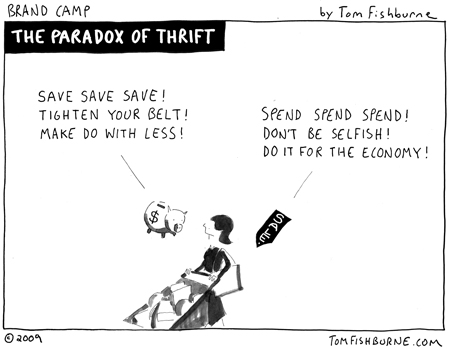
I have previously blogged about what Keynes called the Paradox of Thrift, but I want to explore it in a bit more detail as it applies to local authority budgets. If you are a business, then money you spend goes on the negative side of your balance sheet - it is a leakage, its benefits are external to your balance-sheet and therefore it should be minimised. This is because your business has clear boundaries. If you are a highly diversified business you may be able to keep a much higher degree of spending within your organisation, which is why SMEs are facing unfair competition, but none the less keeping costs down makes absolute sense.

If you are a local authority all the businesses within your area are inside your organisation, since all pay taxes if they thrive as do the people they employ. The boundary you should bear in mind when writing budgets is the local economy: just as you try to minimise costs within a business your priority as a politician should be to minimise leakages from the local economy. To cut your own budgets to the bone, or not to spend money budgeted in this period, is like cutting your own income rather than cutting your own outgoings.

What Keynes so elegantly described in his multiplier theory is that public spending and private spending follow opposite dynamics. An understanding of the systemic nature of a local economy, the importance of the circulation of money rather than individual transactions, and the importance of multiplier effects are all vital to those who set budgets within local authorities. Sadly, too many are bringing the mindset they used to maximise profit on an individual balance-sheet into the council chamber, and through their misplaced thrift they are undermining our local economies already struggling as a result of centrally imposed spending cuts.
.