Showing posts with label assumptions of perfect competition. Show all posts

24 June 2011

Market Myths: Perfect Information

The superiority of the market as a system of allocation for goods and services relies on a number of assumptions. It was the central theme of my 2006 book Market Schmarket that these assumptions no longer held in the highly developed globalised economy of the 21st century. This post is offers more evidence that this is so.

One area where this assumption is clearly being broken is in the purchase of train tickets. The hugely complex details about when many types of ticket are valid defeats understanding. Not only is it complex, but it also changes frequently and is not easily available. When you buy a ticket at the station machine you are simply required to consult the website for information about the validity of the ticket you are buying. How can this possibly fulfil the market requirement for perfect information?

The answer, of course, is that it is not intended to. You are expected to buy a ticket with greater validity than you need, at higher cost, rather than risk being caught without a ticket and obliged to pay a penalty fare. This also contravenes another assumption of the market system in being entirely abitrary. Whether or not you pay the penalty fare relies on the mood of the inspector you encounter. If he is hungover you are likely to suffer. If he takes pity on you for a foolish young woman you may be spared.

Most people who travel regularly by train are aware that splitting your journey works out cheaper than buying a through ticket. This is easily done by visiting website such as Split Your Ticket. However, a new rule has gone out to ticket salespeople: they are no longer allowed to give you the information you need to compare prices at the station. This makes a lie of the poster of an attractive young woman at our station who promises you the cheapest ticket, and advice on how to find it.

This left me playing a bizarre guessing game at the ticket office in Cheltenham the other day. I enquired about the relative prices of a ticket to Manchester, and two tickets, one to Birmingham and the other for the second leg. The downtrodden salesman was trying to stick to his rules: he was not allowed to tell me which way was cheaper; he was allowed to tell me prices if I asked for specific routes.

This refusal to inform the customer about the best value way of buying a ticket to their destination clearly contravenes the market assumption of perfect information. But it also illustrates how the market system really works: by setting us against one another and undermining the basic human motivations towards honesty and mutual aid that enable us to live a good and happy life.
.

31 October 2007

Competing definitions of a free market

The Competition Commission has found that supermarkets serve customers well. According to the limited economistic, marketistic mindset from which they see the world this is actually the correct conclusion. It is that mindset, and its political support, that we need to unpick in order to understand how they could have arrived at this frankly shocking conclusion.

The problem we face is that, as a society, we are undergoing a paradigm shift. For those of us living in the sustainable world of the future, diversity means a range of types of shopping, different shops or makers selling subtly different versions of the same product, or whose ownership structure or style suits our value system. To the Competition Commission diversity means four monocultural shopping outlets within which you can buy a range of 100 different fish all of which taste of very little. If you only have one of these you lack competition; if you have two the free market is functioning well for you.

For the proponents of supermarkets they are efficient places because you can buy everything you need as quickly as possible for as little time as possible, allowing you more time to make money to buy more. As a capitalist production-and-consumption unit supermarkets allow you to be as efficient as possible. The fact that they rely on global agribusiness which uses 10 calories of energy to make 1 calorie of food (according to Richard Heinberg) does nothing to undermine their claims to efficiency.

Although such reports can lead to unhealthy gnashing and grinding of teeth the real problem is a political one. We are building the new, sustainable, community-focused world we want to live in. Nowhere is this more evident that in the area of food, where most greenies use an alternative system of wholefood shops or have their own wholefood co-op. The producers and distributors, many organised as co-operatives themselves, provide a parallel food economy based on the values of the future.

The problem is that the political parties who operate at Westminster are united in their support of the old way of economics. An enlightened government might link support to local businesses with their positive outcomes in terms of community and sustainability. A restructuring of the market to support local businesses rather than the global businesses who free-ride on the infrastructure we all pay for, and the commons we should share, is politically possible, but only once the stranglehold of the uniformly pro-market parties is broken.

14 May 2007

The Assumptions of Perfect Competition: Lesson 5

Assumption 5: Producers and consumers have perfect knowledge of the market

Of all the assumptions of perfect competition the assumption about knowledge of opportunities to buy and sell this one relating to information has failed the test of time perhaps worst of all. In Adam Smith’s 18th-century market it was a reasonable suggestion that you might be able to have ‘perfect information’ about all the goods between which you were making your choice. There were, let’s say, three shoemakers and you could stroll from one stall to the next, and on to the third. In markets and fairs of this time, producers of similar goods helpfully located themselves alongside one another, which is why we are left with street names such as Butcher’s Row or Shoe Lane.

Pretty nearly perfect information was possible then, because there was such a limited range of goods. Proponents of market capitalism frequently list the expanded range of goods as one of the achievements of their favoured economic system, yet they have failed to consider how this impacts on the assumption about perfect knowledge. With millions of goods currently available how could we possibly know about all of them? Evidence that we do not comes in the form of advertising campaigns like the one by Superdrug claiming ‘If you find it cheaper elsewhere, we’ll refund twice the difference’. Clearly, if you had perfect information you would know it was cheaper somewhere else to start with and, if you wished to ‘maximise your utility’ buy it there. Such advertising campaigns manipulate us on the basis of our well-founded fear that our knowledge of the market and its goods is far from perfect.

This assumption comes in two parts, and far from reality though the side relating to consumers is, that relating to producers takes us once again into the realms of fantasy or farce. For the assumption to be true, sellers of goods have to have perfect information about all the opportunities to sell. As Sloman puts it: ‘Perfect knowledge means that potential entrants know immediately of a change in market circumstances which will yield them better rewards than can be earned elsewhere’‘Producers are fully aware of prices, costs and market opportunities. But in the global marketplace this would have to include selling opportunities right across the globe. In reality the only players who have this sort of reach are well-established, well-capitalised corporations. What chance do you or I have of finding out about market opportunities in Montevideo or Novosibirsk?

The focus of this point about the perfect knowledge of sellers is that they must have a knowledge of market opportunities. This will fulfil the necessary constant entry of new sellers which is the way that prices are kept low and racketeering is prevented, the basis of why the market system is a good system for distributing goods in the first place. Potential entrepreneurs are expected to scan the economy for market opportunities for them to exploit, which are those opportunities where existing suppliers are making the largest profits, ‘abnormal profits’, as economic theory calls them. But how are we to know the size of these profits, normal or abnormal, when such knowledge is constrained by commercial confidentiality. Modern corporations pay accountants to distort the financial figures they are required to declare, while most others are kept secret to protect their commercial position.

1 May 2007

Assumptions of Perfect Competition: Lesson 3

Given the savagery with which corporations defend their right to control the markets they operate in, the third assumption of a perfectly competitive market seems fairly extraordinary.

Assumption 2: There is complete freedom of entry into the industry for new firms

This assumption follows directly from the first and is necessary to ensure that there continues to be a large number of buyers and sellers so that competition between them occurs. In order for entry and exit to the marketplace to be free there must be no ‘barriers to entry’. As just explored, it is obvious that in the market for complex products, the need to invest in R&D, to prepare a product for the market, and then to advertise it all create barriers too huge for all but the largest corporate investor. James Dyson has described in detail his experience of trying to break into the market for vacuum cleaners, with a new product which he wanted to sell himself rather than selling the idea to one of the corporations controlling that market.

The whole concept of ‘intellectual property’, enshrined as TRIPS (Trade-Related Intellectual Property) in the WTO agreement makes a mockery of free entry into the market, since patent or licensing laws will operate to restrict this assumption. So one of the central assumptions used to argue that markets are the ideal way to distribute goods relies on the fact that producers can have free access to information about products they might wish to produce, that the inventor of the process cannot use the law to protect his right to extract profits from that invention while preventing others from producing it more cheaply. That, in fact, that 564 pages of Blackstone’s Statutes on Intellectual Property do not exist. In reality, of course, this is the kind of law corporations use to protect their profits. How surprising that an organisation like the WTO, which claims to be the foremost global promoter of ‘free’ markets, in fact defends the right of corporations to extract profits in this way that wholly invalidates the free operation of markets.

We may take the example of the pharmaceutical industry, since it is a clear case where every moral pressure, never mind the strictures of a genuinely free market, suggests that knowledge about how to cure disease should not be restricted. Patents have long been used in the pharmaceutical industry to protect the fruits of research. The justification used is that, if companies could not be guaranteed the right to be the sole profiteer from their discoveries, they would not invest the money in the initial research. However, when faced with dire humanitarian need few think that the global protection of what is referred to as ‘intellectual property’ under the TRIPs agreement, can be maintained. This is why, with 25 per cent of its people of working age being HIV-positive, the South African government decided to ignore international law and import generic AIDS drugs from India. The price difference is staggering—$350 for a year’s supply compared with $10,000 for the branded medicines—so a poor country like South Africa had little choice. Under the TRIPs agreement South Africa was clearly able to justify its actions under clauses exempting countries facing public-health disasters, but its actions were legally challenged by the US trade representative and action was taken against the government of South Africa by the Pharmaceutical Manufacturers’ Association. The courage of the government was rewarded and the PMA eventually withdrew its case in 2001, coming to a deal with the government over reasonable pricing and availability of AIDS drugs.

The reality in the pharmaceutical market, as in many markets, is that businesses will produce what they can make a profit from, not what is in the public interest. This is why there are no high-tech cures for sleeping sickness and malaria, which poor people die from, while there are a superfluity of treatments for the concerns of the affluent, from skin products to slimming pills. It is a recognition of the fact that research for profit is not directed in the public interest that leads to the awarding of research grants for the development of a range of important recent drug successes.

A report from the US Congressional Joint Economic Committee in May 2000 established that 7 of the 21 most important drugs introduced in the US between 1965 and 1992 (including tamoxifen, AZT/zidovudine, Taxol, Prozac and Capoten) were developed with the help of federal funds. AZT, the leading anti-AIDS drug, was originally synthesized in 1964 as a result of a National Cancer Institute grant. However, GlaxoSmithKline determined the drug’s anti-AIDS properties and were granted a patent for this use, and hence profited from its worldwide sale. Many of these drugs that are so jealously guarded have been developed partially, often to the extent of half the funding, by public money. And yet the ‘intellectual property’ reverts to the corporations and we, the public who funded the research, have to pay them for the benefits of the knowledge they developed at our expense.

The other side of the free-entry-and-exit coin is the need for ‘factors of production’, i.e. labour and capital, to be perfectly mobile. Just in personal terms it is clear that labour is far from mobile: rrestrictions range from family or neighbourhood ties to the loss of pension rights’. But the most glaring ‘restriction’ is found in the strict immigration rules that govern freedom of movement of labour. What is the value of basing a claim to the superiority of the market on the fact that workers can move freely to better paid jobs in a world where they are not actually allowed to enter Britain, are condemned as economic migrants and, if they succeed in entering, put in gaol as illegal immigrants or deported? Even in a labour-market with apparent free movement of labour, as the EU has been since 1992, there is actually very little movement of workers from one country to another, since they are dissuaded by language and cultural barriers.

The devastating consequences of genuine free movement of labour can be assessed by comparing the minimum wage in the UK with the sorts of wages paid to workers in the Chinese SEZs (special economic zone, or specially exploitative zone) in Guangdong exposed by Corporate Watch. A shoemaker there earns only £40 per month of 14-hour, 7-week days, out of which s/he has to pay for food and bedding. It is the working conditions faced by people like this that turn them into economic migrants, and their desperation and willingness to be exploited that frightens European governments into undermining the free market they officially support by preventing their freedom of movement into our labour market.

13 April 2007

The Assumptions of Perfect Competition: Lesson 2

Assumption 2. There are so many firms in the industry that each one . . . has no power whatsoever to affect the price of the product

The second first assumption is intended to guarantee that neither individual buyers nor individual sellers can have undue power within any market. This is because, with so many sellers, it would be impossible to operate an effective cartel, since the cost of finding information from so many sources would preclude such an arrangement. Again, because there are so many sellers, none can individually influence the price of the good s/he is selling. Large buyers might also come to have too much power in a market, so the assumption applies also to the demand side of the market.

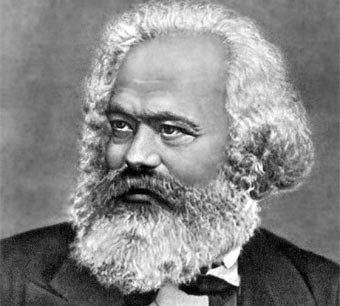
Is this a realistic view of how modern markets operate? In reality, it flies in the face of the consolidation that has typified capitalism at least since it was critiqued by Marx (what a fantastic beard!). Perhaps in this Information Age we should be most concerned about the heavy consolidation in the world of media, as demonstrated by the merger of AOL and Time-Warner, two of the largest global media corporations, in 2001. Since the merger the group has gone from strength to strength, now out-competing other providers of high-speed internet connections and seeing profits increase by 76% in the last quarter of 2004.

Let us carry out that manoeuvre so detested by economists and test out this assumption against the reality of the market for food in the UK at the beginning of the 21st century. The reality is that the market is dominated by a small number of very powerful players—the supermarkets. As middlemen, standing between producers and consumers, they both buy and sell food, and ensure that what economic theory might consider the ‘buyers’ and ‘sellers’ have to meet their in needs in terms not only of price, but also in terms of quality. According to Corporate Watch research, in 2000 the major supermarket chains controlled 88 per cent of the UK food market, a concentration of retail power far greater than in continental EU countries or the USA. Later that year analysts predicted that the number of major players would be down from the existing five—Tesco, Sainsburys, Safeway, Asda, and Somerfield—to just two.

So much for competition: without a large number of potential entrants to the market, what mechanism does the market offer to constrain their behaviour? This assumption relies on a separate sub-theory focused around the concept of ‘barriers to entry’. In order to ensure that there are plenty of buyers and sellers in the market, there must be nothing to stop the potential market players from entering the market, no ‘barriers’. Competition only works when there are large numbers of suppliers who cannot unduly influence our purchasing decisions or preventing other producers from entering the market and improving on their offer to us as consumers.

This view may have made sense why you consider the 18th-century market that Adam Smith visited, where he might have bought meat, potatoes and shoes, but it has little relevance in a complex, modern economy where purchasing decisions are based on advertising and goods do not reach the market without many years of development and massive R&D investment. Or to a market where a new item cannot reach the consumer's attention without massive investment in branding and advertising.

Parkin and King deal with advertising as follows: ‘To the extent that advertising provides consumers with information about the precise nature of the differentiation of products, it serves a valuable purpose, enabling consumers to make a better product choice’. Sloman deals with advertising as follows: ‘There is no point in advertising under perfect competition, since all firms produce a homogeneous product (unless, of course, the firm believes that by advertising it can differentiate its product from its rivals’ and thereby establish some market power; but then, by definition, the firm would cease to be perfectly competition’ (p. 156). Trying to imagine what kind of advertising might conform to this the world of the perfectly competitive theory Mr. Cholmondley-Warner sprung into my head, kindly pointing out in his received pronunciation that Mr. McVitie is now producing his digestive biscuits with chocolate on top. If this was all advertising were about why would companies spend millions on it every year? Why would there by whole journals dedicated to informing company executives of the most effective ways to manipulate the minds of potential buyers?

In reality, the business of a corporation in the global economy focuses on holding its market share and defending it against all-comers. The business of corporate capitalism is not about perfect competition but about obstructing competition. This is done not only through creating and defending the corporation’s unique identity through its brand, but also through investing in advertising and PR to support its brand and litigation to attack those who transgress it, and through concealing virtually everything about its operations, from the details of how its products are made (remember the Coca Cola secret recipe?) to how it spends its profits.

6 April 2007

The Assumptions of Perfect Competition: Lesson 1

At the heart of the justification of the supremacy of the market system within academic economics lies the theory of perfect competition, so it is high time to carry out a reality check on this theory, which is itself based on a series of assumptions. In this section we will explore and test these assumptions and find that, unsurprisingly, they are as far from reality in the global marketplace as the model of Camelot in the Monty Python film. Others have produced similar critiques, so we may conclude, as do Gaffney and Harrison, that it remains for ideological rather than rational reasons.

It is an old joke in the economics profession that if there is some fact about the real world that makes modelling difficult you deal with this by assuming it away. This technique is used with gay abandon in the case of the theory of perfect competition which is based on a series of fundamental assumptions without which it is assumed not to be valid. The list of assumptions of perfect competition that I critique in this and a few following posts is taken from a book published in 1974, the 2003 edition of a standard economics text (I refer to it from here on simply as ‘Sloman’); but similar ones could be found in any introductory economics text. In fact, a rapid search of the internet will find plenty of examples of university courses teaching approximately the same theory as is critiqued below.

The paucity of change over the past 30 years or so, during which economic conditions have changed beyond all recognition, is evidence of the theory as catechism rather than science. The last time I taught this theory to undergraduates I was issued with a US text. It explained the theory of perfect competition by reference to suppliers of two competitive products: ice cream and frozen yoghurt. This seems to epitomise some of the problems with the theory and with economics in general. First, it clearly originates in a foreign, US culture: how many UK kids have ever tried frozen yoghurt? Secondly, the example is trivialising. I felt embarrassed explaining these issues which influence so many lives (and deaths, in the developing world) in terms of an irrelevant, self-indulgent good such as ice-cream. For many of those who are the victims of the market ideology, ice-cream is a luxury which, although far better suited to their climate than ours, they will never have the pleasure of enjoying.

Assumption 1: Producers aims to maximise their profits . . . and consumers are interested in maximising their utility

At first sight there seems little to take issue with in this first assumption. We might quibble with the use of the word ‘producers’ since, as I discuss in Chapter 7, very few producers are actually able to take their own goods to the market in the capitalist as presently structured. We might also question the idea of ‘utility’. The consumer’s interest in the market transaction is often reduced to that of gaining the maximum amount of the good in question for the minimum amount of money: as the later fourth assumption makes clear, according to economic theory, consumers cannot choose between goods on the basis of quality, since goods are taken to be homogeneous.

Should we be satisfied with this thin description of the market relationship? In reality, our purchasing involves significant psychological and cultural content, and our production and exchange of goods plays a far deeper and more significant part in our human lives that this assumption suggests. Our decisions about purchasing may be based on strong moral or religious commitments, as the growth in the fair trade movement has made clear. Economists may theoretically absorb these concerns by extending their concept of ‘utility’, but frequently they do not, and even if they wish to they are unlikely to succeed in summing up such complex social processes within their desired economic calculus.

13 February 2007

Market, Schmarket!

When was the last time you felt really happy? If you think back to that time, did the feeling arise from anything you bought in a market using money? I can fairly confidently predict that in most cases the answer is no. As a species we are brought delight by the birth of our children, by a curious juxtaposition of ideas, by the misty beginnings of a glorious spring day. The tragedy of the modern economy is that, although the well-springs of our joy are found in our shared humanity and our beautiful planet, we have allowed ourselves to become enslaved to a market and its hegemonic ideology.

It has become a cliché of the political debate that if something fails it should be ‘marketised’ and this will solve the problems. This is now a general solution to political problems that is proposed for areas as diverse as depressed local economies and over-crowded hospitals. In spite of the images of beast-infested jungles that abound in the marketeers’ discourse, this solution is not seen as throwing a group of vulnerable people to the lions; rather it is offered as a panacea for all the ills of a late capitalist society and economy.

If, as is often the case, this solution fails, it is not reversed. We are told not that the market as a system has failed but rather that this particular market has failed, and it is generally concluded that the failure results from the fact that the market was not ‘free’ enough. Although Joanna Bloggs can clearly see that a train system does not work well within a culture of competition she is silenced by the ideologues who will offer the free marketeers an infinite number of opportunities to kill consumers, whether from BSE or the string of rail crashes. So convinced are they of the supremacy of their market mechanism that they will accept these sacrifices to the market fetish in their own societies, and numerous more overseas.

So the dissection of the market as a concept is essential before we begin to rebuild our economy. The first step is to question what we really mean by the market. For managers and politicians it is simply shorthand for an economic structure that advances their ideological position; but economists actually mean something by it. They are the keepers of the holy grail of the market mechanism, whose beautiful qualities are passed on to all students of economics within a year of reaching university. The problem is that the central assumptions on which the claimed supremacy of the market system is based are universally flawed and anachronistic. I will unpick these individually in a few forthcoming posts.

This task is not intellectually demanding. Testing the market against reality invariably results in its demonstration as a hollow icon. However, if you try publishing a swingeing attack on this ideal view of the market as the best system for the distribution of goods, not to mention money and people, you will find your arguments dismissed on the basis of naivety. The attack is unfair, the economists will claim, because nobody really believes the world works that way. But if not, where is the justification that the market is the best system? And, perhaps more importantly, why is this non-existent ideal system taught to all first-year students of economics? Here is the answer given by one standard introductory economics text:

These assumptions are very strict. Few, if any industries in the real world meet these conditions. Certain agricultural markets are perhaps closest to perfect competition. The market for fresh vegetables is an example. Nevertheless, despite the lack of real-world cases, the model of perfect competition plays a very important role in economic analysis and policy. Its major relevance is as an ‘ideal type’. Many on the political right argue that perfect competition brings a number of important advantages. The model can thus be used as a standard against which to judge the shortcomings of real-world industries. It can help governments formulate policies towards industry.

Here is the response to this question provided by the ‘hints to teachers’ book that accompanies the undergraduate text, Parkin and Kin[i] Its authors being by conceding that ‘perfectly competitive markets are quite rare in the real world’ (no examples are given), but continues that there are three important reasons to continue to propagate this false view of the economic world:

1.Markets ‘quite closely approximate perfectly competitive markets’;
2.The theory allows us to discuss these ‘competitive forces which are at work in all markets’;
3.The ‘model’ can be used as a ‘benchmark’ against which to ‘evaluate relative allocative efficiency’.

This paragraph constitutes a fascinating admission of intellectual manipulation. It explicitly states the theory of perfect competition as an ideological tool rather than a scientific theory. Without it governments would not be able to justify their policies so, although it is a completely inaccurate portrayal of the world we live in, it is of vital political importance. This first makes it clear that, before the market can be brought up as an ideal, the arena it is being introduced to needs to be justified as being at least approximately capable of supporting the ‘ideal’ and non-existent market in which the efficiency of this system was justified. In fact, as will be demonstrated later, this cannot be done in the market for tea-bags, never mind in that for health care or labour.

The second point generalises the relevance of the discussion to all markets. But point 1 has already accepted that, rather than all markets demonstrating these competitive forces, in fact very few, or perhaps none, do. What are these ‘competitive forces’ that really exist in all markets? They have not begun to be identified. Unperturbed by this contribution the authors forge on to point 3, forcing the world to conform to an unattainable model.
Perhaps most telling is the claim that this ‘model’, meaning something that is not real, which does not exist in the real world, can now be used as an ideal against which we can compare other system of allocation which do exist in the real world. In other words we can assess how efficiently tea-bags are being distributed and if this does not match up to our model we can legitimately criticise it, even though we are aware that our model is an impossibility. It is at least admitted in black and white that, like the Camelot of the Monty Python film (the Holy Grail one), the market is ‘only a model’, it is a chimera against which a real system can be compared, against whose perfection we who exist in the grubby world of monetary exchange can match our imperfections. This is a far cry from the laws of physics claimed by those who use market theory to justify strict competition laws.

[i] Parkin, M., Cohen, A. J., King, H. B. and Spencer, D. E., Economics: A Study Guide (Wokingham: Addison Wesley, 1995).