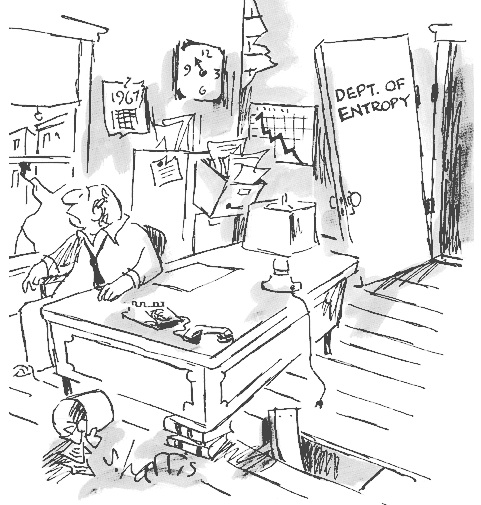
As my Christmas gift this festive season I hand you an interesting concept, which has kept me entertained during several recent train journeys. It is the concept of entropy. To understand entropy you need to have a scientific mind, so I am at something of a disadvantage. Here is how a scientific friend of mine, Steve Harris, has helped me explain it:
'Thermodynamics is among the most important topics in science; it studies how energy is exchanged between physical systems as heat and work, resulting in changes in pressure, volume, temperature and entropy, the measure of disorder within a system. The laws of thermodynamics provide some of our most basic understandings of what is physically possible.'
He goes on to explain why the laws of thermodynamics - which explain how our physical universe functions - are of fundamental importance:
'The first law of thermodynamics, also known as the conservation law, states that energy can be neither created nor destroyed, only transformed. However, the second law of thermodynamics—
‘the entropy law’—tells us that in general, the total amount of useful, organized energy available to do work is always declining. For example, a lump of coal is a high-quality, highly organized form of energy; when burned it turns into smoke and heat, which are low-quality, dispersed and much more disordered forms of energy. This process is irreversible; we cannot recapture all the heat and smoke produced by burning and turn it back into a lump of coal. The second law tells us that all energy systems have a tendency to increase their entropy (or degree of disorder) rather than decrease it. This appears to apply to everything in the physical universe. So, although many natural and technological processes do increase order on a local scale—through the growth of plants, say, or the manufacture of goods from raw materials—the material waste and heat produced by these processes steadily, if imperceptibly, increases the general disorder of the physical universe.'
To my unscientific mind this concept is very appealing. My anarcahist inclinations are soothed by the thought that the inherent tendency in the universe is towards chaos, rather than order. The idea of entropy seems intuitively to help explain what is going wrong with our relationship with the planet, and how this relates to our economic activity. It was used in this way by the ecological economists, following up on the work of Nicolae Georgescu-Roegen.
The first law of thermodynamics is about quantity - there is only so much energy in the universe and it can only be changed from one form to another, never created or destroyed. The second law is about the quality of that energy, which changes as its form changes, and with an inherent tendency towards a higher level of entropy, or disorder.
The first economists to consider why our economy was growing out of control and why economists had no concern for the physical limits of the universe soon identified the cause: the pseudo-science of economics pre-dates the discovering of the laws of thermodynamics by some fifty years. Its Promethean optimism about what humans can achieve operates outside physical reality, and has never been brought into line.
There is something intriguing about the relationship between entropy and life itself. Natural processes are able to transcend the movement between disorder and order more creatively than our industrial systems can, an example being the way that nature transforms wastes into life-giving systems, potato peelings into soil, for example. I hope you will be able to do something similarly creative with the concept of entropy itself. It could change your life and could fill a dull moment between meals. Tweet


