Showing posts with label jubilee. Show all posts

3 June 2012

Time for a Real Jubilee

I am not sure whether the coincidence of the next critical phase in the global credit crisis with the celebration of the Queen's jubilee is ironic or tragic, but it certainly gives me an opportunity to explore the real roots of the concept of jubilee, a concept whose real meaning could not be further from the spectacle of disempowered British citizens, burdened with the debts of their unaccountable elite, paying homage to the figurehead of the system of unequal power and property relations that oppresses them.

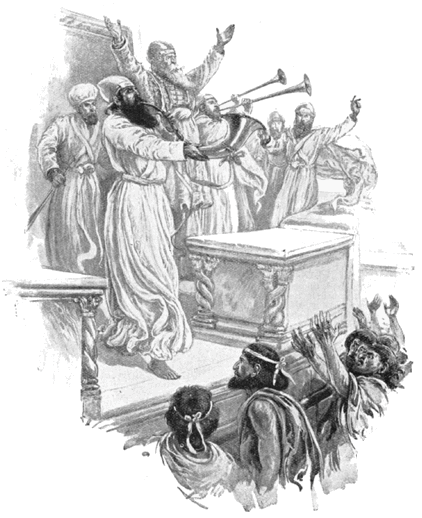
A jubilee is not an arbitrary celebration of any feature of civil society that has simply lasted a certain number of years, rather it is a distinct legal requirement introduced by the ancient Jewish community to ensure that the ownership of land and property did not become too concentrated. In the ancient world, as in ours, bad luck or bad character could mean that some fell into debt slavery, but the inherent spiritual offensiveness of such a status required the possibility of release, and this was realised in the jubilee that occurred every 7 x 7 years.

I am not an aficionado of the Jewish bible so I am relying on the interpretation of the German theologian Ulrich Duchrow whose book Property for People not Profit explores these writings as a prescription for a world of economic justice. His interpretation of the writings of prophets such as Isaiah and Micah was that they were critical of the devastating consequences for the Jewish people of social and economic injustice. The jubilee - the freeing of slaves, the returning of land to its original owners, and the cancellation of debts - was proposed to ensure the stable functioning of Jewish society:

'To sum up, according to the Book of the Covenant, in view of God's solidarity with all his creatures, the needs of real life, including freedom from oppression, write the economic rules.' (p. 18)

I had always assumed that Jesus, who was clearly either a communist or a hippy or some combination of the two, could be called in to support my opinions regarding economic emancipation, but now it seems that he was merely reviving ancient wisdom that had been lost in the decadence of the Roman world.

I have been posting for some time about the contemporary proposal for a debt jubilee, a process that begins with a campaign for a Citizens' Audit. I have now finished a full paper on this proposal, including detail about its origins in international law. You can find the paper on the Social Science Research Network, and I would be grateful if you could use the opportunity of the jubilee to share it with your friends.

So, enjoy your bank holiday. Although many radicals criticise the Windsors for being out of touch, I credit them with enough understanding of working people to know that giving us holidays from labour is a useful way to reach our hearts. It seems unlikely that the members of the elite we have bizarrely elected to run our country would have increased the number of days when we are allowed the freedom to do what we really enjoy: chatting, resting, and drinking. But wherever you are, please use the opportunity of the unusual occurrence of the word 'jubilee' in everyday speech to remind people of what it was really for. If we could resuscitate the concept of jubilee in everyday understanding we would no longer need to rely on the magnanimity of an unelected elite to enjoy a well earned rest from work.
.

5 August 2009

Time To Declare the Jubilee


As we stagger on through the summer with our ball-and-chain of impossible debt it appears that the accepted view amongst commentators is that we must knuckle down, swallow the unpalatable work-ethic pill, and 'create more wealth' to pay it all back. These people must think that we all suffer from the sort of scale-blindness that makes it impossible to grasp debts of this size, just as we can't really feel compassion when we hear about thousands of children dying in famines or millions being threatened by climate change.

Because if we can maintain some sense of perspective we rapidly grasp that the implications of the public-spending cuts caused by bailing out the banks on such a massive scale are devastating. Borrowing announced in the budget amounted to £175bn. in 2009/10 and a huge £701bn. over the next five years. If you add in our liabilities for bad debts we have ‘insured’ (since they are already bad debts it seems certain that we are going to have to pay these liabilities) then the total we are in hock for is more than twice the value of all the activity in our economy for a whole year. Just the interest on this borrowing is more than £40bn., about a third of total NHS spending in any one year. Following this year’s budget public spending will fall from 48% of national income to just 39% by 2017-18, with the health budget facing cuts of £10.5bn.

The question of the public finances is the major political issue for our generation. Smart government accountants can find ways to shift financial liabilities through time but we should not be distracted from the central political question: why should the poor pay for the mistakes of the rich?

There is nothing new about the accumulation of wealth in the hands of a minority: capitalism only increases the efficiency, speed and scope of accumulation. The ancient Hebrews had a way of dealing with this problem: a jubilee, where there was a forgiveness of sins, a wiping out of debts — and universal rejoicing. True to the biblical idiom it occurred every seven-times-seven years. So this can be our political demand: an international debt jubilee to relieve the working people from the slavery of repaying mountainous debts for which they are not responsible.

Not paying your debts can be a little embarrasing, but it is nothing compared to the consumption of energy and resources (and its impact on the planet), the sheer tedious drudgery, and the social conflict that seriously attempting to pay back debts on this scale will require.

22 November 2008

Gordon is Not a Moron


On Monday Alastair Darling will announce his plans for borrowing. He will be quite explicit in his hypocrisy. All the ideological ranting we have listened to for the past 40 years about how spending would destroy the economy has suddenly been abandoned. Was it wrong for all those years? Or is our economy so close to collapse that all the rules we have lived by can be gleefully abandoned?

The scale of borrowing is set to exceed $100bn., which is three times more than the government predicted. What are we to make of this? How can we possibly take any more of those projections - neat lines of exactly 45 degrees on x-y axes - seriously ever again? It is quite clear that the government economists are not in control and don't know what they are doing.

So what are the economic rules for? One begins to suspect they may be made up to find excuses for not doing what the people in the democracy demand. Want a new hospital funded from government spending? Sorry, we can't possibly borrow more than 40% of GDP. Could we have more investment in the railways so that people have a serious alternative to driving? Can't do that because we can only borrow to invest.

It all turned out to be nonsense. Because when it looks like a situation might arise where really radical economic change is called for, any amount of money can be borrowed to ensure this doesn't happen.

When this level of borrowing was first mooted I remember waxing biblical and wailing about the debt hanging around our descendants necks unto the tenth generation. I thought I was being rhetorical, but the size of debt we're talking about raises questions of intergenerational equity in financial, not just planetary, terms.

What is our chuckling ex-chancellor thinking about all of this? I have a sneaking suspicion that he may have been expecting it just like I was. Is it just possible that he is deliberately provoking this massive indebtedness to force us towards the grand jubilee, the wiping out of all national debts, and the road to the New Jerusalem?

27 October 2008

International Monetary Farce


Where do you turn as national chancellor when your country is bankrupt? If you don't have a reserve currency to protect you this is a situation you are pretty likely to face in the coming months. Your only option is to hope that you get in while the IMF still has some funds.

The International Monetary Fund is the part of the global financial system that is supposed to support the occasional accident that results from over-exuberant capitalist enterprise. It is not in a position to support the whole global banking system. Its pot apparently only extends to $200bn, which, given the size of money flows we've seen recently, appears extremely modest.

So, it could be that the Fund will be coming to national governments, asking them, on our behalf, to put our hands in our pockets again. Now we will be expected to bail out not only our own banking system, but whole economies across the world. The countries themselves will be required to take on more debt - the last thing they actually need. Surely it would be better to cancel all these debts in one almighty jubilee and negotiate the whole system again from scratch?

Imagine yourself as that national chancellor. You have only done what you were advised by economic theory. You have no control over global capital flows, and is isn't really your fault that your rely heavily on oil, or steel, or that you are a country which financial speculators don't like the look of.

The IMF tends to make offers to people who are in no position to refuse, and the offers are usually in the neoliberal mode, requiring restraint on public spending, a contracting state, and more market liberalisation. Exactly the sorts of policies that got those countries into the mess in the first place.

Interestingly, in the past few years many of the poorer countries who have been the recipients (victims?) of IMF loans have wised up and chosen to repay (see stories on Argentina and a story of recent IMF politics). In the insane world of banking, without anybody to lend to, the IMF would have gone bankrupt. It does seem a strange coincidence that exactly at this point a whole new range of countries are being forced into bankruptcy and into crippling loans that will keep the IMF afloat for another few decades.

30 April 2008

Housing Entitlement Day


Shelter's annual affordability index, published earlier this month, shows how disastrous the house price increases have been for most people in the UK. It indicates that the price of a first home has risen from £52,674 to £159,494 over the past ten years, with house price to income ratios rising from 1.72 to 3.4. Mortgage repayments now represent 21 per cent of household income compared with 12 per cent a decade ago. This cash is returned as interest payments to wealthier home-owners and bank shareholders - another redistribution of wealth from poor to rich.


Many years ago, Spencer Fitzgibbon, a former external communications supremo for the Green Party who has now retired to write novels, came up with a brilliant policy which he called 'housing entitlement'. The idea was they we chose a day and made it law that, wherever people were living on that day became theirs.

This was a brilliant stroke - a thought experiment that requires you to question what home ownership means, and whether something as fundamental as the need for a roof over your head should ever be subject to the vagaries of the market.

So what would it mean for different groups in society? Those with mortgages would lose them instantly - no need for the stress of working to pay for housing. Those who were renting would suddenly gain home security and an asset to allow them onto an equal footing with the more prosperous members of society. These would be the winners.

And what about the losers? Mutual building societies would no longer own assets and would have to begin again by taking deposits from savers before they could lend. Private banks would also lose their assets - which would impact severely on the indirect absentee landlords who make up their shareholders. Landlords and landladies would also lose assets - the more they owned the more they would lose.

The great thing about this thought experiment is that your reaction depends entirely on where you find yourself in the present housing hierarchy, but the reality is that the majority of this people would, on average, find their well-being improved by such a policy. The overall losers would be quite a small number of very rich people.

Every now and then the government could name a new housing entitlement day. It could be about every 40 years or so - like biblical jubilees - about the amount of time it takes the greedy and unscrupulous to distort the ownership system enough for goodly citizens to really be suffering.