It is good to know that the personal is still political, because a major international finance story has linked very closely with my own local politics this week.
In the midst of the excitement over David Cameron opening his mouth and saying something you might have missed the news that European Free Trade Court delivered an important ruling on 28th of this month in the case between those huge bastions of the global economy the EFTA Surveillance Authority and the European Commission.
According to the website of the Committee to Oppose Third World Debt,
'The judgement clearly states that it is not the
responsibility of the parent nation of a banking company to cover the costs of
the guarantees to their banking system, and the safety net structure must be
financed by the banks themselves. This implicitly confirms that the normal
liquidation process, as applied to Landsbanki (Iceland mother company) is quite
correct when a bank, even too big to fail, has greater liabilities than assets.
Which would be the case for most of the big European banks if the toxic assets
on their balance sheets were counted at their real value.'
The case was brought on behalf of the UK and Netherlands, whose citizens has been the target of aggressive selling by the Icelandic bank as it began to fail. These loans were not covered by national guarantees, meaning that savers were set to lose all their money. You may recall Gordon Brown's use of terrorist legislation to seek to freeze Iceland's assets to force the country to pay debts its banks had incurred that had already bankrupted it ten times over.
This ruling cuts right to the heart of the decisions of governments in all the world's leading capitalist countries to provide massive bailouts to support their banks, arguing that they had a legal responsibility to do so. Surely this strengthens the case for arguing that debts incurred to fund such bailouts are odious.
And the personal aspect? Well before I became elected to Stroud District Council a very unwise investment of £2.5m was made in Icelandic bank Glitnir. That money was recently returned and has been a windfall in the recent budget-setting period. As Green members of the administration we have been managed to argue for half a million to be invested in a hydro generation scheme at our district council offices.
.
Tweet
All other green campaigns become futile without tackling the economic system and its ideological defenders. Economics is only dismal because there are not enough of us making it our own. Read on and become empowered!
Showing posts with label Gordon Brown. Show all posts
30 January 2013
16 May 2011
Something rotten?

To the plethora of three-letter acronyms that infest the discussion of finance has been added another. Alongside the CDO and the CDS we now have to contend with the DSK. Like the others the outward power and appeal of the DSK has given way to doubts about its inherent quality. We are led to question whether, behind the impressive facade, it may be toxic.
We must, of course, respect the presumption of innocence, but even if Strauss-Kahn is eventually cleared over the sexually aggressive charges against him now, the scandal has brought into the open his past sexual conduct, which I am old-fashioned enough, and perhaps Anglo-Saxon enough, to consider undermines his suitability to hold the most powerful office in the world of global finance.
It has been clear for some time that what is happening in the world's banking system has passed beyond the stage where we might consider that there is merely something rotten. The whole system is corrupt, dishonest and socially destructive. The fact that its figurehead personifies these qualities, while revelling in the sort of lifestyle that is an insult to the working people in countries the IMF is supposed to be aiding, just reinforces the sense of hypocrisy. There is no glee at this scandal but a growing sense of disgust that we have been betrayed by those in whom we have entrusted power.
The process of ‘financialisation’, a term coined by social scientists to describe the way that relationships mediated through finance have penetrated more and more areas of life, is the hallmark of contemporary capitalism. Money is exalted until social and economic institutions are hollowed out of other values, with finance taking up all the space. Whether we are thinking of pensions and mortgages, or football and the music industry, the greed and immorality of the world of finance has spilled over into most areas of modern life.
The fall of Strauss-Kahn has left two huge voids: at the IMF and in French politics. It is an indication of how desperate the stakes are that I am rather hoping that Gordon Brown may finally be given the chance to achieve his life's hopes by taking over at the world's central bank. I have long since given up hope that he would then reveal his colours as a former communist and have the courage to take political control over the disaster that an the private operation of capital has engendered, but at least he seems to have maintained a sense of moral purpose rather than being dazzled by wealth.
In French politics there may be another interesting outcome. Because of the double ballot system used for French presidential elections, the left must coalesce around one candidate, who need not necessarily come from the socialist party. Eva Joly, who has already proved herself capable of standing up to the might of the oil and finance industries, is likely to be the candidate from the Green Party. Given the disarray that DSK's fall has created in the socialist party, perhaps Joly will be the beneficiary, giving her the chance to compete directly with Sarkozy to lead the country.
. Tweet
Labels:
Dominique Strauss-Kahn,
Eva Joly,
financialisation,
Gordon Brown,
IMF
26 November 2010
Merkel Confronts the Market Wolves

Throughout the years of financial crisis it has been notable that financial and business interests have been writing the story. Media analysts have been colluding: those who understand what is going on are in the pockets of the business lobbyists; those who do not are scared to reveal their ignorance. The result is that we are being sold a lie.
The official version of what is happening in the finance markets goes like this. Countries are in debt so they look like a bad risk. The debt of risky countries is harder to sell and so the price falls and traders need to be offered a better rate of interest to accept it. Traders will not buy it at all unless they are convinced about the soundness of the national economy selling it, so that markets demand that countries introduce austerity measures. If they are not satistifed the austerity must be made more austere.
The truth is different. As they pick on each country in turn the bond traders create a self-fulfilling prophecy. They (through the credit-rating agencies) downgrade the surety of the country's debt. Its price falls and the return they gain from holding it rises. Thus their creation of this story is a simple means of increasing their profits. They feel they can still squeeze more out of Irish debt, hence the story that the 'markets don't believe' the Irish government is secure. Once they have destroyed Ireland they will move on to Portugal, Spain and even Belgium, according to today's story. Governments in those countries tremble and beat up on their own people.
Understanding the behaviour of market traders is not difficult; devising policy to counteract it is. The process of globalisation meant the signing away of political power over economics, so even when the free operation of finance markets is clearly disastrous for the world's people politicians feel powerless. If one country acted alone they would face the massive movement of speculative money and, as Black Wednesday proved, no country or currency can withstand that.
German Chancellor Angela Merkel has been clearest about the need for political action, perhaps because she represents the strongest economy, perhaps because of the folk memory of the 1930s and the destructive consequences unrestrained finance wreaked then, perhaps because she grew up in a debt-averse Protestant home. First she called for political controls over credit-rating and now she is suggesting that the bond-holders should contribute to paying for the costs of the crises they are causing, shifting the balance of their incentives away from destroying domestic economies. These represent the first feeble attempts to reassert political authority over the globalised economy. "Have politicians got the courage to make those who earn money share in the risk as well? Or is dealing in government debt the only business in the world economy that involves no risk?" she asked on Wednesday.
Gordon Brown is short of a job these days. Perhaps the son and daughter of the church could combine their efforts in devising a plan for European governments to take charge. If he really wants to save the world, now could be just the right time.
. Tweet
Labels:
Angela Merkel,
euro,
financial crisis,
Germany,
Gordon Brown
16 October 2008
Hero or Heroin
I'm sure Gordon Brown was secretly delighted to have been compared with Flash Gordon at a recent press conference. Given his recent shady dealings with the bankster fraternity I would have thought Flash Harry was more appropriate. What would the flaming red Gordon of his student days have made of this man who is putting the poor of this country in debt to prop up a failing capitalist system?
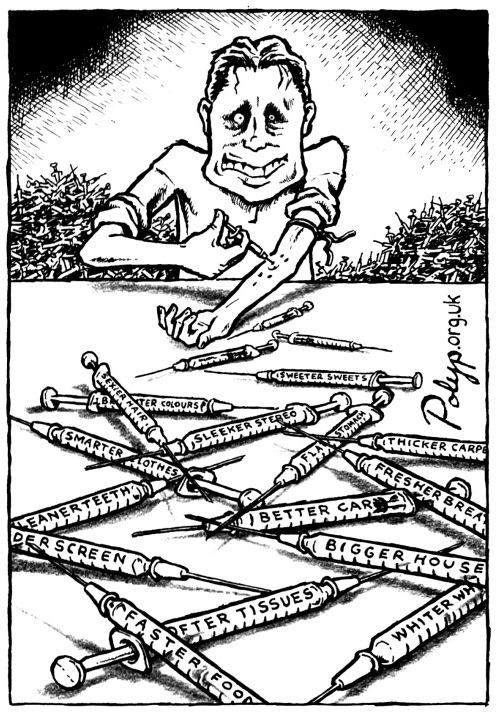
But is it the right thing to do, to fuel capitalism's addiction to money? Isn't Gordon rather acting as a drug dealer, providing more of just what is worst for the global economy, bloated with years of excess and destroying the body it depends on?
If you will indulge my extended metaphor for a while longer, perhaps we could explore what mechanisms we might pursue to tackle the addiction, to move the economy away from its moneylust and towards a balanced steady state. What would be the methadone that we could introduce as a substitute during the transition?
Gordon is calling for a summit to debate a new financial architecture. Part of that might be Richard Douthwaite's Ebcu or environment-backed currency unit. This is a neutral currency created by agreement between the world's nations and under their control. It could contribute to a global economy where the economic power of countries was more equal; in a world dominated by the dollar this can never be the case.
But more importantly, because the ebcu is linked to emissions of carbon dioxide, it operates like a carbon standard, linking economic activity to the ability of the planet to support that activity. It follows the Contraction and Convergence model for a decline in CO2 emissions and a fair sharing of these emissions between countries.
Although the 'summit' will be exactly that - our exalted leaders meeting like so many Old Testament prophets on the mountain top - we should make our demands clear. The agreement should be for a steady-state economy that balances the interests of the people of the world, and the planet we all depend on.
[Thanks to Polyp for another brilliant cartoon. Visit his website and check out his great new animated version of the rats in the trap] Tweet
But is it the right thing to do, to fuel capitalism's addiction to money? Isn't Gordon rather acting as a drug dealer, providing more of just what is worst for the global economy, bloated with years of excess and destroying the body it depends on?If you will indulge my extended metaphor for a while longer, perhaps we could explore what mechanisms we might pursue to tackle the addiction, to move the economy away from its moneylust and towards a balanced steady state. What would be the methadone that we could introduce as a substitute during the transition?
Gordon is calling for a summit to debate a new financial architecture. Part of that might be Richard Douthwaite's Ebcu or environment-backed currency unit. This is a neutral currency created by agreement between the world's nations and under their control. It could contribute to a global economy where the economic power of countries was more equal; in a world dominated by the dollar this can never be the case.
But more importantly, because the ebcu is linked to emissions of carbon dioxide, it operates like a carbon standard, linking economic activity to the ability of the planet to support that activity. It follows the Contraction and Convergence model for a decline in CO2 emissions and a fair sharing of these emissions between countries.
Although the 'summit' will be exactly that - our exalted leaders meeting like so many Old Testament prophets on the mountain top - we should make our demands clear. The agreement should be for a steady-state economy that balances the interests of the people of the world, and the planet we all depend on.
[Thanks to Polyp for another brilliant cartoon. Visit his website and check out his great new animated version of the rats in the trap] Tweet
11 July 2007
Hell fire or a bottle of Bulgarian red on the beach?
The early industrial workers were faced with a stark choice: a joyless life of work or an eternity of hellfire. It is unsurprising that so many took Kierkegaard's way out and struggled to keep a faith in eternal life. In a similar way many lives are being stolen today by an economic system which finds its own supportive ideology in the forced-work ethos of New Labour.Like the beliefs of their Protestant antecedents, Labour's apparent belief that work is a universal panacea to solve all our social and economic problems can only have its source in faith. It has no basis in either fact or experience. As Brother Gordon intones from his postmodern, designer pulpit to the faithful journalists, the glint in his eye gives a clue to the messianic origin of his political project.
In fact the obsession with work pervaded Christianity for only a small part of its 2000-year history. Despite the odd desperate Biblical reference to his training as a carpenter, it is obvious that Jesus Christ himself was the prototype hippy. It was Jesus who advised his disciples to "Consider the lilies of the field; they toil not, neither do they spin". He spent most of his adult life telling stories, discussing the meaning of life, begging food from friends; and he had long hair and wore sandals.
The problem with religious commitment, however, is that it does not allow this sort of argument. We are not permitted to take issue with our Prime Minister about how we would like to spend our short span here on earth, either we take up our oars on the slave-galley of the economy or we are wicked sinners to be cast into outer darkness. Like Torquemada, enforcing belief in an insane ideology with the fire of the Inquisition, to be acceptable in New Labour Britain we must spout the litany of holy work: yes, I enjoy my job; since beings made redundant I have spent every hour on my bicycle seeking work; I don't enjoy being unemployed; I wish I could spend all my waking hours licking up toxic waste like you do (melody available on request).
The political commitment to work for all is taking on totalitarian dimensions. It is becoming almost blasphemy to suggest that we might not want to work, might not enjoy work, might rather sit on the beach and listen to the sea, or even (out come the garlic and crucifixes) prefer to stay in bed with a bottle of Bulgarian red. But New Labour ideology, like all religious ideology, is no diversity. Those who use their own energy to bolster an impossible belief cannot afford to listen to opposition. They will not enter the arena of rational debate. If it makes Blair, Brown and their brethren feel good to work hard all day then not I would not wish to stop them. What I would challenge is their right to impose their choice on the rest of us.
My own view is that most of the work that is carried out in a modern, advertising-led, consumption-based economy is both environmentally and socially destructive. Would we really rather that the uncountable unemployed all found jobs in the factories of transnational corporations making cars? Aside from the corporations' profits, who benefits from their work? Wouldn't they be better off living on a citizens' income and enjoying their lives? As I sit patiently at my postmodernised "work-station", watching my life tick away on the office clock, I think venomously of this crusade for jobs. And I rage against the New Jerusalem Labour has led us into.
Tweet
1 July 2007
New Labour's Puritan Agenda
It was the 19th-century Danish philosopher Søren Kierkegaard who said that the more insane and irrational a proposition the more faith is required to believe it, and the more effort required to prop up that belief. He was, as the forerunner of existentialist philosophy in an era dominated by the established church, referring to the Christian doctrine. But we might make a similar critique today of the Labour government's ideology of work which has been redolent of the frenzied rhetoric of the lay preacher, in the case of Tony Blair, and the musty smell of the manse that hangs around Gordon Brown.
John Smith, Blair's predecessor as Labour leader, was also a fervent member of the Church of Scotland. In 1993 he edited a collection of essays entitled Reclaiming The Ground: Christianity And Socialism. The book was produced by the Christian Socialist movement, which numbers many leading Labour ideologues amongst its members, most prominently Tony Blair. In his foreword to Smith's collection Blair wrote:
"Christianity is a very tough religion... It is judgemental. There is right and wrong. There is good and bad. We all know this, of course, but it has become fashionable to be uncomfortable about such language. But when we look at our world today and how much needs to be done, we should not hesitate to make such judgements. And then follow them with determined action. That would be Christian Socialism." Yes, Tony, and that would also be the explanation for the horrendous misjudgement to invade Iraq.
In terms of their denomination, most of the contributors to this short but telling book are Methodists. Paul Boateng begins his essay with the statement that "The Labour Party owes more to Methodism than to Marxism". So it is worth noting that doctrines of Methodism were taken by EP Thompson in his classic study The Making of The English Working Class as the prototype of the disciplined worker. The creation of the punctual and punctilious workforce required by capitalist production systems was far from straightforward, as our ancestors were understandably loath to give up the many "holy days" they enjoyed each year.
This problem was solved by the invention of the ideology of work. I
t was the Methodists who invented the concept of the "calling": one's work-role in life, as assigned by God in some lottery that was both random and unavailable for inspection. The role of the good Christian was to work hard within whatever calling "God" had assigned, hence the following lines, typical of many Methodist hymns: A servant with this clause, Makes drudgery divine; Who sweeps a room as for thy laws, Makes that and the action fine The "clause", of course, is to perform the act in God's name.
Perhaps the line about making drudgery divine is most telling in terms of Labour's attitude to work policy. It is particularly sickening to learn that the author of this simple hymn, George Herbert, was himself a wealthy aristocrat and MP for Montgomery.
According to the 17th Century theologians, to question one's position in life, particularly one's work-station, was to question God's plan, and hence blasphemous. This was the ideological justification for the creation of disciplined workers, but the weapon that was used to achieve it was fear. Success in one's allotted station was taken as a sign of being favoured by God, and so increased one's likelihood of finding a place in heaven after death. People's energy and time was to be stolen here on earth in return for a promise of eternal life. No wonder Thomas Paine wrote that: "Of all the tyrannies that affect mankind, tyranny in religion is the worst; every other tyranny is limited to the world we live in; but this attempts to stride beyond the grave and seeks to pursue us into eternity." Tweet
John Smith, Blair's predecessor as Labour leader, was also a fervent member of the Church of Scotland. In 1993 he edited a collection of essays entitled Reclaiming The Ground: Christianity And Socialism. The book was produced by the Christian Socialist movement, which numbers many leading Labour ideologues amongst its members, most prominently Tony Blair. In his foreword to Smith's collection Blair wrote:
"Christianity is a very tough religion... It is judgemental. There is right and wrong. There is good and bad. We all know this, of course, but it has become fashionable to be uncomfortable about such language. But when we look at our world today and how much needs to be done, we should not hesitate to make such judgements. And then follow them with determined action. That would be Christian Socialism." Yes, Tony, and that would also be the explanation for the horrendous misjudgement to invade Iraq.
In terms of their denomination, most of the contributors to this short but telling book are Methodists. Paul Boateng begins his essay with the statement that "The Labour Party owes more to Methodism than to Marxism". So it is worth noting that doctrines of Methodism were taken by EP Thompson in his classic study The Making of The English Working Class as the prototype of the disciplined worker. The creation of the punctual and punctilious workforce required by capitalist production systems was far from straightforward, as our ancestors were understandably loath to give up the many "holy days" they enjoyed each year.
This problem was solved by the invention of the ideology of work. I
t was the Methodists who invented the concept of the "calling": one's work-role in life, as assigned by God in some lottery that was both random and unavailable for inspection. The role of the good Christian was to work hard within whatever calling "God" had assigned, hence the following lines, typical of many Methodist hymns: A servant with this clause, Makes drudgery divine; Who sweeps a room as for thy laws, Makes that and the action fine The "clause", of course, is to perform the act in God's name.Perhaps the line about making drudgery divine is most telling in terms of Labour's attitude to work policy. It is particularly sickening to learn that the author of this simple hymn, George Herbert, was himself a wealthy aristocrat and MP for Montgomery.
According to the 17th Century theologians, to question one's position in life, particularly one's work-station, was to question God's plan, and hence blasphemous. This was the ideological justification for the creation of disciplined workers, but the weapon that was used to achieve it was fear. Success in one's allotted station was taken as a sign of being favoured by God, and so increased one's likelihood of finding a place in heaven after death. People's energy and time was to be stolen here on earth in return for a promise of eternal life. No wonder Thomas Paine wrote that: "Of all the tyrannies that affect mankind, tyranny in religion is the worst; every other tyranny is limited to the world we live in; but this attempts to stride beyond the grave and seeks to pursue us into eternity." Tweet
24 January 2007
Bank money: source of debt and destruction
A bank charter is literally a licence to print money. Since the system of requiring a certain proportion of assets to be kept on reserve has gradually been eroded the only control on banks’ ability to produce money as credit is our willingness to borrow, hence the constant stream of junk mail and TV advertising offers of credit. When the banks lend us the money the debt is listed and the money sought and retrieved but at that point it belongs to the bank. They have used our willingness to borrow as an opportunity to create a debt; when we repay the debt the money they have taken from us belongs to them. No wonder we are seeing record bank profits: they are simply creating their profits out of our debts.
No surprise also that we see spiralling levels of personal, business and public debt. Neoclassical economists see no problem with this. On their planet, the creation of money in this way will be balanced out by a corresponding amount of econom
ic growth. Apart from the obvious fact that money supply is growing far more rapidly than economic activity from a green perspective this growth itself is a problem. So the most important first step towards creating the steady state economy that will not put intolerable pressure on the carrying capacity of the planet is to change the system of money creation that generates the need for the growth.
The discussion so far has been in terms of a national currency, but currencies are also exchanged and used to pay for exchanges of goods and services between national economies. This role is now played primarily by the dollar, which has acquired the status of international reserve currency since the agreement establishing the financial structure to dominate global capitalism after World War II. Under the Bretton Woods Agreement, the USA also extracted the right to have its currency—the dollar—considered the equivalent in terms of economic weight of gold reserves. In the post-war exhaustion, low morale and financial desperation of the other world powers the USA pulled off this extraordinary confidence trick which has enabled their dominance for the past fifty years but left us all with a teetering economic system. The coda to the story is that the USA proved itself incapable of maintaining the value of the dollar and, in the face of the need for massive liquidity resulting from the costs of war in Vietnam, Nixon ‘closed the gold window’ on 15 August 1971. This meant that dollars were now themselves no longer linked to the reserves in Fort Knox but floating free, and foreign Central Banks could no longer exchange their dollars for gold.
Global capitalism relies on one country’s currency to provide credibility for the system as a whole. Initially this role was undertaken by gold itself, as a commodity of real value, but the movement towards fiat money which went hand in hand with the capitalist expansion, meant that currencies rather than gold played this role. The reserve currencies—sterling, the dollar, the yen, and the euro—are all used to underwrite economic activity, but just as in banking there is a central bank so in the currency system there is a central currency and this is the currency of the most powerful player in the global economy—the global hegemon.
It is mainly its own credibility and that of its economy and military structure that guarantees the functioning of the international economy, but it needs its own back-up in the form of gold reserves. During its days of empire the UK played the role of preferred currency. At that time US bankers supported the pound, a fact that alienated those outside the charmed circle who could not understand why US gold was being used to support a foreign competitive economy. Similar questions were raised when Chancellor Gordon Brown sold 415 tonnes of the UK’s 715 tonnes of gold reserves in May 1999, reducing the official reserve percentage held in gold from 16.7 to 7 per cent, and substituting currency, a mixture of dollars, euros, and yen. This is a record low level of gold holdings compared with the 2000-2500 tonnes held between 1958 and 1965, most of which were sold during Britain’s financial crises of the late 1960s and early 1970s.
The may seem like technical stuff, but the central point is simple. The nature of money creation via bank debt is undemocratic and unsustainable. Money should be created by ourselves, as citizens, to facilitate necessary economic exchange. Neither we, nor our governments, should be required to borrow it from banks. The debts this create cripple lives and are also fuelling unsustainable economic growth. Tweet
No surprise also that we see spiralling levels of personal, business and public debt. Neoclassical economists see no problem with this. On their planet, the creation of money in this way will be balanced out by a corresponding amount of econom
The discussion so far has been in terms of a national currency, but currencies are also exchanged and used to pay for exchanges of goods and services between national economies. This role is now played primarily by the dollar, which has acquired the status of international reserve currency since the agreement establishing the financial structure to dominate global capitalism after World War II. Under the Bretton Woods Agreement, the USA also extracted the right to have its currency—the dollar—considered the equivalent in terms of economic weight of gold reserves. In the post-war exhaustion, low morale and financial desperation of the other world powers the USA pulled off this extraordinary confidence trick which has enabled their dominance for the past fifty years but left us all with a teetering economic system. The coda to the story is that the USA proved itself incapable of maintaining the value of the dollar and, in the face of the need for massive liquidity resulting from the costs of war in Vietnam, Nixon ‘closed the gold window’ on 15 August 1971. This meant that dollars were now themselves no longer linked to the reserves in Fort Knox but floating free, and foreign Central Banks could no longer exchange their dollars for gold.
Global capitalism relies on one country’s currency to provide credibility for the system as a whole. Initially this role was undertaken by gold itself, as a commodity of real value, but the movement towards fiat money which went hand in hand with the capitalist expansion, meant that currencies rather than gold played this role. The reserve currencies—sterling, the dollar, the yen, and the euro—are all used to underwrite economic activity, but just as in banking there is a central bank so in the currency system there is a central currency and this is the currency of the most powerful player in the global economy—the global hegemon.
It is mainly its own credibility and that of its economy and military structure that guarantees the functioning of the international economy, but it needs its own back-up in the form of gold reserves. During its days of empire the UK played the role of preferred currency. At that time US bankers supported the pound, a fact that alienated those outside the charmed circle who could not understand why US gold was being used to support a foreign competitive economy. Similar questions were raised when Chancellor Gordon Brown sold 415 tonnes of the UK’s 715 tonnes of gold reserves in May 1999, reducing the official reserve percentage held in gold from 16.7 to 7 per cent, and substituting currency, a mixture of dollars, euros, and yen. This is a record low level of gold holdings compared with the 2000-2500 tonnes held between 1958 and 1965, most of which were sold during Britain’s financial crises of the late 1960s and early 1970s.
The may seem like technical stuff, but the central point is simple. The nature of money creation via bank debt is undemocratic and unsustainable. Money should be created by ourselves, as citizens, to facilitate necessary economic exchange. Neither we, nor our governments, should be required to borrow it from banks. The debts this create cripple lives and are also fuelling unsustainable economic growth. Tweet
Labels:
banking,
debt,
Gordon Brown,
money creation,
reserve currencies
Subscribe to:
Posts (Atom)