All other green campaigns become futile without tackling the economic system and its ideological defenders. Economics is only dismal because there are not enough of us making it our own. Read on and become empowered!
10 December 2012
Understanding Money
Very sensibly, Mary's local Transition Towns network asked her to give a series of lectures explaining money, which were filmed and have been made available online. Mary gives four lectures: What is Money?, Money and Banking, The Financial Crisis, and The Future of Money. Mary's view of the latter is an empowering one: money should be a social resource from which we all benefit. We must end the privatisation of money and the banking monopoly.
Mary is critical of the view of money in economic theory, claiming that it is shot through with inconsistencies. It is focused on modelling rather than understanding. 'The influence on coinage on Western notions of money has misled us', she claims. Even in 1698 the amount of money held in 'tally sticks', a physical system of recording money owed between two parties, was actually larger than the amount of money held in coins. Money is a story of relationships, a story of communities, and of economic exchanges based on trust.
James Robertson, doyen of the monetary reform movement and grandfather of green economics, said about these lectures: 'Mary Mellor's understanding makes an essential contribution to anyone wanting to know more about how the money system work and what its future could and should be. I warmly recommend these films to anyone who wants to learn more and think what we should do about it.' So please find time to watch them, learn more, and begin to change the world.
. Tweet
22 October 2012
IMF Study Supports Public Money Creation
The paper is couched in terms of a re-examination of the proposal from Henry Simmons of Chicago University and later summarised by Irving Fisher in 1936 and is thus called The Chicago Plan Revisited. The report has two authors, a Czech economist named Jaromir Benes who works for the Reserve Bank of New Zealand and Michael Kumhof who is a staffer at the IMF. While the report states clearly that its findings do not represent the policy of the Fund it has been approved for publication.
The authors summarise the Chicago Plan as follows:
'The key feature of this plan was that it called for the separation of the monetary and credit functions of the banking system, first by requiring 100% backing of deposits by government-issued money, and second by ensuring that the financing of new bank credit can only take place through earnings that have been retained in the form of government-issued money, or through the borrowing of existing government-issued money from non-banks, but not through the creation of new deposits, ex nihilo, by banks.'
Fisher argued that such a policy would remove the ability of banks to introduce instability into the monetary system. More crucially in view of the highly damaging consequences of the massive public debts being carried by a number of developed economies, the Plan would allow for the elimination of these debts, since money would be created by public authorities rather than borrowed from banks with interest, which creates a corresponding debt, given that irredeemable government-issued money represents equity in the commonwealth rather than debt'. Fisher forecast a similar reduction in private debt.
The authors of this report test Fisher's theories using an econometric model. Their conclusions are striking: 'We find strong support for all four of Fisher’s claims, with the potential for much smoother business cycles, no possibility of bank runs, a large reduction of debt levels across the economy, and a replacement of that debt by debt-free government-issued money.' They suggest that banks would continue to exercise their role of allocating money between lenders and borrowers and providing high-street banking functions, but they would lose the role of creating money.
The authors write that 'We take it as self-evident that if these claims can be verified, the Chicago Plan would indeed represent a highly desirable policy'. Since their modelling suggests that the claims can be verified in terms of the current economic crisis we must await further policy moves from the IMF with interest, and the kind that doesn't bring debt crises in its wake.
. Tweet
23 September 2012
Financial Ignorance a Sinn
The answer is that German money is needed to make the banking union work, and the German monetary authorities will not agree to this unless they have control of what those banks are able to do. A proposal so draconian and disempowering will never be acceptable to banks in the countries of the European periphery that still have the economic strength to resist, which will make withdrawal from the EU much more likely, and especially in the UK. The proposal is the opposite of a real solution to the crisis, which would rely on more diversity, the breaking up of the larger banks into smaller banks more responsive to their local communities, and the creation of many currencies rather than the monopoly of the Euro.
The public debate about the Eurozone crisis has been lamentably shallow. A recent exception was an interview with Hans-Werner Sinn on Hardtalk. He was responding to George Soros's recent call that Germany should either 'lead or leave' the euro, which Sinn portrayed as a veiled demand for Germany to pay more. As a financier it is unsurprising that Soros should call for the German government to create more money that, as previously identified on a guest post on this blog, will mostly end up in the hands of financiers.
The most interesting parts of the interview have been cut from this video, although Sinn does identify how the 'policy of making private debt contracts public debt contracts is dangerous to Europe'. By increasing tensions between national governments, as the northern countries become the creditors of the southern European countries. This will raise tensions between the nations of Europe, the very tensions that the EU was set up to diminish. The whole interview, available as a podcast, is well worth listening to, as a heterodox view of the Eurozone crisis that also exposes the ignorance and lack of understanding of BBC staff.
.
16 June 2011
Chancellor Fails to Separate Retail and Commercial Banking
The loudest call for reform following the failure of the banking system in 2008 was that the risky activities undertaken by investment banks should not, in future, be able to threaten the deposits of ordinary working people. Osborne's speech at the Mansion House last night indicated that he is not going to separate these two very different aspects of UK banking activity.The newspapers this morning draw attention to the proposal, adopted by the far-from-independent banking commission, to 'ring-fence' the savings and deposit side of banking from the global casino. Like the stock-market itself, this tired metaphor is drawn from the agricultural sector. But the beasts of the City are far more powerful than the politician's fence. Admissions that negotiations are still ongoing makes it clear who will decide the outcome. Needless to say, the citizens who have paid for the banking fiasco are not represented in these discussions.
If retail banking remains within the same company structure as its more glamorous, more profitable and more powerful investment-banking sibling, the efforts of all the most creative and Machiavellian minds within each global conglomerate will surely be bent towards finding ways through the barrier. Only a clear separation into separate companies, with separate boards pursuing different agendas can remove the threat of another crisis in future. The banks will refuse to settle until they have made this clear separation impossible, until they are sure that the ring fence is full of holes.
But this whole discussion addresses only half of the problem. Even if your own savings are safe, if the massive investment banks run into problems as a result of their absurd and irresponsible activity then, while they are large enough to provoke a systemic crisis, the risk that we will all have to carry the costs and take over their debts onto the public balance-sheet will remain. Another policy proposals is, if anything, even more important than the separation of retail and venture banking: to limit the overall share of the market held by any individual institution.
I would anticipate that most readers of this blog keep their own money far away from the commercial banking system, in a mutual organisation such as a building society or with the Co-operative Bank. However, we are still vulnerable to the threat that the uberbanks make to the credit system on which our national economy depends. Never was there a clearer example of when finding your own small-scale solution is not enough: we must rather find a way of turning public anger into a significant political challenge to the banking sector.
. Tweet
30 October 2010
Follow the money
Any intelligent observer who was paying attention must have learned since 2008 that the money system is the trick that facilitates the control of the global economy in the interests of a tiny but powerful minority. So when any proposals are made to change the way that money-banking system works we should pay great attention.On Tuesday Mervyn King, the Governer of the Bank of England and therefore the man responsible for both banking in the UK, monetary policy and the pound sterling itself, gave a speech in New York (aka Capitalism Inc. HQ) where he said explicitly that 'Of all the many ways of organising banking, the worst is the one we have today.' (Full text available here.) This is the clearest indication yet that capitalism is in the course of a major adaptation: the key to who will gain and who will lose will be in the design of the money system that will emerge.
King's central point in terms of critique seems to be similar to that made by my good friend Mary Mellor in her book The Future of Money, namely that it is simply unfair that a system so unstable as that of fractional reserve banking should be guaranteed by the public so that, in the now familiar cliche, the losses are socialised while the profits are privatised.
According to Robert Peston's summary of the speech, King argued that the hastily agreed Basel III accords are insufficient guarantee for publics who still stand behind their banks. For those do not spend their time watching the pin-stripes, Basel is the place where international bankers go to decide amongst themselves what is the least they can agree to tinker with their business model to keep the world's politicians happy (again: note the location).
What Mervyn King was arguing for, in the heart of the banking beast, was the abolition of banking as we know it. He proposed two alternative models. The first is already the subject of wide debate and would require a complete separation of retail and investment banking. The second is more interesting and known as 'limited purpose banking'. It works on the insurance model inherent within mutual approaches to finance and, as far as I can understand, leads to a situation where we really are ‘all in it together’, since the risks between capital and personal investments are pooled, with businesses and households sharing risks, but within different kinds of 'banks', operating with different degrees of risk.
Mervyn King places his hope in the Independent Commission on Banking, whose members are all well-steeped in the capitalist money and banking system, and are sure to recommend an adaptation that does nothing to change the status quo in terms of the sharing of economic power within global capital. Perhaps it is time to launch our own People's Commission on Banking in response. This could propose that the creation of money should be in the public, not the private sector, thus solving all King's problems at a stroke. I propose Mary Mellor for Chair. Tweet
16 September 2010
Capitalists Defend Capital Against the Banks?
Now here is something you didn't expect to see: a link from my blog to a Conservative one. Although, given the recent suggestions that I am incapable of using the word 'capitalism' in a critical way, perhaps you wouldn't be surprised. Although this post on Conservative Home begins with a childish and laughable indication of the blind hegemony of the pro-market ideology, this is to reassure readers who may be shocked by what follows.The interesting news you can read between the lines of what follows is that the debate on monetary reform is on the move. This is one of those issues where the old left-right, capital-vs.-labour argument gets thrown into disarray, because those who own the capital appear to be becoming disgruntled about those who 'create' money undermining their holdings. Clearly, I have wildly different reasons for wishing to take the power to create money from banks, and in fact I doubt many Conservatives would agree that this right should lie with the people. But, as this Carswell makes clear, a minority are resuscitating arguments for a return to the fractional reserve system.
On a less cheery note, the policy motion on monetary reform to this year's Green Party conference was not passed, and cannot now be brought back for another two years. The US Greens, by contrast, have included in their policy platform for 2010 a full commitment to monetary reform and for political authorities to reclaim the power over money from the banks.
After the large number of responses to my last post, some of them rather forceful and a little unfair, I wonder whether I dare encroach onto this territory. I will be responding to the interesting debate that ensued in a later post. In the mean time perhaps I should take Harry Enfield's advice and 'know my limits'? Tweet
5 August 2010
Laughing all the way . . .

So the banks are in profit again, and this is apparently a cause for celebration. The number of questions being begged by the mainstream media mounts by the day. Robert Peston, our most promising hope as a curious voice, limits his comments to an arm-waving complaint about the banks' failure to lend in sufficient quantities to small business, a complaint they bat away with tired lies about low levels of demand. Politicans have failed to enforce strict new capital requirements, indicating that banks are still more powerful than our political representatives. And the profits are a clear indication that the money being made at the public expense is being spent on both bonuses and shareholder dividends, and not to rebuild capital reserves.
We are living through a time when history is being rewritten. The Tory line is that Labour has mismanaged the economy leading to a fiscal crisis, a socialist tradition they enjoy drawing attention to. This is a Big Lie to conceal the reality that we have barely survived a monetary crisis that is a periodic symptom of a capitalist economy system.
Let's ask a few of the questions that the pundits are ignoring. The first is: where do the profits come from? This is a difficult one to pin down, for the very reason that the banks' international venture-capital operations are mixed up with their domestic banking operations so we cannot easily see where the profits are being made. However, the wider distance between Bank of England base-rate (which has been at half a per cent for 18 months) and bank interest rates indicates that much of the profit is coming from the people they lend to. Another source of public subsidy to the banking industry and small cause for celebration.
The media line that we should greet news of a return to profitability by the banks with unbounded joy since belong to us and so their profits are our profits also seems disingenuous at best. The debts we incurred by rescuing the banking system in its entirety two years ago are on the public balance-sheet and the cause of the massive public-sector deficits and consequent cuts. The odd billion here and there that may come into the public finances via the bank levy seems a small compensation. Tweet
20 July 2010
One Law for the Rich . . .
One of the greatest benefits of an academic life is that it forces you to keep in contact with academics from across the world so that you keep an international perspective. For a localist like me, who might otherwise lurk in my burrow with only the occasional foray to the 'big city' (Cardiff) this is a salutory obligation. In Bordeaux I recently had the pleasure of listening to two presentations about radical economics in Latin America. This is not the wishful thinking of pressure groups or smaller parties but the work of governments on behalf of their citizens.Ana Rosa de Mendonca from Brazil presented a paper about the role of public banks in the Brazilian economy. In Brazil these banks, which are politically managed, control 43% of the credit in the economy. For many people they are their retail bank of choice, in place of the high-street banks we rely on, which exist to maximise profits for their shareholders.
Economic theory suggests that such public banks can play a useful role in underdeveloped economies until the market is sufficiently developed so that the private banks can take over, offering their manifestly superior services. Ana Rosa quite reasonably questioned whether such public banks might in reality play an important role in developed economies too, especially since they can act in an anti-cylical way, i.e. investing more when the economic is in recession and drawing money out to prevent over-heating.
Public banks, operating in the public interest, can also support important economic transitions as they did in Latin America's building of its industrial infrastructure in the 1950s and 1960s. In the UK, if the banks which we already own large portions of were simply turned into public banks, with political governance structures we could see them playing a similar role in our transition to a low-carbon economy.
Meanwhile, Eugenia Correa from the National University of Mexico outlined arguments for politicians to retake political power over the financial structures of the Latin American countries. Venezuela and Bolivia are already controlling their currencies on the foreign exchange markets. All the LA countries, she argued, have been net exporters of foreign capital for decades, as their wealthy citizens have deposite funds abroad, Switzerland being the destination of choice. This has left them short of capital for domestic investment and expansion.
She also proposed a Banco del Sur and a regional exchange currency. The latter already exists in the form of the SUCRE, which already exists to enable countries to settle foreign-exchange balances without needing to hold foreign exchange reserves. This could allow the Latin American economies to create a thriving regional economy that is insulated from the depredations of the rest of the world.
Like Africa, Latin America has for long seen its resources sucked out to benefit corporations sited elsewhere. Its people are no longer engaged in violent revolution in response to economic injustice but are rather electing politicians who are smart enough and courageous enough to defend their interests. Viva la revolucion economica! Tweet
24 March 2010
Vote for the Original Red Robbo
Robert Owen was a paradox. A self-made millionnaire entrepreneur who is considered to be the father of co-operation. A pioneer of mutualism, all of whose schemes failed, and who was only able to be successful by using capitalist methods. With his 'silent monitor' system at the cloth mill in New Lanark he could also be considered a pioneer of modern managerial methods, and yet he is considered to have liberated the working man.Owen was a living manifestation of the truth of Oscar Wilde's epigram that the truth is rarely pure and never simple. I wonder if the two ever met. I like to think of Owen in his Manchester days, possibly rubbing shoulders with the radical thinkers of the day, who congregated in the unitarian chapel. Did he influence the philosophies of Marx and Engels? Did his work experience find its way into the novels of George Eliot?
The English are rather embarrassed about Robert Owen and not only because he was a fan of naturism. He is claimed by the Scots, because of his stature as a businessmen in Clydesdale, although he was actually a Welshman. His greatest popularity today is in Japan, where the Robert Owen Society keeps his memory alive and the country's co-operative sector flourishes.
And now, perhaps the greatest paradox of all, there comes a petition to call for Owen to be commemorated on a Scottish banknote. Owen saw through the iniquities of the banking system and how it was used to extract value from working people. His Equitable Labour Exchange and his time-based money were established precisely to end this exploitation. So should we support the campaign? I think so, if only because the paradox would probably have amused Owen himself. Tweet
2 July 2009
Commons Sense and Market Mayhem
The theory says that 'public goods' cannot be provided efficiently by the market. The rather grainy image below shows why this is the case by setting up a simplistic four-dimensional division of goods between different categories according to whether you can exclude other people from them and whether you compete with other people to obtain them.
Today the focus is on the final category: public goods. Theory says it makes sense to provide these as a community, paid for from taxation, because you cannot exclude people from them and they benefit everybody in the community. This is a recognition that education or a decent postal service are not personal services but important components of the sort of society we all want to live in. Some of us will pay more for them than others, and we will use them more or less at different points in our lives. They are services we share and therefore should be in the public sector.
I need hardly point out that, following hard on the heels of our lesson about the very public nature of banking, the theory has been proved this week in the case of both railways and post offices - they simply will not work in the private sector. When bits of them are privatised profits are made by corporations and their shareholders, the service declines, and when profits are no longer available we still have to fund them from taxation because they are too fundamental to do without. This is not a radical old-Labour conclusion; it is the obvious conclusion from any (even a market-orientated) examination of how the economy works.
So why have we struggled for years with disastrous and declining rail and post systems? The megalomania of the market makers has outstripped even their own dubious theory. Their mantra that the market is always best was used to extract all possible value from some of our most precious public goods, leaving us with near-worthless husks that we will now have to resuscitate. Tweet
21 January 2009
Starting to Feel Queasey

There is considerable discussion in green circles these days about whether we should support the nationalisation of the banks. We need to be clear about what this means. First, we need to distinguish between ownership and control. At present, the government is taking on ownership of the banks but, because of its ideological revulsion from any sort of economic management, it is not controlling them.
This is an irresponsible and dangerous policy. Brown and Darling appear to have naively believed that, once substantially publicly owned, banks would automatically start acting in the public interest, abandoning a lifetime of self-interested profiteering. They still appear reluctant to appoint citizen directors, or other public-minded experts, to the banks' boards. A green proposal for control of the banks would surely also include their breaking into smaller, regional and local banks with requirements to serve businesses in their local communities with lending facilities.
The more serious question is whether we can afford to support the banks. Where is the money coming from to balance the bad assets of the bankrupt banks? Initially, we were borrowing it from our children. Now we are creating it in return for our financial credibility in the world - hence the precipitate decline in the pound. The end of this road comes when private-sector investors refuse to accept government 'paper', effectively ceasing to believe that the assets and workers of UK plc can make good on the IOUs.
It appears that we are reaching that situation. The value of long-term gilts (money borrowed from investors now that we promise to pay in 30 years' time) is falling. The quantitative easing we have heard so much about is being used only as a bootstrap technique to conceal this unpopularity of government debt. So the Bank of England is providing itself from nowhere with the ability to buy our own national debt.
No country can absorb the sorts of debts that have been produced by reckless bank lending. The policy of quantatitive easing to finance the unfinanceable lacks all credibility and begins to suggest a situation where, by taking on bankrupt businesses, we may be moving towards banktupting our own nation. Tweet
17 January 2009
No, no, no
How can it be that we have seemingly taken on the chin decades of servitude to pay for the banking bailout? I have lost count of the dizzying sums involved (if anybody knows where these are handily calculated please drop me a line) but when I last looked it was already enough to keep my putative grandchildren on the capitalist treadmill long into their dotage.
The people we are dealing with here are wideboys and sharks. They are the kind of people who, when given and inch, will take a mile. So we should not be surprised that having pulled this scam so spectacularly in the autumn they are now coming back for another go in the new year.When it comes to the executives and shareholders of Barclays and RBS, and those who trade in their shares, we are talking about people who are in the habit of living off the work of others. In a recession, of course, when the economy is shrinking and money is tight, they cannot extract value using the traditional methods. They need to bully and defraud the government and taxpayers.
The tactic appears to be for stock-traders to target particular financial institutions and drive down their share price. Those controlling large numbers of shares, working with short sellers, can provoke massive downward movements in company values. The media creates a shock-horror story headlining the 'inevitability' of more public money; the politicians dutifully oblige.
The phrase 'public money' feels safe, almost positive, and is a cover for the fact that money is now being extorted from us and our descendants to be sent directly to bank directors and shareholders. This was originally billed as an unpalatable emergency measure - it now appears to have become routine. The phrase 'impotent rage' seems to sum up how I feel. Any suggestions as to means for making this rage potent would be welcome. Tweet
9 October 2008
'Let Finance Be Primarily National'

In recent weeks we have probably all looked back wistfully to the days of John Maynard Keynes. It just feels like a world where stability was a normal state of existence, not a chimera that seemed unavailable no matter how many billions we were prepared to spend to achieve it.
It seems to me that Keynes was always right about economics. I really wish I had more time to read his lucid and insightful writings about money and inflation. Sadly, the academic's life was not what it was in Keynes's day - and besides, like Ricardo before him, he made a fortune from the stock markets that funded his life of thoughtful leisure.
I sympathize, therefore, with those who would minimize, rather than with those who would maximize, economic entanglement among nations. Ideas, knowledge, science, hospitality, travel--these are the things which should of their nature be international. But let goods be homespun whenever it is reasonably and conveniently possible, and, above all, let finance be primarily national.
The quotation from which the title of this post is taken is a favourite amongst greens, who usually cite it because of its emphasis on economic self-reliance. But Keynes's focus is on the importance of national governments having control over finance.
Once finance is no longer national we have lost effective control and no longer live in a democracy. Our government can do nothing about the lending policies of US mortgage dealers or insurance companies. If these companies can bankrupt our banking system which we then have to subsidise with our own money, what is the point of voting? The fact that the three main parties simply congratulate each other about their ability to prop up capitalism is only a complacent confirmation of the reality of politics since the globalisation of finance and deregulation of the money markets in the 1980s.
I feel similarly reluctant about giving my money to people who sent their money overseas to invest in countries beyond their democratic remit for an extra half percentage point of interest. Guaranteeing rich people's savings in our banks is one thing; guaranteeing rich people's savings in Iceland, Bulgaria or the Cayman Islands feels quite different.
The 1930s was a time when men who modelled their sartorial style on Mr Cholmondley-Warner, spoke like Trevor Howard and were exclusively white, dominated economic and political life. Although we feel ourselves infinitely more sophisticated and cosmpolitan we haven't solved the problem of our powerlessness in a world dominated by global capital. Credit and exchange controls, giving us as voters power over our national economy, seems increasingly attractive. Tweet
7 October 2008
Credit crunch for breakfast?
The banks’ lack of concern for the real economy is shown in their profiteering from the difference between the bank rate and the rates of interest they charge to businesses. This is now the only way banks still have to leverage money out of the economy and their use of it will rapidly increase the number of businesses going bankrupt. They are using the same tactics on mortgage-payers, which will cause an increase in foreclosures and damage the housing market yet again. Far from being the saviours, the banks are shown again to be the destroyers of the economy.
Darling’s plan should focus on the small businesses that provide 99% of the employment in this country. He should establish an ‘Economy Saving Bank’ (literally!) and use taxpayers money through that route to be channelled into business lending. Does this begin to seem like political management of the economy? Might I be the first to mention that unspoken phrase ‘credit controls’? If money is in short supply it seems only sensible to ration it. Those who need to borrow can justify their right to the shrinking pot on the basis of their usefulness to society. My guess would be that in any democratic system the banks would come rather low on this list at present.
Thanks to the Green Bean Counter for the joke and to Lew Rockwell for the cartoon. Tweet
4 October 2008
Bush is laughing all the way
Let's consider the three sectors of the US economy whre the wealthy earn their money: banking, arms, and oil. We'll start with the most obvious: arms. When Bush came to power I would never have believed that the US, still suffering the hangover from Vietnam, would willingly engage in not one, but two lasting military commitments. The profiteering this enables for arms companies is clear. Major success number one for the Bush Presidency.
In the case of oil, the Bush administration worked closed via its networks in the industry to hold back policy to tackle climate change. And of course the wars in Iraq and Afghanistan have both interrupted oil supplies, thus pushing up price and increasing the profits for Bush's cronies.
Hats off to Dubya. While we laughed, he just single-mindedly achieved everything he came into office to do and more. This only proves that it isn't the spin that matters; it really is the substance.
Meanwhile we should not be so smug on this side of the Atlantic. With typical British deceit, the Bank of England is playing a similar game but without any discussion by democratic representatives. Behind the cover of the Mandelson gossip yesterday The Bank agreed to accept much weaker collateral (for which read worthless assets) at its credit window. Tweet
20 April 2008
Our national bank lies in ruins
In evidence that this is the case I offer the fact that the Bank has lowered interest rates without requiring the banks it lends money to to pass those lower rates on to customers. Instead retail and corporate bankers alike are charging higher rates on money they lend, and using the difference to inflate profits.
This is obviously greedy and immoral - but it will also prevent the positive impact of cheaper money from easing the operation of the real economy. Shareholders will continue to extract maximum value, but businesses which cannot afford credit will fold, and jobs will be lost.
We have private banks, being supported by a privatised national bank, working in the private interest. When times were good banks made the profits; now times are bad the public is expected to bear the loss. Vast sums are being added to the national debt - our children will be working to pay back money created to be put into the pockets of present-day shareholders.
When the Bank of England accepts worthless assets in return for government bonds this is the consequence. We might support such a policy to prevent the collapse of our banks, but only if we take ownership and control of the banks as part of the deal. The high-street megaliths could be broken up into a series of regional, mutual banks with members of the community sitting on the boards and all surpluses reinvested in community projects.
The current crisis is the consequence of allowing banks to operate outside political control. The global financial system is crumbling, our national bank is in ruins: it is time we proposed a nationalisation of the whole money-creation system. Tweet
18 March 2008
You only give me your funny paper
Although the Bank of England is officially apolitical, it is in fact deeply political. It can create money by selling government bonds, in other words mortgaging the country in order to create money. At present it is creating money in this way to bail out banks and investment houses who have bought worthless assets. They took the risk but we are paying for it. They took their bonuses when they made the deals, but those bonuses are being paid by ourselves and future taxpayers.
I confess the workings of the central banks are highly arcane and deliberately obscure, so I may have this wrong. If so, I would be glad to be informed of where BoE can find a hidden stash of gold that is not available to others.

The nature of money creation is a shared scam by the commercial banks. They create debts which other banks accept as credits, and this allows the banking system as a whole to create money from nothing, which they share between themselves to create their massive profits.
The problem is that the reverse also applies. In troubling times a bank will refuse to accept another bank's paper but will rather ask for something of real value. Since the very nature of the system of money creation means there is nothing of real value there, the circle which was once (at least if you are a bank) virtuous, will very rapidly become vicious.
This explains the anomalous situation that, as the central bank cuts its own interest rate (meaning we are getting less back for our bonds), banks are actually charging us higher interest rates. They have become more risk-averse which means they have less trust about whether we (or other banks) will repay, which they reflect in making money more expensive. This also has the handy side-effect of increasing their profits at a time when their traditional means for doing this has folded up.
In the face of such disastrous mismanagement of the financial system the obvious solution is for political authorities to take back the power to make money. I predict that any suggestion along these lines will be met with some worthy bank stooge (my money would be on the Ken Clarke-Denis Healy double-act) waffling on about inflation. A shame they forgot to mention that when they allowed the banks to create worthless paper money. Tweet
13 December 2007
Political, not banking, crisis
It is not clear how this money was 'created' but it was probably by the selling of government bonds, in other words increasing the value of the public debt that we will have to pay off through taxation. Since there is no asset to balance this debt the central banks are guilty of just the sort of monetary inflation that the government says is impossible when policemen want a pay rise. Such action is defensible, it seems, when it is financial investors who want a pay rise.

Is it the fact that the word 'inject' is always used about the creation of debt-money by central banks in this way that leads journalists to use the metaphor of a drug pusher, encouraging debt-addicted banks to go back for another fix? To me the more appropriate metaphor is that of the weak parent.
The role of the central bank is to ensure what the jargon calls 'fiscal probity', which means not lending in an irresponsible way. But how could banks judge what is responsible or not when lending to people to gamble on the future value of unplanted cocoa crops is acceptable? No clear boundaries here. And when the unruly children see their playfully created 'financial instruments' blow up in their faces they are not punished or even reprimanded but simply payed off and allowed to continue. No tough love in the world of banking.
Since the reserve ratio (the proportion between bank lending and assets of real value held in the banks) was abandoned, central banks have only required that commercial banks act with prudence. The purchase of junk assets, such as mortgages held by people with no incomes to pay them back, is a clear example of imprudent behaviour. But do the central banks punish banks for this? Of course not, they just enable this sort of lending to continue.
Central banks, and the governments they answer to, are in an uneviable situation of their own making. Following the ending of credit and exchange controls, the deregulation of financial markets, and the ceding of control of monetary policy to banks by governments, political control over money has been abnegated. The role of politicians was to ensure a money system that served the real economy and our interests as citizens. The role of banks was to maximise profits for shareholders. If things are as bad as they currently seem, and the whole monetary system fails, this will be a disaster for us all.
To see what happened when Argentina experienced a 'credit crunch' see my article.
For more on the creation of money see Richard Douthwaite's excellent (and short!) book The Ecology of Money.
Or you could buy Market, Schmarket where this is covered in Chapter 6. Tweet
19 November 2007
Currency for the Little Big Man
In his excellent book Money and Liberation, Pete North describes the struggle to maintain democratic control of the issue of currency in the post-Civil War US. Farmers organised against the 'tyranny of organised capital' and called for democratic paper money rather than the gold-backed money which allowed elites to dominate the economy. Their struggle culminated in the presidential race of William Jennings Bryan as Democratic candidate in 1896. He lost to McKinley, whose campaign had been supported by the plutocrats who reordered US capitalism and tied the dollar back to gold.

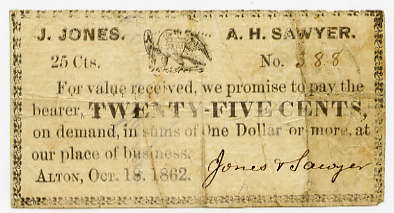
In the 1930s, following the collapse of this phase of capitalism, farmers in the South and West of the US again responded by producing their own currencies, known as 'scrip issue'. Nobel Prize-winning economist Irving Fisher supported this development, as did Upton Sinclair in California. His End Poverty in California movement promoted scrip issue as a means of exchange between co-operatives.
In the US today complementary currencies are more about ecological imperatives than poverty, but from Berkshares to Ithaca hours they are providing inspiration and underwriting alternatives livelihoods.
Given this history we should perhaps not be surprised that last week FBI agents raided the offices of the Liberty Dollar in Evansville, Indiana and confiscated the precious metals used to back this local currency. The activists who created it are reacting against the link between the dollar and global hegemony and war, as well as sharing the general loss of confidence in the dollar as reserve currency. Confidence in the dollar is falling globally and several of the nations who are bankrolling the US by buying government bonds could pull the plug on the whole US economy at the time of their choosing.
Aside from control there are sound financial reasons why bankers wish to keep control of the issue of the money we need to function in a complex economy. Conall Boyal has calculated that, if the Chancellor took the seignorage on money created by private banks there would be an extra £80bn. in the UK kitty. At present this money stays as bank profits. See more here: http://www.conallboyle.com/housing/SeigniorageBromsgroveoct07v2.ppt#22
Tweet20 September 2007
Dramatic Demise of King
Journalists who are referring to the appearance of Mervyn King before the Treasury Select Committee later today as 'theatre' are for once not over-dramatising. His inevitable humiliation by the bankers can be seen as the culmination of the second act of a tragedy we all share in. The end of the first act was the appearance outside No. 11 of Chancellor Norman Lamont in 1992.The ashen hero, brought low by his hubris, enacted a classic moment from Greek tragedy. He had overestimated his power and faced humiliation. His efforts to prove that the British government was in control of the British currency in fact proved the reverse: since financial deregulation and the globlisation of currency trading the large players in the markets are more powerful than governments.

So what can we expect to happen to Mervyn King today? He appears to have become a victim of his own economic theories, failing to see that phrases such as 'moral hazard' have always been merely fig-leaves to cover the political manoeuvrings of the dominant forces of capitalism. It is the owners of capital who really control the economy not the espoused objective and neutral forces of the market. When King refused to allow the banks the extra money they demanded surely his fate was sealed.
The agent provacateur of this drama appears to be another former Chancellor, Kenneth Clarke, who has been sharing his avuncular opinions across the range of media outlets. Views on why him, and what his game is, would be welcome.
Meanwhile focus on the need to change the 'tripartite' regulatory system is misplaced. Rather we need a system where politicians have the courage to take back political control over the monetary system, and to replace money creation by banks, as debt, with a system where government spends money into circulation for the public benefit. A truly creative solution would link this to carbon rationing and both a business and individual carbon trading system. Tweet