After Bush it was a relief to have in Obama a US President who was witty, urbane and physically attractive. However, in policy terms I think we have to admit that he has been an utter failure. US citizens need a President who can stand up for them, as Roosevelt did in the 1930s, but the US seems like a state utterly captured by financial interests. Although we will never know what happened around the Camp David hearth, we can be sure that the pressure was on Merkel to provide more cash for the vulture financiers.
It has been embarrassing in recent days to see the self-created powerlessness of our 'leaders', as one after another they call for a plan to tackle the exhausting and debilitating crisis. The absence of leadership results from the obvious fact that what is needed is a political challenge to the power of finance, while all our politicians are utterly in hock to those same financiers. The only solution to this crisis is to be honest about the gap between the real economic value of the world's economies and the phoney book value, and then to negotiate an arrangement to bring these back into balance. This would mean huge losses for all those who control the financial value. This is why it never reaches the negotiating table. Instead we have political performances of terror and concern, which are intended to soften us up for the next round of ruthless exploitation and loss of social and democratic rights. I put forward such a plan last summer, and it still seems just as relevant today.
This weekend 20,000 European debt audit campaigners have been camped and demonstrating in Frankfurt, the heart of European financial power and home to the European Central Bank. They have a simple platform of demands: refusal to accept a fiscal pact that puts finance in control and sidelines democracy and the needs of ordinary people; expression of solidarity with the struggles of the people of Greece and support for the political platform of Syriza; and rejection of the way that the debt crisis is being used to usher in the next phase of neoliberalism, that is to say financialisation and the sale, at often low prices, of public assets. Their call is for a thorough audit of all European public debts and state assets so that a real negotiation can take place about what the value of the economics is and how it can be fairly shared.
.
Tweet
All other green campaigns become futile without tackling the economic system and its ideological defenders. Economics is only dismal because there are not enough of us making it our own. Read on and become empowered!
Showing posts with label financialisation. Show all posts
7 July 2011
Rule of Law is that Money Talks
The term financialisation has been coined to describe the process where, in late capitalism, all systems of values have been hollowed out and money alone remains the driving-force of economic and social life. The Skygate saga demonstrates clearly the distorting effect this process has on political life.We are receiving our information about the nefarious activities of News International employees through the lens of the media and so it is inevitably distorted. The focus has, as so often, been cast away from the political and onto the personal. From sordid to disgraceful, the adjectives available to describe a person who would profit from the grief of the parents of a murdered child have grown tired with use. Yet this is not the most serious aspect of the current crisis: that lies in the way the media barons, led by Murdoch, have undermined our democracy.
Our politicians make the laws. Rupert Murdoch's minions have gained control over those politicians by illegally acquiring information about them through hacking into their phone messages. So we have no laws to constrain the the media or to limit them to the role appropriate in a democratic society. Such a claim was made by Adam Price, who later withdrew from public life, although his blogs on the subject are useful evidence. His rhetorical skill and political insight singled him out amongst our dreary politicans - was his decision to quit another proof that the rotten alliance between media and power is destroying the health of our democracy?
Our police should enforce the laws, yet for years it appears they have been bribed by News International: through wining and dining and the open payment of cash for stories the police have been bought by the media. Can we still believe that they are 'our' police, enforcing the laws on 'our' behalf. The Jo Yeates case is just the latest where the interests of justice have been sacrificed to the interests of media power and profits.
This post may seem inappropriate to a blog dedicated to economics, but it is not. The theory of financialisation predicts exactly this sort of behaviour in response to a process where values are lost and only money remains of importance. A public enquiry into the behaviour of our newspapers and broadcasters will not solve these flaws in our democratic system: only a fundamental restructuring of our economic system can do that.
. Tweet
Labels:
Adam Price,
financialisation,
Jo Yeates,
News International
16 May 2011
Something rotten?

To the plethora of three-letter acronyms that infest the discussion of finance has been added another. Alongside the CDO and the CDS we now have to contend with the DSK. Like the others the outward power and appeal of the DSK has given way to doubts about its inherent quality. We are led to question whether, behind the impressive facade, it may be toxic.
We must, of course, respect the presumption of innocence, but even if Strauss-Kahn is eventually cleared over the sexually aggressive charges against him now, the scandal has brought into the open his past sexual conduct, which I am old-fashioned enough, and perhaps Anglo-Saxon enough, to consider undermines his suitability to hold the most powerful office in the world of global finance.
It has been clear for some time that what is happening in the world's banking system has passed beyond the stage where we might consider that there is merely something rotten. The whole system is corrupt, dishonest and socially destructive. The fact that its figurehead personifies these qualities, while revelling in the sort of lifestyle that is an insult to the working people in countries the IMF is supposed to be aiding, just reinforces the sense of hypocrisy. There is no glee at this scandal but a growing sense of disgust that we have been betrayed by those in whom we have entrusted power.
The process of ‘financialisation’, a term coined by social scientists to describe the way that relationships mediated through finance have penetrated more and more areas of life, is the hallmark of contemporary capitalism. Money is exalted until social and economic institutions are hollowed out of other values, with finance taking up all the space. Whether we are thinking of pensions and mortgages, or football and the music industry, the greed and immorality of the world of finance has spilled over into most areas of modern life.
The fall of Strauss-Kahn has left two huge voids: at the IMF and in French politics. It is an indication of how desperate the stakes are that I am rather hoping that Gordon Brown may finally be given the chance to achieve his life's hopes by taking over at the world's central bank. I have long since given up hope that he would then reveal his colours as a former communist and have the courage to take political control over the disaster that an the private operation of capital has engendered, but at least he seems to have maintained a sense of moral purpose rather than being dazzled by wealth.
In French politics there may be another interesting outcome. Because of the double ballot system used for French presidential elections, the left must coalesce around one candidate, who need not necessarily come from the socialist party. Eva Joly, who has already proved herself capable of standing up to the might of the oil and finance industries, is likely to be the candidate from the Green Party. Given the disarray that DSK's fall has created in the socialist party, perhaps Joly will be the beneficiary, giving her the chance to compete directly with Sarkozy to lead the country.
. Tweet
Labels:
Dominique Strauss-Kahn,
Eva Joly,
financialisation,
Gordon Brown,
IMF
21 June 2010
Equitable Life
In so many of the areas that are now the source of public debate, the money system is being used to conceal a sleight of hand that transfers the value created by working people into the bank accounts of the wealthy. This is true of the pensions system, so before we listen to the pronouncements and proposals of the politicians charged with persuading us to suffer poverty in our old age, we should remember how we reached this situation we are in.
In The Future of Money, Mary Mellor anatomises the switch from public and company pensions to private pensions as part of the financialisation of life in the UK during the 1990s. Bribed with their own money on the up-swing of the capitalist business cycle, many were persuaded to leave company schemes, forsake the contributions made by their employers, and join the short-term orgy that was people's capitalism. Working people who had historically prepared for their old age through mutual savings and friendly societies became competitive individualists.
In reality, becoming involved in the money game as a punter was always going to be a mistake, dependent on the mistaken assumption that money has some independent value. The whole debate is couched in terms of putting away money now to spend later. But what is important in our old age is the existence of good public services and people to care for us. Accruing extra cash may put you ahead in the competition for these as they dwindle under right-wing governments, but being part of a society that takes responsibility for social welfare for ethical reasons is always going to be a better protection.

So how might we think about pensions in a balanced and grounded way? In the figure I have illustrated a person's productivity curve over their life-course. When the curve is below the line the person is in commitment to the community, receiving more than they contribute; above the line the reverse in the case. Give or take a few years for earlier retirement or more time spent in education, each person is in the workforce for 40 years, or around half their expected lifespan. The curve might look different for people with physical vs. intellectual employment, and for those with a special call on society, because of illness or disability, for example.
The conclusion is a simple one: we spend half our lives being productive and the other half relying on other members of our family, group or society. Since we are all in the same position we can abide by the Golden Rule and contribute more in the time we spend above the line for the benefit of those below the line, knowing that one day we will ourselves be below the line and that members of our own family group are in that position right now.
Bearing this image in mind we can now try to compare the security offered by two contrasting schemes: a private pension scheme and the teacher’s pension scheme. In a company scheme your money is used to buy stocks and shares. You security is based on the schemes of Darth Trader and his colleagues in the Square Mile, whose activities are routinely discussed in academic economic papers as examples of irrational behaviour. You are relying on your ability to gamble effectively now, to make yourself secure in 20 or 30 years’ time.
The Teachers’ Pension, by contrast, is a real-time scheme. The contributions I make every month pay for the pension of teachers who are now retired, my mum for example. So I only have to bet on the fact that, when I come to retirement, people will still be having children and teachers will still be being paid to educate them. This seems a much safer bet than the stock-market. At a larger scale, of course, this is exactly how a properly funded state pension system would work.
We may see in our fear about pensions a projection of the selfishness that is encouraged in a capitalist society. We know that all our miserable lives we have only been storing up material value. We have not been establishing the relationships of trust and love with our friends or our children that will enable us to live comfortably in dependence on them. We have fallen into the economist’s trap of turning all relationships into financial relationships, increasing our children’s allowance to make up for the fact that we have no time to spend with them, for example. Unlike the older people of more traditional societies, we know that when the emotional balance-sheet is tallied we will be in serious debt. We will have no hope except our money. Tweet
In The Future of Money, Mary Mellor anatomises the switch from public and company pensions to private pensions as part of the financialisation of life in the UK during the 1990s. Bribed with their own money on the up-swing of the capitalist business cycle, many were persuaded to leave company schemes, forsake the contributions made by their employers, and join the short-term orgy that was people's capitalism. Working people who had historically prepared for their old age through mutual savings and friendly societies became competitive individualists.
In reality, becoming involved in the money game as a punter was always going to be a mistake, dependent on the mistaken assumption that money has some independent value. The whole debate is couched in terms of putting away money now to spend later. But what is important in our old age is the existence of good public services and people to care for us. Accruing extra cash may put you ahead in the competition for these as they dwindle under right-wing governments, but being part of a society that takes responsibility for social welfare for ethical reasons is always going to be a better protection.

So how might we think about pensions in a balanced and grounded way? In the figure I have illustrated a person's productivity curve over their life-course. When the curve is below the line the person is in commitment to the community, receiving more than they contribute; above the line the reverse in the case. Give or take a few years for earlier retirement or more time spent in education, each person is in the workforce for 40 years, or around half their expected lifespan. The curve might look different for people with physical vs. intellectual employment, and for those with a special call on society, because of illness or disability, for example.
The conclusion is a simple one: we spend half our lives being productive and the other half relying on other members of our family, group or society. Since we are all in the same position we can abide by the Golden Rule and contribute more in the time we spend above the line for the benefit of those below the line, knowing that one day we will ourselves be below the line and that members of our own family group are in that position right now.
Bearing this image in mind we can now try to compare the security offered by two contrasting schemes: a private pension scheme and the teacher’s pension scheme. In a company scheme your money is used to buy stocks and shares. You security is based on the schemes of Darth Trader and his colleagues in the Square Mile, whose activities are routinely discussed in academic economic papers as examples of irrational behaviour. You are relying on your ability to gamble effectively now, to make yourself secure in 20 or 30 years’ time.
The Teachers’ Pension, by contrast, is a real-time scheme. The contributions I make every month pay for the pension of teachers who are now retired, my mum for example. So I only have to bet on the fact that, when I come to retirement, people will still be having children and teachers will still be being paid to educate them. This seems a much safer bet than the stock-market. At a larger scale, of course, this is exactly how a properly funded state pension system would work.
We may see in our fear about pensions a projection of the selfishness that is encouraged in a capitalist society. We know that all our miserable lives we have only been storing up material value. We have not been establishing the relationships of trust and love with our friends or our children that will enable us to live comfortably in dependence on them. We have fallen into the economist’s trap of turning all relationships into financial relationships, increasing our children’s allowance to make up for the fact that we have no time to spend with them, for example. Unlike the older people of more traditional societies, we know that when the emotional balance-sheet is tallied we will be in serious debt. We will have no hope except our money. Tweet
22 March 2010
Come On You Reds!

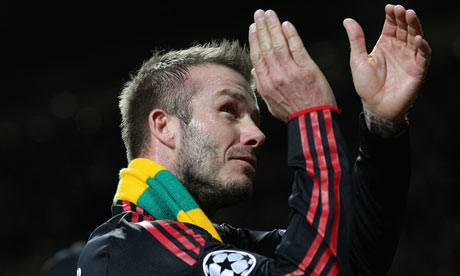
It was this image of David Beckham, wearing the green-and-gold blazon of the gathering campaign against the ownership of Manchester United by the Glazers, which made it clear to me that the move towards football supporters' trusts was more than a minority sport to warm the hearts of those of us on the mutual fringe of economic life.
Here is evidence that capitalism has overplayed its hand. The working men of this country ignored the way it destroyed their workplaces, their families, even the music they enjoyed. But now it is serious: now it has reached the place closest to their heart. Capitalism is destroying football, and that hurts. The billionnaires who have moved into the game are wrecking the sport, but also wrecking our football clubs as businesses.
Marx theorised the commodification of aspects of life that we value as being central to the social process of alienation. The products of our labours are usurped by the owners of capital who employ us, and something of our essence is stolen too. 21st-century capitalism extends this process by what is known as 'financialisation', so that every aspect of economic life is hollowed out, its meaning being replaced by the empty token of money. In work we see the hegemony of the accountant; in music the rise of the manufactured band.
But it is for football that people are apparently prepared to stop whingeing and take action. New research commissioned by Co-operatives UK indicates that 83 per cent of Manchester United fans and 72 per cent of Liverpool fans thought their club would be better off as a co-op. The YouGov poll found that 56% of all the football fans who gave an opinion agreed. Manchester United fans were willing to invest about £600 each, which could raise the £2.34bn. needed to buy the club.
The latest plan afoot to save Manchester United from becoming a hollow icon has been inspired partly by the example of Barca - always a co-operative and arch-rival to the formerly pro-Franco Real Madrid, who Beckham chose to play for - which has always been a co-operative. The 'Red Knights' plan to raise investment finance to buy the club and then sell shares to its own fans. Whether they seek to gain from this financially is hard to assess, but we might hope that the sense that ownership matters it brings could spill over from the terraces into the workplaces of this country. Tweet
Subscribe to:
Posts (Atom)