Showing posts with label climate change. Show all posts

14 December 2013

Bursting the Bubble of Carbon Finance

The idea of a carbon bubble first came to my attention when I was researching a submission to the Environmental Audit Committee's Inquiry into Green Finance on behalf of the Green House thinktank. Anmongst other questions they asked:

'How effective are the financial markets in matching available finance to the required investment in renewable energy and other green projects? To what extent is a potential “carbon bubble” a real risk?'

They referred those providing evidence to a page from the seemingly well funded Carbon Tracker project which seeks to quantify the over-valuation of what they refer to as 'stranded assets'. The project seeks to put a value on the carbon-related assets that cannot be realised if we seriously address the issue of climate change. Once we introduce rigorous carbon limits the fuel their value relies on becomes unburnable and therefore the value is lost. Carbon Tracker reports frighteningly large numbers of potentially stranded assets: they take a value of $4trillion in 2012 that is used servicing $1.27trillion in outstanding corporate debt.

The frightening way of framing of this discussion is that once the over-valuation is recognised it could precipitats another collapse in financial markets and another financial crisis. This always seemed to me hugely naive suggesting that the rich and powerful who control these assets would permit political decisions on climate change to destroy their value. It was in this vein that I responded to the EAC inquiry:
 
'The idea of a "carbon bubble" assumes that legislation passed in the wake of concern about climate change to limit carbon dioxide emissions is more powerful than the political influence of fossil-fuel companies. While we would like to believe that this is the case we suggest that it is a rather naive position. Is it not more likely that, if energy companies find themselves with quantities of fuel that cannot be burned within existing carbon limits, they lobby to have those limits changed rather than allowing their investments to be diminished? We suggest that the EAC is in a strong position to generate evidence on this to prepare for such lobbying.'

Then I simply forgot about the debate. What brought it to my attention again was the machinations of self publicist MP Jacob Rees-Mogg and the internal Tory party debates about green crap and green levies. As I blogged earlier, it seems fairly apparent that the concern of Tory grandees is for their own assets and not shivering pensioners. Here we see the playing out of the political end-game of climate change. The post-fossil world is one of community-owned energy and economic liberation, so there is no surprise that climate change is a battle based in political economy rather than science.

The discussion about the carbon bubble issue has become a dialogue of the deaf between holders of carbon-related assets and those who are fearful about The Financial Crisis round II. How refreshing it was, therefore, to be at the Compass Youth meeting on this issue at Portcullis House last week. Although the meeting itself was advertised in a fairly scary way, through debating the issue we discovered that in reality we may not be facing a catastrophic economic collapse but an orderly transition to a post-fossil future matched by a gradual reduction in the value of carbon-related assets.

In a strange way it is even encouraging that Bloomberg recently launched their carbon risk valuation tool. Investors and those who serve them seem unconvinced by the Tories' dinosaur protection plans and appear to see the wind is blowing in the direction of renewables. And we can all play our part here by encouraging those who hold our assets, whether our pension funds, universities, or local authorities, to divest from carbon assets just as they have or should have divested from assets relating to tobacco, alcohol and arms.

.

4 November 2013

A New Carbon Budgeting Tool

A guest post from Aubrey Meyer of the Global Commons Institute

In the light of the positive attention to 'Contraction and Convergence' shown by the Gaian Economics blog, please may I introduce you to CBAT, the 'Carbon Budget Analysis Tool'.

CBAT is the latest phase of C&C development: and is intended to be useful now that - following the IPCC's Fifth Progress Report (AR5) - 'carbon-budgeting' seems finally to be on the agenda.

For example, the analysis tool quickly shows the IPCC AR5 Contraction-to-Concentrations results as a result of the UK Climate Act (UKCA). This particular piece of analysis shows the emissions-budget-integral in the UK Climate Act is either: -
[a] twice too much (and that's without the feedbacks) or
[b] just a third too much or
[c] just right
This really gives one something to chew on over regarding IPCC's stated '1,000 Gt C' maximum for two degrees!

Its also interesting to see/play that combined that with contraction-convergence-rates CBAT Domain Two. 
CBAT Domain Two perhaps explains why the prescribed global convergence date of 2050 in the UKCA was so inflammatory at COP-15. The convergence to equality by 2050 in the UKCA was something of a fig-leaf and using CBAT D2 animation quickly shows that. Its quite an eye-opener i.e. convergence by the time 80% of the budget has been used up makes no real difference at all.

GCI has always modelled that convergence for any rate of global emissions contraction should be at a negotiated in the light of 'historic responsibilities'. Subject to the UNFCCC-compliance rates of Contraction and Concentrations in D1, the animation D2 clearly shows the maths sub-division of this.

The CBAT is open to consultation and amendment so please take some time to look at it and comment on it. So far some others have and said supportive things, which is encouraging which are available on our website.
.

6 August 2013

No Fracking Way

I try not to be too party political on this blog, but it will hardly have escaped notice that I am the Green Party's Economics Speaker and that I have been selected as the top candidate for the south-west for next year's European Elections. So I will be seeking votes during this year, although I hope this will not affect the focus of the blog too heavily.The reason I stand for election is because I would trust myself to make the right decisions for the right reasons more than a member of any of the other parties. Unless you have decided that democracy is so corrupt that it is best avoided, a position I think has been created and is being reinforced by the corporate lobby, then you will end up having to make a choice next year and the following year.

Which brings me to the purpose of this blog: to express my utter disgust at the prospect of the fracking industry turning into some sort of Wild West boom in our pleasant countryside as it has in the US, and to explore how the other parties are reacting to the possibility of fracking. The evidence is that all three parties that make up the corrupt political establishment are supportive of this new, dirty and expensive fossil fuel. In their world, where economic growth is the holy grail and profit is king, bizniz must chase after this next opportunity to make money and we must bear the cost in our communities.

I am starting from my backyard because it is the part of the world I feel responsible for protecting. I grew up in Bath and brought up my own children in Blagdon, in the Mendips, so I found to my horror that licences have been granted all round that area, seeking to exploit the gas reserves in what was once the Somerset coalfield. The local campaign group Frack Free Somerset have provided a map of the licenced areas and also a list of suggested actions you can take.

The economics of fracking demonstrate the extractive and exploitative approach to everything of value typical of capitalism. Licences to what are natural resources, and therefore in my book a common heritage, are auctioned by the Department of Energy and Climate Change. The prices look absurdly cheap to me, which probably explains the glee with which the energy industrialists are pushing forward with fracking. Cuadrilla's licence to destroy the Forest of Bowland in Lancashire cost just £160m. for an area of 450 square miles between Blackpool and Preston. There are tax breaks too: Britain will have the lowest tax rate for the fracking industry anywhere in the world, with a tax break called the 'shale gas allowance' more than halving the tax payable from 62% to 30%. This is one of Osborne's wheezes to make the economy boom in the run-up to the 2015 general election, and our local environments will bear the cost.

With their friends and relatives in the oil industry and advisor Lynton Crosbie also having strong links to the oil and gas industry we should not be surprised that the Tories are supporting fracking. What about their partners the Liberal Democrats, those well known supporters of all things enviromental? When he spoke at the end of the last parliamentary session, Treasury Secretary Danny Alexander could hardly contain his excitement at the prospect of so much money to be made. It was Alexander who announced the bribes for local communities, which are in fact paltry compared to the profits to be made. For a mere £100,000 and 'at least 1 per cent' of overall revenues undefined 'communities' are lured into selling the birthright of their grandchildren. Unsurprisingly, where profits are concerned it turns out that it is not we who are the 99%.

As befits a party seeking election within the next 18 months, Labour has been less sanguine about the prospects for such an unpopular and exploitative industry. Back in June 2011 Labour's energy spokesman Huw Irranca Davies called for a temporary moratorium while a review on safety was undertaken. His replacement as shadow energy minister, Tom Greatrex, continues the line of the need for better regulation rather than opposition to fracking in principle. In an interview with Business Green he argues explicitly that 'an absolutist position' is not in our interest, so we cannot expect opposition to fracking from Labour, whose opposition is avowedly conditional.

Aside from the planetary pollution there is also the certainty of more local environmental pollution. Fracking is a vile industrial process that uses toxic chemicals that will contaminate our land and our water supplies. It is entirely inappropriate in our small island. It will set back the attempts to reduce our climate-damaging carbon emissions, which were already failing due to inconsistency and attempts to revive the economy through boosting energy-intensive consumption. But it also provides a way of avoiding the fundamental changes to our lifestyles and industrial processes that we know are ultimately necessary. To support fracking is like a parent encouraging their child to eat more sweets and drink more fizzy drinks while at the same time telling them that they need to lose weight.

So, you know where I am going, and I at least have the excuse of having made this clear from the start. If you really want a party that will oppose fracking as part of a consistent policy to reduce energy use and undertake a transition to a fossil-free future you know what to do. The Green Party stands against fracking. Caroline Lucas's rousing speech this past weekend at Balcombe makes the arguments clear, but in case you think we are jumping on a bandwaggon you can also watch her demolish the greedy pro-frack apologist on Newsnight in March 2012, while successfully putting Paxman in his place. As she argues, fracking will divert effort and investment from the expansion of renewables that is so urgently needed. It is dirty and dangerous to our health: we must stand together to oppose it.
.

5 August 2013

Climate Change and Cognitive Dissonance

The most recent edition of the British Social Attitudes survey has some interesting findings for those of us struggling with the cognitive dissonance that characterises public policy towards climate change. While the government may be chasing after the dollar with heedless disregard for the future of the species, for example by relentlessly increasing the cost of rail travel and increasing the pressure for new airport capacity, the British people are actually convinced that climate change is happening (76%) and that transport is a major factor contributing to our impact on the climate (although this percentage is down from 80% seven years ago to 65% today.

It is clear, however, that the failure of political leadership in the field of transport policy is affecting public opinion. If the government produces farcical and trivialising messages about the impact of our transport decisions - as in the notorious example of the advice about solving climate change by driving 5 miles less per week - then we can hardly be surprised if people see little need to change their travel habits. According to the report 61% of people think that they should be able to fly as much as they like, and 18% maintain this right even if it harms the environment. Conversely 55% think everyone should reduce their car use for the sake of the environment, but 47% see no point in doing so unless others do the same. The clear pro-car policies espoused by the Tory-Lib Dem government are a clear signal that others are not expected to do the same and therefore, in themselves, undermine the motivation of the socially and enviromentally conscious half of Britain.

What emerges from the data around the perceived impact of transport decisions is that they are driven by the nature of media and political messaging rather than by the scientific evidence. As we passed the spine-thilling 'milestone' of 400 parts per million of carbon dioxide in the global atmosphere earlire this year, the percentage of people in the UK who stated that air travel has a serious impact on climate change returned to its 2005 level (64%), before all those warnings about how climate change is more threatening than global terrorism. And the percentage thinking that car use has an impact on climate change had fallen significantly from 77% in 2005 to 66% in 2011.

Human beings are not rational and we are not scientific. We respond to social pressure and to our desire to feel loved and experience pleasure. If people enjoy their two weeks in Thailand enough they can easily convince themselves that this has no impact on the lives of their grandchildren; they can walk the line of cognitive dissonance just like the government does. Many of us have already chosen to abandon flying and driving and live in communities where it is already unfashionable and socially unacceptable to fly casually and frequently. But more important is the need to redouble our efforts to emphasise this as a political message about renationalising railways and reducing the need for car journeys to school or work, because changing our attitude towards travel is a vital political issue rather than a personal lifestyle choice.
.

5 January 2013

Evolution become Conscious


Following up on my earlier post about 'joining the evolution', Michael Dunwell, my fellow green economist from the Forest of Dean, writes to tell me that Teilhard de Chardin thus described the human race in his book The Phenomenon of Man, published posthumously in 1955. It prompts me to post a talk I gave at a seminar in London on Europe Beyond Growth shortly before Christmas.

I’m going to start by saying something about science. On Monday I listened to Evan Davies interviewing fisheries minister Richard Benyon about his decision to oppose the latest EU fisheries proposal which Benyon claimed he was doing ‘on scientific grounds’. Davies brought in the top fisheries scientist from Defra, who argued for the EU proposal. Evan Davies seemed genuinely perplexed by the inability of the scientists to agree. He was seeking a ‘right’ answer, that was scientifically proved and unassailable.

Years ago I put together a report called ‘I Don’t Know Much About Science But I Know What I Like’. It’s Martin Amis’s joke but I’ve always enjoyed it. The reason I enjoy it is that it achieves with wit and brevity the task of challenging the right of science, usually in this context meaning statistical evidence, to trump other forms of thought.

Caroline Lucas has said that we are going to be the first species that is able to scientifically monitor our own extinction. Consecutive reports from the IPCC suggest that she is right about this, but I am a bit more optimistic. My optimism organises itself under my latest personal mantra: ‘Join the Evolution’ and it works like this.

We are unique in being a self-conscious animal. When other animals receive indications that they are reaching the limits of their evolutionary niche they respond to these by finding a new niche, or by failing to reproduce, or otherwise by ensuring that their numbers decline. As humans we are too clever for that. We can use our clever minds and our technology to keep pushing the boundary outwards, ignoring and filtering out the clear evidence that the ecological safety-limits have been exceeded.

So as a self-conscious animal we need to evolve self-consciously. We need to find a way to get a collective grip on ourselves, to stop believing our own fantasies, to get back down to earth. This is what I mean by ‘joining the evolution’,  and I would argue that it is a desire to do something like this that has brought you here today.

So I have nothing against science, and I think being able to prove that resources are not limitless and have some idea of the scope of the problem we are facing is vitally important in convincing those trapped in the scientistic mind-set. But it is not going to save us. We need much more human solutions to do that.

23 November 2012

Life without the Car

For my generation the car represents freedom and I am struggling to evolve. I spent an exhausting six weeks without my car some years ago. It meant a lot of cycling in the rain and a greatly reduced social life, since I live in rural Gloucestershire where there are no buses after 6pm or on a Sunday. Now I spend some of my life in London and my daughter has left home I am inspired to try again. The difficulty of overcoming the indication is made clear by the fact that, since my car broke down more than a month ago, it has been sitting on my drive. I will not get it mended but I cannot give it up.

How cheering it was, then, to find a short film that indicates how little younger generations are attached to the car. This emerged from some teaching I did at Masaryk University in Brno. The students were asked to make a film about any aspect of 'green economics' and one group chose reducing their carbon footprint. The university is internationally focused and so they were able to interview students from across the world, asking them which of a number of energy-balanced aspects of their lifestyle they would sacrifice to reduce their carbon footprint.

Of course this film was made in Brno, where the trams are a delight and the transport system is integrated in terms of timetables and ticketing. And these young people do not yet have children and are still for the most part energetic and healthy. But what cheers me most is that for people of this generation the car is no longer a symbol of freedom or a source of glamour. As a recent episode of Costing the Earth reported, young people no longer find psychological satisfaction in car ownership in the way we did: bikes and buses are cooler than a shiny set of wheels.
.

9 July 2012

Climate Justice

The Joseph Rowntree Foundation is to be congratulated on funding a range of research programmes that tackle head on the justice aspects of climate change. It is clear that within a market framing the wealthy can respond to carbon taxes or rising energy prices by changing their spending decisions; it is the poor who could suffer significant threats to the quality of life, and even their health. Those on fixed or falling incomes, especially the elderly, may not survive if they are forced to cut their fuel bills and not supported with energy-efficiency home improvements.

I already blogged about an excellent piece of work by Thumim and colleagues at Bristol University which explored the relationship between wealth and carbon emissions. Another piece of research under the same funding programme and carried out by the Fabian Society has recently been published: this time the focus is public attitudes to climate change and justice. The researchers challenge the policy focus on individual behaviour change and the emphasis on a consumer paradigm. They suggest that communitarian motives may be more effective in changing behaviour in pro-enviroment directions.

The most important findings were that:
  • Those who could most easily afford to reduce their CO2 emissions should be asked to carry the greatest burden of reduction;
  • That there should be compulsion to reduce household emissions, since individual decisions risked increasing mistrust that others' were not pulling their weight and hence reduced everybody's motivation to tackle the problem;
  • That members of the focus groups preferred regulation (i.e. outright bans) to taxation-based incentives.
 Unsurprisingly, the researchers also found that they were unwittingly involved in 'action research', that is to say that the research itself changed the attitudes for the members of the focus groups, who became more concerned about climate change and more supportive of environmental policy as a result of discussing these issues in small groups. This flies in the face of the emphasis on individual behaviour change and the politics of nudge that, together with the commodification of nature, is the main focus on official policy for the environment.
.

18 June 2012

Damned Lies and Carbon Statistics

What a contrast there is between the attention paid to the first Rio conference and the low profile of the 20-year follow-up which comes to a head this week. I have already posted to raise the question of whether the carbon emissions of our politicians are worth the investment, when it seems that so little political progress is going to be made. What can explain the great difference in interest between the two conferences, especially when almost all the indicators of ecological crisis have become far more urgent since 1992?

First, I think we must not forget the huge vote for the UK Green Party in the 1989 European Elections. This indicated to politicians that people do care about the environment, but rather than introduce the hard-edged policies necessary to constrain the corporate economy, the politicians managed expectations and allowed the corporations to take over the green economy even before it was defined.

Secondly, we must not be naive about the vast amount of lobbying and deliberate confusion that has been caused. Today's launch of a report from the Green House thinktank indicates clearly that the claim that our greenhouse gas emissions have been falling since the first Earth Summit is a deception. Two of the most significant sources of CO2 emission are simply left out of the calculations: those caused by air transport and freight shipping; and those embodied in consumer goods we import.
 If you put these and a few other sources of emissions that have been discreetly tidied away back into the picture it looks like this.

It is clear that emissions are continuing to rise. It can't have escaped the notice of Kyoto negotiators that these were the fastest rising sources of emissions, and omitting them from consideration is, as the report notes, rather 'like a chocoholic going on a calorie controlled diet and deciding not to
include chocolate'. The explanation can only be the result of significant, powerful and ultimately destructive lobbying on the part of those who profit from the global trade in goods and the massively increasing amount of air travel.

7 June 2012

Flying Down to Rio

World leaders are gearing up for their trips to the global environmental conference in Rio later this month. With so much bad news around who could resist a little climate grand-standing? The suited heros will stride the world stage comparing the size of their green stimulus packages. Civil servants will spend hours preparing documents demonstrating reductions in CO2 emissions, despite the fact that a report soon to be launched by Green House thinktank includes clear evidence that, if you include aviation and freight emissions that are left out of the Kyoto totals, and especially if you include the emissions embodied in our imports, then we are polluting more and not less.

And what of the carbon impact of the conference itself? The admittedly rather primitive calculator provided by the website Flying Off to a Warmer Climate suggests that a business flight to Rio generates around 3,000 tonnes of carbon dioxide with a warming equivalent of around 10,000 tonnes. (The warming impact from aviation is higher because the emissions are produced high in the atmosphere.) This is more than two years' worth of an individual's total carbon emissions. And that is just Ed Davey. What about his civil service retinue? I can imagine a situation where, if these high-level negotiations were serious, this production of CO2 could be justified, but the kind of hot air that will be produced in Rio just does not deserve this level of planetary warming

It is a times like this that I wonder whether there is a God, but the constant stream of cosmic jokes and coincidences restores my faith. Not only does God exist, but she has a great sense of humour and wonderful timing. In 1933, some four years after capitalism's last world-wide catastrophe, and during a similar burst of cultural escapism, RKO made the film Flying Down to Rio. The film, which starred Ginger Rogers and Fred Astaire, included a range of crazy scenes with tiller girls high-kicking on the wings of planes that seemed so novel and glamrous in the thirties. This has provided the inspiration for the wonderful cartoon by Imogen Shaw that you are invited to share far and wide.
.

11 December 2011

Make the Rich Pay for their Emissions

An excellent funding programme from the Joseph Rowntree Foundation into the social impacts of policies to address climate change is beginning to bear fruit. They have created a microsite to make the findings available.

As well as the more conventional investigations into the impact on poorer households of rises in energy bills, a research team based in Bristol and Oxford has produced data about how responsibility for CO2 emissions is shared across the socio-economic classes. Put more bluntly, to what extent can we blame the rich for climate change as well as for inequality?

The primary finding is that:

'Mean average CO2 emissions are strongly correlated with income: households within the highest equivalised income decile have mean total CO2 emissions more than twice that of households within the lowest equivalised income decile. Emissions from private road travel and aviation account for a high proportion of this differential: aviation emissions of the highest income decile are more than six times that of the lowest income decile.'

In other words, the concerns that are often raised about alienating those who fly to Ibiza for a summer holiday by introducing aviation taxes are quite misplaced. It is the rich who jet around the world for conferences and business meetings who are most responsible for aviation-related CO2 emissions.

The figure represents mean annual emission of carbon dioxide from all sources across the income deciles. As we move from the lowest 10% to the wealthiest 10% there is a clear increase, class by class, in the amount of CO2 emissions that are produced. More importantly, a larger proportions of the emissions of the richer people in our society are transport related.

The policies implications are clear. Using household energy bills as the focus of increasing the cost of carbon is not only regressive but will also be ineffective:
'if household carbon reduction policies addressed all transport emissions as well as those from household fuel use, there would be far fewer low-income/high-carbon households, and policies which placed a cost on carbon itself would be likely to be more progressive.'
.

10 May 2011

Will the UK Abandon its Climate Targets?

During the past year we have seen the painful exposure of the political strategy of a party that has thrived by promising all things to all people. Now that the Liberal Democrats have had their bluff about coalition government called, we see both their opportunism and their political incompetence exposed to full view. This is by turns hilairious and tragic for the party but leaked documents about cabinet splits over climate change policy suggest that it may soon prove tragic for the country and the world. These documents suggest that the Tory government, in its desperate drive for growth, is seeking ways to avoid the strict carbon dioxide emissions targets enshrined in law by the previous Labour government.

The Climate Change Act, which became law in November 2008, was a recognition that climate change is too important an issue to be left to the vagaries of the electoral cycle. It included two important provisions. First, 'a legally binding target of at least an 80 percent cut in greenhouse gas emissions by 2050, to be achieved through action in the UK and abroad. Also a reduction in emissions of at least 34 percent by 2020. Both these targets are against a 1990 baseline.' To remove the temptation to avoid these strict targets the bill also established a Committee on Climate Change, with a particular remit to ensure that the law was being respected.

It would appear that this committee is becoming nervous about a battle within the cabinet over the tension between the CO2 emissions reductions and the desire to reboot the destructive growth cycle. This follows the leak of a letter from Business Secretary (and ex-chief-economist at Shell) Vince Cable to Energy Secretary (ex-anti-nuclear, ex-merchant banker) Chris Huhne. Cable challenged the Committee's attempts to reduce CO2 emissions as a threat to economic growth.

The fact that the CCC is leaking to the press is a sign of how serious the situation is. This is hardly a radical green outfit: the list of its members indicates the usual selection of ex-business and conventional science establishmentites. But they find themselves at the sharp end of the tension between pro-growth economics and the climate reductions the human race needs. The battle-lines are drawn and the issue will be decided at the cabinet meeting on Monday.

The evidence of this fight at the very heart of government makes it clear that climate change emerges from a structural problem within the capitalist economic system, as green economists have long argued. Both sides in this current spat are right: we must have CO2 emissions, but we cannot have CO2 emissions. The only was to resolve this apparent impasse is to ditch the 19th-century economic paradigm we are still suffering for the ideas of green economics that Caroline Lucas has called 'the economic paradigm for the 21st century'.
.

2 April 2011

If you want to save the species, get political

Is has become increasingly apparent during the past couple of years there is an inability amongst a wide range of people in politics and media to think about more than one issue at the same time. Since the financial crisis and the advent of deficit-vision any thought of showing concern for the environment has entirely evaporated.

In a sad report on the Transition Network website we learn the consequences of a shift in one administration from fluffy Lib Dem to market-hard Tories (that of Somerset County Council). The article quotes the authority's new hardline budget strategy: 'some services will be stopped completely e.g. climate change work, work on renewable energy, natural environment policy and delivery'. They have also sacked their Climate Change Officer. In the world of deficit-think, the environment is entirely forgotten.

The absence of any analysis around political economy was one of the criticisms most frequently made in the early days of the Transition movement, especially by academic commentators. Rupert Read, for example, made the case some three years ago that Transition Towns play a valuable demonstration role but cannot offer a sufficient response without taking politics seriously. Rob gave a spirited defence of the need for unleashing the powers of positive thinking and creative community action.

Like Rupert, and many other green politicians, I have been engaged in Transition initiatives from the start. And from the start I was well aware that any political support demonstrated by 'grey' parties who have always been adherents of the prevailing political and economic culture, whose existence relies on the power structure that is killing the planet, could only ever be partial and opportunistic. What has happened in Somerset appears to validate the view that inspiration, hard work and bright ideas, while important, are insufficient without political analysis, strategy and action.
.

12 March 2011

Why Are Nuclear Reactors Like Dangerous Dogs?


Across the world we are waiting to find out whether Fukushima is to join the list of nuclear disaster zones: a place which, once unfamiliar, becomes a household name. In spite of the familiar faces of 'nuclear experts' trailing through TV and radio studios, it is clear that nobody can answer this question. The situation is out of control and the only science that is relevant is statistics. We are in the realm not of knowledge but of chance.

As a retired anti-nuclear agitator I find it amusing to watch the Grimes and Grimston show. Their webpages indicate that both are pro-nuclear, yet their TV appearances are bravura performances of scientific disinterest and thoughtful reassurance. The emerging line is that the power-station was damaged in the earthquake, which seems to me to gloss over the fact that the reason it is in trouble is that electricity and water supplies have failed. Such failues are common even in highly technological societies, and can only become more frequent as climate change leads to more unpredictable and more extreme weather events.

But what does all this have to do with our canine companions? I have been afraid of dogs since I was a child. What made me suspicious was my instinct that they were not really domesticated. That somewhere within them lurked the potential for sudden savagery. I can still remember my rage when owners used to say blandly 'He won't hurt you'. 'He won't hurt you', I thought back, but that isn't really the point is it? Just as the owners of those dogs thought they had them under control, so the proponents of nuclear power boast of their ability to 'tame the atom'. But the release of the energy of the nuclear bond has always been a high-risk endeavour. The myth of control is undermined by routine emissions and occasional catastrophes. It cannot be any other way, which is why Greens have always opposed nuclear power.

When the unpredictability of the dangerous dog is expressed the damage is one dead child or a person with a patchwork face. These are tragedies, of course, but on a relatively small scale. The tragedies that will be caused if Fukushima is in the midst of meltdown will be far more devastating. Direct deaths will be the source of infinite debate, and may even be statistically massaged away altogether. The brave workers who sacrifice their lives to save their fellow citizens, like the Chernobyl liquidators, will have their courage insulted by scientific manipulation of data. Who knows where the indirect deaths will occur? If the emergency results in radioactive emissions into the atmosphere we will all spend the rest of our lives with a few more atoms of Caesium or Strontium ticking away, decaying unpredictably, within our cells.
.

7 January 2011

No Stabilisation without Escalation

Here's something unusual: an opportunity to agree with the Tories. Media discussion has returned to the issue of the damaging results of volatility in the fuel price, a problem which affects citizens as well as businesses. Back in 2008, the Conservatives published a consultation paper on the question of using fuel taxation to stabilise the price, rather than raise revenue.

More surprisingly, the paper made reference to the need for 'stabilising the price of carbon'. This was the time when the Conservatives had changed their torch of enlightenment to a tree of sustainability and were trying to persuade us they would be the greenest government ever. Now that they are the government the link between stable fuel prices and sustainability appears to have been severed.

As I have already argued, in a long-term perspective, government would help business most by establishing a clear upward trajectory for fuel prices, making the direction of travel towards low-energy production and renewable sources of supply clear, and pushing managers towards building this in to their organisational planning.

Abandoning the link between stable fuel prices and the transition to a low-carbon economy is an example of the threadbare nature of the Tories' green clothes. But more seriously it demonstrates their failure to understand where the global economy is going. Far be it from me to provide business advice to capitalist corporations, but it doesn't take much insight to realise that relying on fossil fuels in the era of peak oil and climate change is a recipe for business failure.
.

11 November 2010

Improving the Climate for Business

The history of the fuel-duty escalator in the UK was a chequered one. Rather than energy policy being determined in the public good, and with respect for the planet, it became an area of political in-fighting and corporate bullying. The fuel protests of 2000 frightened politicians away from a responsible policy of a steadily increasing fuel price.

But perhaps we could go one better. Perhaps we could set an upward trend in fuel prices that would not only send a clear signal to markets that carbon-based energy would only get more expensive, but also support them by ensuring a consistent upward trend, removing the volatility that increases business costs by making long-term planning so difficult.

Price volatility presents a major hurdle to the business and public-sector investment in renewable sources of energy that can serve as an alternative to oil, as well as a hurdle to investment in efficiency measures, conservation, and the general re-ordering of our society to be less energy intensive. A stable oil price across the UK would be a huge support to business. The idea of the policy would be that the government would relate fuel tax inversely to fuel prices, so that it would suffer the volatility rather than business and customers, who would none the less face a steady upward trend in price.

The Conservative government introduced a ‘fuel price escalator’ in 1993, ensuring that the annual increase in fuel duty would be initially 3% and later 5% greater than inflation. This was explicitly intended to help the UK achieve its Kyoto targets. According to the UK Treasury in 2000, ‘The road fuel escalator was a major success in helping the UK to meet its Kyoto commitments. It is estimated that the increases between 1996 and 1999 will have saved 1 to 2.5 million tonnes of carbon by 2010.’

By 2000, the UK had the most expensive fuel in Europe, with fuel tax representing over three-quarters of the price paid at the pump. These relatively high prices led to protests by truckers, including the blockading of key oil facilities and food shortages, which caused the government to announce the end of the escalator in November 2000.

Fuel duty contributes around £18bn. annually to the UK Treasury; it is collected nationally and is not hypothecated. UK consumers pay an additional sales tax (VAT) on fuel, currently at a rate of 17.5%. A specific form of ‘red’ diesel used by those in agricultural and construction sectors has a much lower rate of tax and aviation fuel is not taxes.

In 2008, the UK Chancellor announced that he would postpone the increase of 2p per litre in fuel duty, to support businesses who were struggling with the combination of increases in oil prices and the credit squeeze. However, this policy has not been changed as oil prices have fallen, indicating that the UK government’s approach to fuel duty is still short-termist and essential political, with no seeming motivation towards encouraging the move towards a low-carbon economy in the long term.

The proposal suggest a simple policy with a simple goal: to set a clear upward trajectory for the price of the major input to most industrial companies—that of their fuel. This would support investment in the transition to a low-carbon economy and remove much of the uncertainty that the Stern Review found was prohibiting such investment.

What are the political implications for such a tax proposal? Although any suggestion that fuel prices might increase is likely to be greeted with horror by the corporate oil lobby, it could be demonstrated to be to the benefit of ‘business’ who appear to be the main political constituency these days. As a proposal which is actually a pro-environment measure, but can be framed as a pro-business measure, it could be very attractive to a party wishing to brush up its green credentials without threatening the business lobby. The proposal would also help to level the playing-field between the large corporate players in the economy, who can hedge the cost of their fuel, and the smaller players who suffer most from price volatility.

Of course a government that can introduce such a measure can also abolish it, and the impact on individuals might be unpopular, particularly if there were no parallel measures to protect the more vulnerable against fuel poverty. However, making a clear commitment to removing fuel price volatility could be a virtuous spiral—initially it would give businesses and individuals an incentive to invest in low-carbon developments, but once they had, they would then have bought in to the measure and would be less likely to lobby for its repeal.

What the breakdown of international negotiations over CO2 reductions has made clear is the difficulty of agreeing a policy to deal with this most important issue. The danger for the countries who industrialised first—such as the US and UK—is that they have become so dependent on fossil fuels that they are finding it difficult to adapt. The most powerful argument in favour of making the changes that human survival requires—especially at the corporate level—is that failing to do so will rapidly undermine the power of business in this new century, which will be the century when fossil fuels cease to drive our economies. Thus a policy which encourages the fossil-addicted businesses in those countries to invest in the new future, by removing oil price volatility, could make high-taxing strong central government the true friend of the corporate sector.

.

30 August 2010

Where Scepticism Meets Denial


I have recently had two arguments with intelligent colleagues about whether we really need to act on carbon emissions. I think it would be fair to say that both my interlocuters have come to this discussion fairly recently and, interestingly, both consider themselves to be rationalists.

It has been my observation for a long time that people do not make up their minds on the basis of evidence and the climate change debate seems to bear this out. Martin Amis once joked 'I don't know much about science, but I know what I like', and it seems that many people do not like the implications climate change has for their way of life. As an economist I spend a lot of time with people who are part of the self-deluding and irrational paradigm that most threatens the balance of the planet: neoclassical economics. As I have blogged elsewhere, the environmental crisis requires us to reassess how rational we are as a species.

The media is not helping here.* The error in the IPCC report concerning the speed at which Himalayan glaciers were melting and a few indiscreet emails about unprofessional relationships sent by scientists at Britain's leading climate-change research centre have both been presented as major scandals casting doubt on the decision to take climate change seriously as a political issue. In an area where human survival is at stake this is, at best, irresponsible. It would be unsurprising if there were not errors in a report with such a massive number of data, and to imagine that academic scientists are wholly beyond reproach is naive in the extreme.

None the less these tiny grains of resistance to the tide of scientific evidence that climate change is happening, that it is accelerating and that the cause is human burning of fossil fuels are being grasped by those who are terrified of the prospects of being swept away by this tide and losing so much of what presently makes up their reality that their very sanity might be compromised.

I think in this context the use of the word 'denial' to describe such people is appropriate. My personal experience is that understanding this as a psychological response, a concern for psychological survival, and a fear of the sudden change that climate change threatens, helps me to find sympathy rather than respond with anger. It might also influence our ways of sharing the message of climate change: with clarity and certainty, but always also with solutions and a clear message about what we should do in response. This certainty about where we are going can help provide the psychological support that those in denial obviously need.

*Roger Harrabin has a two-part series called Uncertain Climate, taking a wider perspective on how the media deals with climate change. The first part is available for download as a podcast here.

1 July 2010

Kevin Rudd: My Part in His Downfall

This is my title but, as you will see from this guest post by Clive Spash, a not entirely inappropriate one. Kevin Rudd may come to be seen as the first premier to become a political victim of climate change.

Rudd's Demise and Corporate Power
by
Clive L. Spash

The demise of Kevin Rudd leaves some stark questions as to how Australia will ever tackle the power of the resource extraction sector. Rudd is cited as having become unpopular for having dropped a carbon emission trading scheme and for having advocated a tax on the mining sector.

Was Rudd wrong to ditch carbon trading? Clearly not in my opinion. Amongst many issues, the scheme (originally developed under the Howard government) was set to transfer billions of dollars to the coal and aluminium industries in 'compensation' and was designed to achieve no domestic reductions, pushing action onto the poor in other countries. Yet Rudd and his party refused to recognise such issues and only abandoned the scheme under political duress. Indeed explaining the general problems with such schemes, in academic terms, led to my own work being banned, subject to censorship and led to my resignation as a senior Australian civil servant. Is this something for which Rudd or his government could be blamed or is there a deeper malaise in Australian politics?


In November last year, the Australian Senate had a special one hour debate on whether the Rudd government was undertaking censorship. Rudd's party colleague, Minister Kim Carr, responsible for the CSIRO where I worked, later tabled a letter by the head of the organisation, Megan Clark, making a series of false allegations against me. Megan Clark is herself a former mining corporation (BHP Billiton) executive. In February this year, in a Senate Estimates Committee, the two attempted to deride my work on emissions trading and question its quality (despite its acceptance in a journal The Australian Research Council ranks as ‘A’ listed under its programme for Excellence in Research for Australia). Minister Carr readout a few selected phrases from a four page confidential journal referees report which can only have been placed in his hands by the CSIRO. These individuals have failed to suppress the work or damage its credibility, but what they did do was to expose the links between a Minister and the supposedly independent results coming from a government research agency. Carr also exposed the readiness of a Minister to place his own opinion above the scientific peer review process.

Rather than the Rudd government attacking alternative voices on climate change policy they should have been listening. They might then have developed a more sensible approach to tackling human induced climate change than the second hand policies of their opponents. Environmentalist should remember that Rudd's action of signing Kyoto meant not cuts in emissions but actually a commitment to an increase of 8 percent over 1990 levels. Rudd offered no alternatives to the rejected emissions trading scheme and seemed at a total loss as to what to do next. This failure to explore alternatives appears to be a long running Australian government problem, not just restricted to Rudd. For example, if research had been ongoing in a fair and open manner Australia might by now be leading the world in the renewable energy sector. Instead it is leading the world in resource extraction and sales of coal, especially to China.

Recent attempts to fund renewables also appear to have gone astray. Energy Minister, Martin Ferguson's solar energy flagship has been criticised as excluding those with the most advanced technology and best experience. Instead the short listed companies included some highly questionable fossil fuel corporations with little or no experience of large scale solar. The flagship was floated short on funds and with little regard to the requirements for creating and sustaining a solar sector. Ferguson has also appeared on television defending large greenhouse gas emitting energy technologies. He has stated the government does not select winners and these things should be left to the market (http://www.abc.net.au/lateline/content/2010/s2842402.htm). That markets are structured institutions set-up by social rules of governance and public policy seems to have slipped his notice, or perhaps not!

Rudd's own failure seems to have been one of too slowly becoming aware of where power lies in Australia. The final substantive act of Rudd's government was to try taxing super profits in the mining sector. This led to BHP, Rio Tinto, Fortescue Metal, Santos and the Minerals Council of Australia spinning propaganda about the tax destroying value for the miner and the nation. Opposition from Western Australia and Queensland inevitably followed. The fact that Rudd was overthrown from within his own party highlights the sensitivity of Australian politicians to mining interests.

The downfall of Rudd indicates on-going problems within Australia of how to control big coal, big mining and international corporations. Things could have been different. A politician brave enough to face down the climate sceptics while admitting emissions trading is a flawed approach should have offered real alternatives. A politician ready to take-on the mining sector and bring-in a serious resource tax should have been ready to first fight the same vested interests to put in place a tax on greenhouse gases. Revenue could then have supported a transition of the economy. A politician ready to seriously support a renewable energy sector could have taken Australia into a new era and weaned it off coal. Instead half hearted attempts at ill-conceived policies have left Australia as the biggest per capita carbon emitter in the world with a political economy heavily invested in exploitation of the environment.

18 April 2010

Return of the Politician?


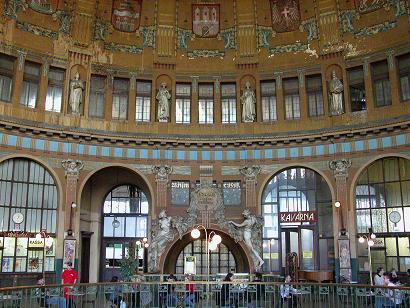
I have just returned from my annual jaunt to teach green economics to students in the Czech Republic. At first I was rather smug about my decision to travel by train, but as soon as I reached Prague central station (which is stunning, incidentally) I realised how Iceland's second world-beating catastrophe in as many years would affect my own travel plans.

The station was full of the sort of people who never normally travel by train. In contrast to the comfortable leisure wear of those of us who routinely use sleeper trains there were tanned women in high heels and middle-aged and unfit travellers with massive suitcases. It was also easy to distinguish those displaced from their accustomed first class exclusivity. Men with the appearance of gangsters and large expensive coats looked sweaty and dislocated.

The culture of individualism that must be a key characteristic of the frequent flyer in these days when the link between climate change and air travel is so clear was predominant. The train from Cologne for which I booked my seat a month ago could not leave because so many without reservations had mobbed aboard. Deutsche Bahn have strict rules about overloading, but clear instructions from the guard that only those with reserved seats could travel were repeatedly ignored.

On arriving back in the UK I was greeted by untypical weather and an equally untypical debate on Any Answers about why the PM had not rapidly set up an emergency cabinet to devise a plan to return citizens to the country. This left me baffled: the individuals who have chosen to spend weekends in Amsterdam and enjoy three long-haul flights every year did so via a market system. You pays your money and takes your choice. Their choice did not pay off this time, but I fail to see how this can possibly have anything to do with a politician.

Are these people perhaps wishing for the return of nationalised air and rail systems? In such a world, there might be some action politicians could take. But in this world of private enterprise we are left to the tender mercies of Willie Walsh. If he decides to restart flights it will be profits rather than pity that is the motivating factor.

If voters are seriously tiring of the limitations of a market world, they might do better to call for the return of political control of the financial system than the transport system. As Mary Mellor argues in her excellent new book about the financial crisis, the reality was always that money was a social construct supported by political will. The power to reorient the monetary system towards the interests of people and planet has always been ours. If we seek politicians with the courage and vision to begin to act rather than merely manage, finance would be a good place for them to start.

3 December 2009

Shooting the Messenger

As the political and economic implications of climate change become clearer, the response from the politicians and the corporate elite who dominate politics will be to pressurise scientists not to blow the whistle. On Monday I was at a public policy seminar in London where Professor Kevin Anderson from the Tyndall Centre publicly admitted that he and his colleagues had spent years sweetening the pill on climate change so as not to cause political offence and damage his chances of receiving research funding. 'Nobody would be funded to find that globalised capitalism is the cause of the problem', he said, a view which I was able to support based on my personal experience.

And now another leading climate academic has had to leave his job for telling the truth about the sorts of changes that are needed to protect the human species from the corporate machine that is destroying our planet. Dr Clive Spash resigned yesterday from his job at Australia's CSIRO so that he would be free to seek the truth about the economics of climate change.

His excellent report 'The Brave New World of Carbon Trading' is due to be published in a peer-review journal early next year and so has already been subject to academic scrutiny. But because he finds that carbon trading will not be effective in addressing the problem of CO2 emission - and in fact doesn't really make sense in terms of economic theory – his employers demanded that he change his findings.

Spash was told that he was in breach of CSIRO policy, which restricts its scientists from making statements about public policy. Put together with the limitations on research funding for academics identified by Kevin Anderson this removes livelihood options from environmentally focused academic researchers unless they are prepared to toe the corporate line.

The climate change debate is hotting up in Australia, having nearly caused an emergency election last week, so Spash's claims that he was being censored forced his boss, Megan Clark, to publish the report on November 26th, but only on the condition that the scientist would be punished for refusing to change his findings. Under intense pressure, Dr Clark publicly released the report on November 26 but warned Dr Spash that he would be punished for his behaviour and his refusal to amend it. Spash, who has been suffering from stress as a result of his mistreatment, consequently decided to resign.

To find out what all the fuss is about read Clive's paper.

2 November 2009

Bloated Economic System Produces More Hot Air

If you have, like me, been wondering how climate change can so suddenly shift from being a consequence of a bloated and over-industrialised hypercapitalist economy to being the result of our decadent eating habits, you may find it useful to have a quick trawl through the report that has caused the recent furore. And before you go any further you should keep in mind that the authors of the report have both spent their careers at the World Bank. So they are unlikely to conclude that climate change might result from a design flaw in the existing economic system.

Goodland and Anhang have not carried out any new research. Had they followed research methods established by others to attempt to measure the CO2 impacts of farming methods it would have been impossible for them to find a jump from 18 to 51 per cent in the proportion of climate-forcing gases that are the responsibility of domestic ruminants. Their shocking statistics result from reinterpretation of previous research and changed assumptions.

Of the things that make me nervous about this new 'science' the first, which is a political rather than a scientific insight, is that the person who first put the issue of farting cows into the climate change debate was former President Bush. It may be the alacrity with which the 'findings' were beamed around the world that makes me wonder who has the most to gain from a shift in responsibility for the global catastrophe from a fossil-fuelled economy to individual consumption decisions and agrarian practices.

Reading the report in more depth than the journalists appear to have bothered to do immediately makes clear that the real problem is the industrialised nature of the global farming system - itself so intensive in the use of oil - together with the clearing of carbon-storing forests to make way for mass grazing to feed the US hamburger market:

'Livestock (like automobiles) are a human invention and convenience, not part of pre-human times, and a molecule of CO2 exhaled by livestock is no more natural than one from an auto tailpipe. Moreover, while over time an equilibrium of CO2 may exist between the amount respired by animals and the amount photosynthesized by plants, that equilibrium has never been static. Today, tens of billions more livestock are exhaling CO2 than in preindustrial days, while Earth’s photosynthetic capacity (its capacity to keep carbon out of the atmosphere by absorbing it in plant mass) has declined sharply as forest has been cleared. (Meanwhile, of course, we add more carbon to the air by burning fossil fuels, further overwhelming the carbon absorption system.)'

The equating of living sentient beings with machines in this quotation is distasteful, and representative of the reductive thinking that fails to distinguish between technical measurements of gases and social and cultural systems.

Methane is known to be a gas that is more powerful at forcing climate change than CO2, but it also disperses more rapidly (8 years compared to 100 years, according to the best current scientific modelling). The reason for the sudden massive increase in the harmfulness of methane as calculated by the report's authors is a decision to take a shorter-term perspective on climate change and hence to increase the multiplier applied to methane as compared with CO2. Presumably this is governed more by the need to reach immediate GHG targets than by a concern for our grandchildren.

'The new widely accepted figure for the GWP of methane is 25 using a 100-year timeframe — but it is 72 using a 20-year timeframe, which is more appropriate because of both the large effect that methane reductions can have within 20 years and the serious climate disruption expected within 20 years if no significant reduction of GHGs is achieved.'

This ability to use maths to shift problems through time is the speciality of the economist, and allows massive leeway for interpretations favourable to the dominant economics paradigm. (Another example highly relevant to the climate change negotiations is the questionable technique of discounting.)

The most serious omission from the article appears to be any attempt to measure the carbon impact of the production of alternative foods that should replace the meat and dairy industry that provides basic nutrition to the mass of the world's population today. It includes consideration of the processing of by-products of the meat industry - such as turning hides into leather - but does not consider the carbon produced in the manufacture of alternatives to these products.

The report makes a direct appeal to corporations to take up the route of 'non-meat meat':

'among the least risky strategies might be for a company subsidiary to build a chain of fast-food outlets featuring soy burgers, soy chicken products, sandwiches made with various meat analog products, and/or soy ice cream. If the chain’s growth were rapid, then other food companies would be tempted to copy from the first mover.'

Nothing could make clearer the difficulty those within the existing scientific and economic paradigm have in grasping that the real problem is structural. More than cows and their problematic digestion, it is the unquestioning commitment to chains, fast foods, and growth that is really driving the upward curve of GHG emissions.

The hyping and rapid dissemination of such research into pseudo-scientific news stories trivialises a vital debate and allows the disinterested and those in denial to claim that, since the scientists cannot agree with each other, there is no point in their engaging with this issue at all. There are so many scientific uncertainties in just this one small corner of the climate change discussion that it is no wonder that most people - even those who can find the time and mental energy to struggle their way through a report like this - are left feeling utterly disempowered.

At this point I always revert to what I can do in my own community. We debated this issue in the Stroud coffee house more than a year ago. Between biodynamic meat-eaters and committed vegans we agreed that we should all avoid the globalised industrial meat system, as much because of its inhumanity as its climate impact. We should also eat fewer meat meals, and the vegetables we eat as a substitute should be locally grown, without oil-based fertilisers and pesticides, on our local allotments and community farm. (Graham Harvey reaches much the same conclusion in his book The Carbon Fields)

As Copenhagen approaches we can expect to see more examples of attempts to skew the debate away from the bloated and inherently unjust global economy and towards individual life-style choices. We should not be convinced by the World Bank that it is our consumption choices, rather than the economy whose design they defend, that are the root cause of climate change.