In spite of the cultural dominance of the idea of 'science' and forming understandings on the basis of 'facts' it is clear that what you think you are is crucial to defining what you are and what you may become. The furore over an ancient calendar belonging to a people who were arguably destroyed by the technologically superior culture of our ancestors is demonstrating today the influence of myths in determining our sense of ourselves in time. I want to argue that we should also be asking questions about how we think of our place in the world in a geographical sense.
Most of us are defined by political boundaries. I am a councillor for Stroud District, but when I think of 'Stroud' it is the people and the landscape that make it a place I love. This emotional identification of places through natural landforms and human and animal companions lies at the heart of the reconceptualisation of our world that bioregionalism demands. It is for this reason that I called my book The Bioregional Economy. I suggest bioregions as the basic provisioning units of a system of self-reliant local economies that will be the sustainable economy of the future. But perhaps more importantly I suggest the importance of a undertaking a rethinking of who we are that involves allowing our selves to be defined much more by the part of the world we inhabit.
Blogger and - crucially - geologist Nick Arini has taken this idea on an produced a really interesting and useful blog about what the boundaries of his bioregion might be. Nick concludes that proponents of bioregions often suggest one characteristic to use in defining their boundaries: watersheds, say, or geological underpinnings. He argues for, and I would agree, a fusion of characteristics, and that the definitional characteristics are specific to each bioregion. He concludes:
'I wanted to consider a bioregion as a living being and this idea that each region is unique and is defined by its own set of characteristics supports this notion. Applying the same formula to each different bioregion is likely to yield sub-optimal results. Listen to your region and let it tell you what characteristics are important for defining its identity.'
He is suggesting sketching the boundaries of other UK bioregions, although since this process is all about knowing your backyard this process is best done as close to home as possible. If you would like to follow Nick's example and define your bioregion please be sure to let me know how you get on.
.
Tweet
All other green campaigns become futile without tackling the economic system and its ideological defenders. Economics is only dismal because there are not enough of us making it our own. Read on and become empowered!
Showing posts with label bioregionalism. Show all posts
21 December 2012
24 January 2011
How do I love thee?
When Elizabeth Barrett Browning recited the catechism of her love to her husband Robert, she listed the spiritual alongside the mundane, and so it should be for our love of trees. Under the traditional British land settlement, there were a range of commons woodland rights to forage for food, fuel and building materials. Rights such as 'estover' (the right to smaller woodland braches for fuel) or 'pannage' (the right to graze pigs in the forests) enabled the subsistence of generations of rural people.More recently we have recognised the literally vital role that forests play on a global scale, maintaining the stability of the climate. The wonderful balance between photosynthesis and respiration, between our need for oxygen and trees' need for carbon dioxide enables and requires a respectful sharing of the biosphere. Our pre-scientific ancestors had such an attitude towards woodlands and their trees.
In his excellent introduction to bioregionalism, Dwellers in the Land, Kirkpatrick Sale describes the propitiation necessary to ease the guilt of killing trees to provide so many vital resources:
Almost all early peoples had elaborate ceremonies connected with cutting and harvesting, asking exoneration for the painful removal of some of Mother Earth's children, and most had stories like the Ojibways', which speak of 'the wailing of the trees under the axe', or like the ancient Chinese tales which mention cries of 'pain and indignation' from fallen branches. (p. 6)
Sale characterises this 'well-nigh universal phenomenon' of respect and reverence for trees as 'innate recognition of the fundamental, life-sustaining function of arboreal life on earth'.
The government's plans to sell off the woodland now owned for the public benefit by the Forestry Commission are an afront to common law. How can we be required to purchase what already belongs to us? It is also a continuing affront to the commons law that tells us we already have a right to enjoy the benefits of our native woodland. Such a plan was not part of the election campaign and has no public mandate, but how might resistance be most effectively organised?The coalition claims not only to be the greenest government ever, but also the government most willing to devolve power back to local authorities. So my suggestion is that we lobby our local authorities to revive our ancient woodland rights. This, together with a sudden increase in the number of applications for Tree Preservation Orders in woods likely to be sold, might ensure that, even if the sales go ahead, the new owners will find it difficult to profit from their purchase.
*An online petition is available to sign.
. Tweet
6 May 2009
Revaluing the Wasteland
T. S. Eliot gave the wasteland a bad name. But then he did begin his famous poem with the words:
APRIL is the cruellest month, breeding
Lilacs out of the dead land, mixing
Memory and desire, stirring
Dull roots with spring rain.
Some cruelty! And he doesn't even mention the bluebells.
Yes, yes, I know he had a sort of spiritual wasteland in mind, where humankind had strayed off the path of learning Greek and revelling in high culture. His pessimistic view might have been tempered somewhat if he had strayed off his own path of intellectual endeavour and found his way into the highways and byways of the real Wilderness.
I have a soft spot for Eliot, though. Something about the cadence of his writing rather than the recondite content. And not unconnected to the fact that one of my first boyfriends caught me with a short bit of his verse involving a rose-garden - no doubt the wildest sort of place Eliot himself ever strayed into.
But I digress. What I meant to share with you was the vast range of uses that peasants once put wastelands to. This was before the days of the National Trust, when non-agricultural land was available for foraging rather than recreation. The study by J. M. Neeson called Commoners indicates just how much they were able to provide. Obviously there was grazing and the possibility to gather firewood and other materials that were used for fires — furze (gorse) and bracken (fern). Commoners also took hazel loppings to make hurdles for penning sheep, and fern was also used for animal bedding and, once burnt, its ash was used to make soap. In addition:
'Reed was plentiful and valued most as thatch for roofs and also to cover the stacks, ricks and clamps for all kinds of crops and vegetables. Rushes — bulrushes — were equally plentiful, waterproof, and woven into baskets, mats, hats, chair seats and toys. . . they were also good for bedding, as a netting in the plastering of walls, and wrapping for soft milk cheeses. They made cheap, bright rushlights too' (Neeson, 1989: 166).
The list of foraging crops, especially nuts, berries and fungi is equally long, and as varied as were the possibilities for salad crops and herbs that could be gathered. It is clear from these accounts that the commoning lifestyle offered two other characteristics crucial to a bioregional approach to provisioning: seasonality and shared experience.
The dismantling of the commons was disastrous for commoners but crucial for the growth of the industrial market system, which they were required to staff. Neeson’s account makes clear the link between the ending of subsistence and the population explosion which Malthus and other political economists later bemoaned. She also chronicles how the move from commoner to labourer undermined the resilience and self-reliance of British citizens. Tweet
APRIL is the cruellest month, breeding
Lilacs out of the dead land, mixing
Memory and desire, stirring
Dull roots with spring rain.
Some cruelty! And he doesn't even mention the bluebells.
Yes, yes, I know he had a sort of spiritual wasteland in mind, where humankind had strayed off the path of learning Greek and revelling in high culture. His pessimistic view might have been tempered somewhat if he had strayed off his own path of intellectual endeavour and found his way into the highways and byways of the real Wilderness.I have a soft spot for Eliot, though. Something about the cadence of his writing rather than the recondite content. And not unconnected to the fact that one of my first boyfriends caught me with a short bit of his verse involving a rose-garden - no doubt the wildest sort of place Eliot himself ever strayed into.
But I digress. What I meant to share with you was the vast range of uses that peasants once put wastelands to. This was before the days of the National Trust, when non-agricultural land was available for foraging rather than recreation. The study by J. M. Neeson called Commoners indicates just how much they were able to provide. Obviously there was grazing and the possibility to gather firewood and other materials that were used for fires — furze (gorse) and bracken (fern). Commoners also took hazel loppings to make hurdles for penning sheep, and fern was also used for animal bedding and, once burnt, its ash was used to make soap. In addition:
'Reed was plentiful and valued most as thatch for roofs and also to cover the stacks, ricks and clamps for all kinds of crops and vegetables. Rushes — bulrushes — were equally plentiful, waterproof, and woven into baskets, mats, hats, chair seats and toys. . . they were also good for bedding, as a netting in the plastering of walls, and wrapping for soft milk cheeses. They made cheap, bright rushlights too' (Neeson, 1989: 166).
The list of foraging crops, especially nuts, berries and fungi is equally long, and as varied as were the possibilities for salad crops and herbs that could be gathered. It is clear from these accounts that the commoning lifestyle offered two other characteristics crucial to a bioregional approach to provisioning: seasonality and shared experience.The dismantling of the commons was disastrous for commoners but crucial for the growth of the industrial market system, which they were required to staff. Neeson’s account makes clear the link between the ending of subsistence and the population explosion which Malthus and other political economists later bemoaned. She also chronicles how the move from commoner to labourer undermined the resilience and self-reliance of British citizens. Tweet
2 March 2009
A Dance to the Music of Home

Continuing my theme of carbon-free culture I have arrived at the importance of music in a bioregional economy. With this in mind, I recently dusted off my ancient violin and am taking lessons. The sounds is appalling but I feel thoroughly virtuous and well-prepared to entertain myself - if not others - once we run out of oil.
Shared music-making will be a staple of the convivial community as it already is in so many communities across the world. Gary Snyder writes that 'When men drink together in Japan, at a certain point in the evening they begin to take turns singing folksongs of their home provinces. When the American in the group is called on, he has a hard time knowing what to sing.'
Having Welsh relatives and living a large part of my life in Wales - renowned as "the land of song" - this has never been a problem for me. In Wales songs are used for identification, for affirmation and for raising your spirits or those of your rugby team. Tough men are quite happy to shed drunken tears. Emotions are unleashed.
In classical music the foremost example of nationalistic music-making was surely Smetana, whose tone poem Ma Vlast (my home country) portrays in music six aspects of the natural world of the Czech Republic, most famously the musical portrait of the river Vltava. Such music was instrumental in supporting the establishment of the nation-states of central Europe in the 19th century.
As we lose the ability to import goods from across the globe the sense of local pride and identification will have to act as a substitute. But the emotional power created by a strong identification with your local soil has a dark side too, a potential for exclusiveness and parochiality that we have to beware in our economic as well as our cultural relationships. Tweet
22 February 2009
Cultivating the Wild
I've been reading Gary Snyder as part of my research towards developing a bioregional economy. The Practice of the Wild revolves around the phrase 'wild and free' which Snyder explores from many different angles. Only through recognising our wild, animal selves can we be truly free.
Snyder has interesting things to say about the commons, which he considers, far from the tragedy as described by neoclassical economics, to be rather a management system for shared resources that comfortably balances control and anarchy. Common land and seas were traditional to many cultures and were not over-exploited because they were organised under a system of social norms and sanctions.
A friend from Stroud tells me about his youth spent in the Yorkshire dales, where the grazing land was shared between farmers who were responsible for mending the bits of wall around their pasturage. The sheep had their own culture of place, recognising the distance they could travel and when they reached the boundary of their flock's piece of grassland.
Acknowledging that we are nothing special as a species, and that lions and sheep alike have culture and wisdom is part of the practice of the wild. In my small way I have made some progress by befriending a field-mouse. Fortunately it keeps its distance since we first collided last autumn and I responded by leaping onto the nearest chair in uncharacteristically (as Snyder would say instinctive) girly fashion.
Being new to mice I sought advice from various friends who suggested a range of harsh routes to death for my harmless furry companion. I could not face killing it, and followed the advice of a wilder friend who suggested I befriend and feed it. I've learned that mice do like cheese, and also nuts and oats. I hope I'm also learning something about my wild side. One thing I know for certain: it is more soulful to have a wild friend that you never see than a tamed pet that sits on your lap. Tweet
14 March 2008
Home-grown Hats
Most of us can trace our families back to the generation that left the land. In my case this was my grandmother's parents, both of whom lived in the small Devon town of Ivybridge. I'm proud to say that various bits of the family still make their living in Devon and from rural trades.
I have always been most proud of my second cousin who is a thatcher. At a recent family event I discovered that he has now become a teacher but another cousin has, inspired by his example, taken up the thatching trade. My practical limitations give me immense respect for people who actually have a craft and so I was full of interest. This was somewhat diminished when he told me that the thatch he uses on the cottages of Devonshire is actually grown in China.
Here is what William Cobbett has to say on a similar subject (in this case Leghorn bonnets) in his Cottage Economy (written in 1820-21):
'The practice of making hats and bonnets, and other things, of straw, is perhaps of a very ancient date. . . In this country the manufacture was, only a few years ago very flourishing; but it has now greatly declined, and has left in poverty and misery those whom it once well fed and clothed.

The cause of this change has been, the importation of the straw hats and bonnets from Italy, greatly superior, in durability and beauty, to those made in England. . . It seems odd that nobody should have set to work to find out how the Italians came by this fine straw. The importation of these Italisn articles was chiefly from the port of LEGHORN, and therefore the bonnets imported were called Leghorn Bonnets.
The straw manufacturers in this country seem to have made no effort to resist this invasion from Leghorn. And, which is very curious, the Leghorn straw has now begun to be imported, and to be plated in this country. So that we had hands to plat as well as the Italians. All that we wanted was the same kind of straw that the Italians had: and it is truly wonderful that these importations from Leghorn should have gone on increasing year after year, and our domestic manufacture dwindling away at a like pace, without there having been any inquiry relative to the way which the Italians got their straw! . . . There really seems to have been an opinion that England couldnot more produce this straw than it could produce sugar-cane.' Tweet
I have always been most proud of my second cousin who is a thatcher. At a recent family event I discovered that he has now become a teacher but another cousin has, inspired by his example, taken up the thatching trade. My practical limitations give me immense respect for people who actually have a craft and so I was full of interest. This was somewhat diminished when he told me that the thatch he uses on the cottages of Devonshire is actually grown in China.
Here is what William Cobbett has to say on a similar subject (in this case Leghorn bonnets) in his Cottage Economy (written in 1820-21):
'The practice of making hats and bonnets, and other things, of straw, is perhaps of a very ancient date. . . In this country the manufacture was, only a few years ago very flourishing; but it has now greatly declined, and has left in poverty and misery those whom it once well fed and clothed.

The cause of this change has been, the importation of the straw hats and bonnets from Italy, greatly superior, in durability and beauty, to those made in England. . . It seems odd that nobody should have set to work to find out how the Italians came by this fine straw. The importation of these Italisn articles was chiefly from the port of LEGHORN, and therefore the bonnets imported were called Leghorn Bonnets.
The straw manufacturers in this country seem to have made no effort to resist this invasion from Leghorn. And, which is very curious, the Leghorn straw has now begun to be imported, and to be plated in this country. So that we had hands to plat as well as the Italians. All that we wanted was the same kind of straw that the Italians had: and it is truly wonderful that these importations from Leghorn should have gone on increasing year after year, and our domestic manufacture dwindling away at a like pace, without there having been any inquiry relative to the way which the Italians got their straw! . . . There really seems to have been an opinion that England couldnot more produce this straw than it could produce sugar-cane.' Tweet
22 January 2008
Making Good Use of the Things that we Find
This blog is called Gaian Economics to engender a sense of reverence for nature and recognition that all our resources - everything whose study falls within the remit of economics - comes initially from the Earth. Indigenous peoples tend to have this recognition at the heart of their culture and practice - a belief they sum up by using phrases like 'The Earth is Our Mother'.
I remember learning in school about the Inuit (we called them eskimos then, of course) and how they used every last part of the caribou: skins for blankets, hides for wigwams, sinew for thread, bones for needles. Not a scrap was wasted, we were told, and we marvelled at this. Such a contrast to the way we lived even then.
I spent this past weekend with my good friends Lydia and Robert, co-creators of Thrift Cottage, and had the usual restful and inspiring time. Robert's knowledge of the natural world - trees and woodworking are his speciality - is something he has learned from joiners and carpenters he has worked with who come from a different era. He is always full of wisdom about his craft that is humbling to somebody like me who lives from their brain.

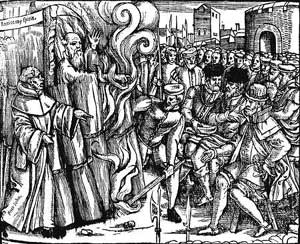
This weekend's gem was a short history of faggots and tallow. These two fundamental parts of the lives of our ancestors just a generation or two ago have slipped out of consciousness. The only picture I have ever seen of a faggot is on the woodcut from Foxe's Book of English Martyrs, but I was interested in converting garden and agricultural waste into fuel and so asked Robert how it is done.
His brother is the tallow man - he recreated by laborious practice the means of extracting this most useful substance from sheep's testicles (didn't I say everything had a use?) following instructions he found in a book from the 1960s. Boatbuilders and joiners are still using blocks of this natural lubricant. Robert says it is the best way of easing a screw into a piece of oak and the only lubricant that resists the tree's attempt to use its natural juices to keep it there. That puts high technology into its place. Tweet
I remember learning in school about the Inuit (we called them eskimos then, of course) and how they used every last part of the caribou: skins for blankets, hides for wigwams, sinew for thread, bones for needles. Not a scrap was wasted, we were told, and we marvelled at this. Such a contrast to the way we lived even then.
I spent this past weekend with my good friends Lydia and Robert, co-creators of Thrift Cottage, and had the usual restful and inspiring time. Robert's knowledge of the natural world - trees and woodworking are his speciality - is something he has learned from joiners and carpenters he has worked with who come from a different era. He is always full of wisdom about his craft that is humbling to somebody like me who lives from their brain.

This weekend's gem was a short history of faggots and tallow. These two fundamental parts of the lives of our ancestors just a generation or two ago have slipped out of consciousness. The only picture I have ever seen of a faggot is on the woodcut from Foxe's Book of English Martyrs, but I was interested in converting garden and agricultural waste into fuel and so asked Robert how it is done.
His brother is the tallow man - he recreated by laborious practice the means of extracting this most useful substance from sheep's testicles (didn't I say everything had a use?) following instructions he found in a book from the 1960s. Boatbuilders and joiners are still using blocks of this natural lubricant. Robert says it is the best way of easing a screw into a piece of oak and the only lubricant that resists the tree's attempt to use its natural juices to keep it there. That puts high technology into its place. Tweet
28 January 2007
Business as battlefield
I had an unexpected treat on Friday. I was at a seminar in Cardiff on Sustainable Production and Consumption. If you've read any of my posts on bioregional economics you'll guess that I was delighted to find out that such a concept exists at the highest levels of government. Slightly more depressing is the realisation that it was invented at Rio in 1992--a full 15 years ago and yet very little has been done.
There was a stirring presentation by a lady from DEFRA who explained everything that is being done to 'green business'. The consumption end is more of a problem, as she rightly admitted, since buying less stuff is not good for business. This prompted me to question how attempts to move towards greener methods of production can be consistent with an economic system that has as its central tenets growth and free trade. She gamely took this on the chin and later invited me to join the UNEP group exploring whether the economic system itself is the problem. I await a phone call . . .
I have slipped into a generalised whinge: back to the unexpected treat. This was a presentation from Ken Peattie, boss of Cardiff University's sustainable business wing, known as BRASS (most of its staff don't seem to know why). His presentation consisted of a demolition of the central business metaphor of the battlefield. This reminded me of a book I edited years ago that was a history of the post-war development of management consultancy. It made a similar point that demobbed officers formed the majority of the first entrants into this dubious profession.
The organisation of business in the post-war world was left in the hands of people whose previous experience of organisation and management was in the extreme culture of the military. Perhaps it is not surprising, once we realise this, that the spread of the managerialist culture that management consultancy bring with it has led to the launching of a long sequence of syntactically impossible wars against unsuspecting nouns such as terror, drugs and cancer. Equally unsurprising that these wars have been a disaster for all except those who produce and sell the relevant weaponry.
Professor Peattie developed his theme by pointing out the consequences for the environment of the business battle. More and more areas of our planet are coming to resemble the classic images of battlefields. Social impacts ranging from stress-related disease to continuing poverty in the poorer countries of the world can be belittled as 'collateral damage'. Those who fail to thrive in this aggressive, militaristic economy can be dismissed as wimps and cowards.
The increasingly unethical nature of modern business is justified, within the economy-as-war metaphor, under the slogan 'All is fair in love and war'. This becomes a self-fulfilling prophecy, so that business is regarded with contempt by many of our most creative people, with only those with a shortage of morals or imagination being attracted to becoming businessmen.
In the summer I attended a family wedding--always a good setting for undercover social research. The person to my right was a policeman, which did not give me much encouragement and we didn't speak much. To my right I had a spivvy looking chap who introduced himself as an entrepreneur, which he qualified by saying that this meant he was a bastard. Should this defensiveness be seen as a sign of hope? Are entrepreneurs becoming as ashamed as smokers and drivers and people who fly to Amsterdam for the weekend? And he didn't even know I was a green economist.
Tweet
There was a stirring presentation by a lady from DEFRA who explained everything that is being done to 'green business'. The consumption end is more of a problem, as she rightly admitted, since buying less stuff is not good for business. This prompted me to question how attempts to move towards greener methods of production can be consistent with an economic system that has as its central tenets growth and free trade. She gamely took this on the chin and later invited me to join the UNEP group exploring whether the economic system itself is the problem. I await a phone call . . .
I have slipped into a generalised whinge: back to the unexpected treat. This was a presentation from Ken Peattie, boss of Cardiff University's sustainable business wing, known as BRASS (most of its staff don't seem to know why). His presentation consisted of a demolition of the central business metaphor of the battlefield. This reminded me of a book I edited years ago that was a history of the post-war development of management consultancy. It made a similar point that demobbed officers formed the majority of the first entrants into this dubious profession.
The organisation of business in the post-war world was left in the hands of people whose previous experience of organisation and management was in the extreme culture of the military. Perhaps it is not surprising, once we realise this, that the spread of the managerialist culture that management consultancy bring with it has led to the launching of a long sequence of syntactically impossible wars against unsuspecting nouns such as terror, drugs and cancer. Equally unsurprising that these wars have been a disaster for all except those who produce and sell the relevant weaponry.

Professor Peattie developed his theme by pointing out the consequences for the environment of the business battle. More and more areas of our planet are coming to resemble the classic images of battlefields. Social impacts ranging from stress-related disease to continuing poverty in the poorer countries of the world can be belittled as 'collateral damage'. Those who fail to thrive in this aggressive, militaristic economy can be dismissed as wimps and cowards.
The increasingly unethical nature of modern business is justified, within the economy-as-war metaphor, under the slogan 'All is fair in love and war'. This becomes a self-fulfilling prophecy, so that business is regarded with contempt by many of our most creative people, with only those with a shortage of morals or imagination being attracted to becoming businessmen.
In the summer I attended a family wedding--always a good setting for undercover social research. The person to my right was a policeman, which did not give me much encouragement and we didn't speak much. To my right I had a spivvy looking chap who introduced himself as an entrepreneur, which he qualified by saying that this meant he was a bastard. Should this defensiveness be seen as a sign of hope? Are entrepreneurs becoming as ashamed as smokers and drivers and people who fly to Amsterdam for the weekend? And he didn't even know I was a green economist.
4 December 2006
Green Lord argues for a convivial economy
Sometimes politics works. On Monday 27th November the only Green Lord, the only Green Party representative in the whole of the palace of Westminster, described a positive and inspiring vision of how the green economy might be. Wrapped up as a challenge to the feeble gesture towards climate change in the Queen's Speech it is really a deep green appeal for a holistic and sustainable economy. It is reproduced here in full:
SPEECH OF LORD BEAUMONT OF WHITLEY, GREEN PARTY PEER IN THE DEBATE ON THE QUEEN’S SPEECH ON THE AFTERNOON OF MONDAY NOV 27 2006
My Lords, there are many things in the gracious speech that the sole Green Party representative in Parliament might have chosen to speak on and for a time I was tempted to speak on international affairs, to protest against our illegal involvement in two wars and to point out that no one had ever dabbled in the affairs of Afghanistan or Mesopotamia with profit to any of the parties concerned from the First Afghan War, chronicled by my great-great-grandfather Henry Havelock, through the advocacy of the use of mustard gas and the bombing of unarmed civilians by Winston Churchill to the present unhappy events.
Not all that long ago the Commonwealth Parliamentary Association sent me to Tonga and I learned there that there is a lot to be said for a policy of no entanglements and of dubbing ones islands The Friendly Islands and behaving accordingly
But even two illegal wars are not the most important matters on our plate.
Much the most important and dangerous problem is Climate Change and we very much welcome the forthright challenge of the Stern Report. In which the risks of making only small cuts to our CO2 production are laid out in full. Including the risk of an increasing likelihood of "abrupt and major irreversible changes".
The major changes include the melting of the Greenland icecap and the resultant 6m rise in sea levels that this implies.
The upshot of this is that if London, New York, Shanghai, Mumbai are to be saved and the cost and suffering of the refugees to be avoided going for CO2 concentrations of 550ppm as the Government is doing is really not enough.
In order for the UK to do our share to avoid such drastic consequences, annual reductions of 9% are needed now, order to cut CO2 production to 90% of 1990 levels by 2030. That is the Green Party's message. The modest 3% cuts envisaged by the recent Climate Change Bill are simply not sufficient. Annual reductions in CO2 production of 9% may sound ambitious, but in reality are not impossible, requiring only political will in the place of political rhetoric.
The first necessary economic steps include putting an effective value on carbon emissions, through a capped tradable quota system. They include ending airport expansion, and embarking on serious investment in energy efficiency and renewables. They include Market mechanisms such as the feed-in tariff scheme deployed by Germany, Japan and Spain, which has resulted in Germany installing 56% of the world's solar panels.
By paying households to generate clean, green electricity, such feed-in tariff schemes can be used to shift our electricity production by making investment in renewables cost effective for the individual. And let no one sneer at the efforts being made by Mr. Cameron. These are early days in exploring the way forward and Mr. Cameron is at least trying.
We also need to take responsibility for all the carbon production in the whole of our economy. Having watched the demise of much of British manufacturing and the coal industry, it should be no shock to noble Lords that carbon emissions in Britain briefly dipped in the early 1990s.
But in truth, those now rising levels of CO2 emissions are an under estimate of what our economic activity produces. For we are in effect now exporting the production of CO2 abroad, to China and other countries. When we consume products manufactured abroad, they use carbon in production and transit. The production is counted in the carbon figures where it is produced, and the transportation, under Kyoto, is not considered at all. If we took these factors into account, our society would be seen to produce around 20% more carbon emissions.
The most obvious and significant conclusion is that, if we were to meet our needs for food, clothing and household goods from local, sustainable production we could drastically reduce the level of carbon dioxide emissions. The Green Party advocates a system of strengthened local economies, where we have a role as producers as well as consumers, thus not only reducing our impact on climate change but also reinforcing our identities and self-esteem within our local communities. Trade should return to its right role as being the exchange of goods we cannot produce within our own economies.
This seems far from the thrust of current economic thinking on any of the front benches at present, which ought to be a source of deep concern to us all. Instead, we continue to hear from them about competitiveness in a globalised economy which provides ever cheap goods manufactured abroad for consumption in countries such as ours. Such a view is fundamentally incompatible with serious and sufficient action on climate change.
Without addressing these fundamental measures, both the government and opposition continue to be insufficiently ambitious, and wrongly focused, for the sake of supposed 'economic stability', thereby risking catastrophic climate events. The Green Party on the other hand believes we must begin to localise our economies into more efficient and sustainable units, to guarantee the future of our planet and economy.
Such a vision offers greater community and personal satisfaction: a world where conviviality replaces consumption, where local identity replaces global trade, and where community spirit replaces brand loyalty. Tweet
SPEECH OF LORD BEAUMONT OF WHITLEY, GREEN PARTY PEER IN THE DEBATE ON THE QUEEN’S SPEECH ON THE AFTERNOON OF MONDAY NOV 27 2006
My Lords, there are many things in the gracious speech that the sole Green Party representative in Parliament might have chosen to speak on and for a time I was tempted to speak on international affairs, to protest against our illegal involvement in two wars and to point out that no one had ever dabbled in the affairs of Afghanistan or Mesopotamia with profit to any of the parties concerned from the First Afghan War, chronicled by my great-great-grandfather Henry Havelock, through the advocacy of the use of mustard gas and the bombing of unarmed civilians by Winston Churchill to the present unhappy events.
Not all that long ago the Commonwealth Parliamentary Association sent me to Tonga and I learned there that there is a lot to be said for a policy of no entanglements and of dubbing ones islands The Friendly Islands and behaving accordingly
But even two illegal wars are not the most important matters on our plate.
Much the most important and dangerous problem is Climate Change and we very much welcome the forthright challenge of the Stern Report. In which the risks of making only small cuts to our CO2 production are laid out in full. Including the risk of an increasing likelihood of "abrupt and major irreversible changes".
The major changes include the melting of the Greenland icecap and the resultant 6m rise in sea levels that this implies.
The upshot of this is that if London, New York, Shanghai, Mumbai are to be saved and the cost and suffering of the refugees to be avoided going for CO2 concentrations of 550ppm as the Government is doing is really not enough.
In order for the UK to do our share to avoid such drastic consequences, annual reductions of 9% are needed now, order to cut CO2 production to 90% of 1990 levels by 2030. That is the Green Party's message. The modest 3% cuts envisaged by the recent Climate Change Bill are simply not sufficient. Annual reductions in CO2 production of 9% may sound ambitious, but in reality are not impossible, requiring only political will in the place of political rhetoric.
The first necessary economic steps include putting an effective value on carbon emissions, through a capped tradable quota system. They include ending airport expansion, and embarking on serious investment in energy efficiency and renewables. They include Market mechanisms such as the feed-in tariff scheme deployed by Germany, Japan and Spain, which has resulted in Germany installing 56% of the world's solar panels.
By paying households to generate clean, green electricity, such feed-in tariff schemes can be used to shift our electricity production by making investment in renewables cost effective for the individual. And let no one sneer at the efforts being made by Mr. Cameron. These are early days in exploring the way forward and Mr. Cameron is at least trying.
We also need to take responsibility for all the carbon production in the whole of our economy. Having watched the demise of much of British manufacturing and the coal industry, it should be no shock to noble Lords that carbon emissions in Britain briefly dipped in the early 1990s.
But in truth, those now rising levels of CO2 emissions are an under estimate of what our economic activity produces. For we are in effect now exporting the production of CO2 abroad, to China and other countries. When we consume products manufactured abroad, they use carbon in production and transit. The production is counted in the carbon figures where it is produced, and the transportation, under Kyoto, is not considered at all. If we took these factors into account, our society would be seen to produce around 20% more carbon emissions.
The most obvious and significant conclusion is that, if we were to meet our needs for food, clothing and household goods from local, sustainable production we could drastically reduce the level of carbon dioxide emissions. The Green Party advocates a system of strengthened local economies, where we have a role as producers as well as consumers, thus not only reducing our impact on climate change but also reinforcing our identities and self-esteem within our local communities. Trade should return to its right role as being the exchange of goods we cannot produce within our own economies.
This seems far from the thrust of current economic thinking on any of the front benches at present, which ought to be a source of deep concern to us all. Instead, we continue to hear from them about competitiveness in a globalised economy which provides ever cheap goods manufactured abroad for consumption in countries such as ours. Such a view is fundamentally incompatible with serious and sufficient action on climate change.
Without addressing these fundamental measures, both the government and opposition continue to be insufficiently ambitious, and wrongly focused, for the sake of supposed 'economic stability', thereby risking catastrophic climate events. The Green Party on the other hand believes we must begin to localise our economies into more efficient and sustainable units, to guarantee the future of our planet and economy.
Such a vision offers greater community and personal satisfaction: a world where conviviality replaces consumption, where local identity replaces global trade, and where community spirit replaces brand loyalty. Tweet
Labels:
bioregionalism,
climate change,
green economics,
localisation
29 November 2006
The Bioregional Economy: A Constructive Response to Climate Change

Bioregions are natural social units determined by ecology rather than economics, and that can be largely self-sufficient in terms of basic resources such as water, food, products and services. Bioregionalism has at its heart two of the central principles of green economics: balance and cycles. Ecology demands that we recognize our part in a complex web of natural systems and this should reflect the places we choose to live and how and where we choose to access our resources. This is what we mean by living in balance with nature. Respecting the natural cycles of life is often referred to as ‘closing the loop’, so that within our bioregional economy we are responsible for all our waste and we have a neutral impact on the natural cycles that maintain the earth in balance, primarily the carbon cycle.
Your bioregion is effectively your backyard. It is the part of the planet you are responsible for. Bioregionalism means living a rooted life, being aware of where your resources come from and where your wastes go. It is the opposite of a life lived in the limited knowledge that food comes from Tesco, leaving everything to the global corporations who are only too willing to take on this responsibility in return for their profits. Unlike political boundaries, bioregional boundaries are flexible, but should be guided by the principle of subsidiarity in the case of any individual resource or service. Within the bioregional approach beginning with the local is a principle that trumps principles such as price or choice. Within our bioregional economy we are responsible for all our waste and we have a neutral impact on the natural cycles that maintain the earth in balance, primarily the carbon cycle. From a bioregional perspective the ideal way to organise your economy is by borrowing for your needs from the local environment.
Tweet
Your bioregion is effectively your backyard. It is the part of the planet you are responsible for. Bioregionalism means living a rooted life, being aware of where your resources come from and where your wastes go. It is the opposite of a life lived in the limited knowledge that food comes from Tesco, leaving everything to the global corporations who are only too willing to take on this responsibility in return for their profits. Unlike political boundaries, bioregional boundaries are flexible, but should be guided by the principle of subsidiarity in the case of any individual resource or service. Within the bioregional approach beginning with the local is a principle that trumps principles such as price or choice. Within our bioregional economy we are responsible for all our waste and we have a neutral impact on the natural cycles that maintain the earth in balance, primarily the carbon cycle. From a bioregional perspective the ideal way to organise your economy is by borrowing for your needs from the local environment.
What can you do?
- Stop flying and drive less; if you must drive set up a biodiesel recycling plant in your community like Sundance have done in Ammanford: http://www.sundancerenewables.org.uk/
Shop more locally, especially farmers’ markets, or start your own community farm, like the one in Stroud: http://www.stroudcommunityagriculture.org/- Form a bioregional group and conduct an annual audit of your consumption to see which changes will reduce your carbon emissions most rapidly
- Have more fun doing things that don't produce CO2, like joining a choir or inviting your friends round for dinner
- Join your local coop and make sure you do at least 90% of your food shopping there; John Lewis (including Waitrose) is also a coop
- Start you own food coop organizing bulk deliveries from suma or essential (both workers co-ops: http://www.suma.co.uk/ and http://www.essential-trading.co.uk/
- Start a group in your town and register as a Transition Town: http://www.transitiontowns.org/
Labels:
bioregionalism,
carbon cycle,
climate change,
ecology,
localisation
Subscribe to:
Posts (Atom)