Showing posts with label public spending cuts. Show all posts

11 February 2012

Why is a Local Authority Not Like a Business?


It is the budget-setting season and in local authority debating chambers across the land administrations are trying their darndest to squeeze every last penny out of budgets - the age of austeria requires nothing less of them.

The hegemonic idea of business as the superior form of organisation was damaging during the boom, when it was used as justification for rising rates of inequality and falling ethical standards, but during the bust it is downright dangerous. Councillors, especially Tory councillors, have often run small businesses and they try to run council budgets the same way. So if you have any influence over councillors, or are one yourself, please make this argument loudly during the process of budget-setting.

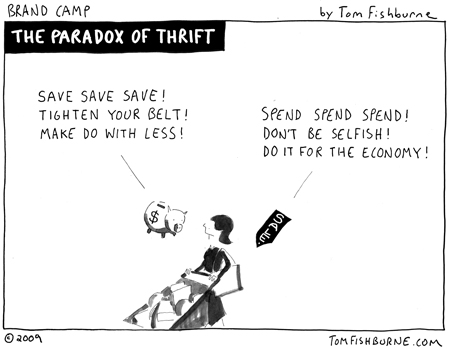
I have previously blogged about what Keynes called the Paradox of Thrift, but I want to explore it in a bit more detail as it applies to local authority budgets. If you are a business, then money you spend goes on the negative side of your balance sheet - it is a leakage, its benefits are external to your balance-sheet and therefore it should be minimised. This is because your business has clear boundaries. If you are a highly diversified business you may be able to keep a much higher degree of spending within your organisation, which is why SMEs are facing unfair competition, but none the less keeping costs down makes absolute sense.

If you are a local authority all the businesses within your area are inside your organisation, since all pay taxes if they thrive as do the people they employ. The boundary you should bear in mind when writing budgets is the local economy: just as you try to minimise costs within a business your priority as a politician should be to minimise leakages from the local economy. To cut your own budgets to the bone, or not to spend money budgeted in this period, is like cutting your own income rather than cutting your own outgoings.

What Keynes so elegantly described in his multiplier theory is that public spending and private spending follow opposite dynamics. An understanding of the systemic nature of a local economy, the importance of the circulation of money rather than individual transactions, and the importance of multiplier effects are all vital to those who set budgets within local authorities. Sadly, too many are bringing the mindset they used to maximise profit on an individual balance-sheet into the council chamber, and through their misplaced thrift they are undermining our local economies already struggling as a result of centrally imposed spending cuts.
.

28 January 2012

Squandering the Wealth of Life

In the immediate aftermath of the 2008 financial crisis, Bank of England staff attempted to estimate the financial costs to the UK economy. In 2009 Andrew G. Haldane, Executive Director for Financial Stability at the Bank estimated that the permanent loss to the UK economy from the banking crisis was anywhere between £1.8trn. and £7.4trn.

The softer, less measurable, more human consequences are only just now becoming clear. A paper in the Lancet in July 2011 began to measure the impact of the 2009 crisis on health, and specifically on suicide rates. Economic crises unsettle people in various ways, but the most obvious, pressing and observable is the loss of employment, which quite literally kills. The authors of the paper considered the pre-2004 EU members and the more recent members separately.

The graphic from the paper reproduced here compares unemployment rates amongst adults with rates of suicide across the EU. Unemployment began rising rapidly in 2009, with a 35% increase over 2007 levels. Shockingly, however, the increase in suicide preceded this, suggesting that it results from fear of unemployment and general rise in anxiety as a result of the instability caused by financial shock. As the authors conclude:

‘the steady downward trend in suicide rates, seen in both groups of countries before 2007, reversed at once. The 2008 increase was less than 1% in the new Member States, but in the old ones it increased by almost 7%. In both, suicides increased further in 2009. Among the countries studied, only Austria had fewer suicides (down 5%) in 2009 than in 2007. In each of the other countries the increase was at least 5%.’

The fact that it is fear and uncertainty that causes suicide, as well as the reality of unemployment and poverty, indicates the irresponsibility of the Coalition strategy of creating an aura of austeria in order to make it easier to impose their draconian cuts. This undermining of social confidence can itself cause increased rates of suicide, which are only a marker of more general social dis-ease.

Greece gives us an indication of the future for the people of Europe if these desperate austerity measures are continued, a policy that Cameron recently argued for at Davos. Official statistics for that country indicate a 40% rise in those taking their own lives between January and May of 2011. Studies of rapid social change repeatedly indicate that the increase in uncertainty and the fraying of the social fabric are not only politically dangerous but also very destructive to human life and health.
.

28 November 2011

A Matter of Life and Debt

There has always been something about the nature of pension calculations that is faintly unsavoury and few roles in life can be as unattractive as that of the actuary. While we all take a vague interest in our life expectancy as well as our life expectations, we frequently balance these with superstitious and childlike attempts to ensure our health and well-being, whether these take the form of prayer or sporadic bursts of jogging. For the actuary, the minute calculation of the likelihood of death from a range of causes is the bread-and-butter of life.

On Wednesday we will see millions of the people who ensure that we live long and healthy lives, and that we enjoy high standards of well-being, going on strike to protect their own security in a retirement they hope to live to see and to enjoy. Investing in a pension is itself a gamble, since a significant proportion of people die before reaching the age of 65. As retirement ages increase and the pension funds those working in the public sector have saved become the subject of the acquisitive attention of politicians, the risks can only increase, making the prudential decision to invest for your old age a much less appealing one.

A rational government would applaud the regularity with which those working for the public sector save for their old age, rather than attacking the union officials who encourage them to do this, and then defend the conditions under which those savings are paid back to them in retirement. Such a government would also value the contribution to the life of the nation made by these servants of the public, rather than consistently downplaying it relative to the 'wealth creation' of the private sector.

More typical of private-sector motivation and value-system is today's news that Rolls Royce has agreed a 'longevity swap' with its pension provider, meaning that it is gambling against its employees ability to live a long and healthy retirement. The company has transferred its unwillingness to countenance a large number of retirement years on the part of its former employees to Deutsche Bank financial services. As pension shifts from being a system of care and mutual support to one of risk and financial reward, one cannot help wondering how long it will be before we are offered a cash incentive to do the decent thing, and make away with ourselves before our allotted time. A moral hazard if ever there was one.
.

17 November 2011

Rebalancing, What Rebalancing?

I write this post as a councillor in the local authority that faced the largest cut in its central government funding in the current funding period - a full 28% over this and next financial years. I assume this is a reward for having a Tory council and having just elected a Tory MP, as well as being a debt-free local authority. I have to hope that the good voters of Stroud draw the right conclusions and do something different with their votes next time.

Recent research from Newcastle City Council has made me feel both better and worse. Published in today's Guardian it makes the partisanship of the present government plain to see. Traditional redistribution measures, including the sharing of local authority rents and local business rates, are being abolished, leaving the richer parts of the country free to profit while those in the deindustrialised north in particular struggle. Northern cities and boroughs are losing £150 to £200 per head, while the leafy boroughs and shires of the south lose between nothing and £50 per head.

The inequalities are magnified by the fact that poorer areas are more dependent on public-sector jobs, which are some of the few well-paid jobs in northern cities that once depended on skilled manual jobs. The massive cuts to the public sector will also hit these areas disproportionately hard.

From a macroeconomic point of view this makes plain the massive withdrawal of liquidity from the local economies up and down our country that is taking place. The paradox of thrift is alive and well in Stroud, as councillors and officers alike respond to fear and threats of future austerity by leaving posts unfilled and cutting spending to add money to the growing reserve. The shade of Keynes haunts our council chambers, but nobody is listening.
.

10 November 2011

McKinsey: The Jesuits of Capitalism

Had you been wondering why, for the past decade or so, all developments in the health sector and most developments in the public sector generally were going against the public interest and in favour of corporate interests. The heavy involvement of global management consultancy firm McKinsey begins to explain this failure of democracy in such a crucial area of our lives.

Barbara Panvel has been studying McKinsey's activities for several years now. In a recent post on her Political Clean-up blog she explains the history of infiltration of the Labour Party by these Jesuits of capitalism, with their free-market catechism and their worship of the God of Greed.
.

10 October 2011

Public Sector Jobs Carnage

Job losses in the public sector are happening much more rapidly than predicted, which will have serious knock-on effects in terms of reducing demand in the economy as a whole, as well as reducing tax payments and increasing the amount of money needed to repay the deficit. This is according to figures from the Chartered Institute of Personal and Development and published by the BBC this morning. Put together with the misguided comments from Cameron about people reducing their credit card debt, which were later pulled from his conference speech last week, this adds to the growing sense that Conservative politicians do not understand how to respond to the second Great Depression which faces us.

An early political move by the New Ricardians was to create the Office for Budget Responsibility - a figleaf to justify their unacceptable policies. Such an Office only has a reason to exist if it can provide informed judgements about the economy that are also genuinely independent. Yet it has repeatedly produced reports to support Conservative policy, and its predictions have been inaccurate to the point of uselessness.

In November 2010 the OBR predicted that the government cuts would lead to 410,000 job losses in the public sector between 2010/11 and 2015/16, a revision downwards from the 610,000 it had predicted that June. The CIPD statisticians indicate that the original figure was correct. So why did the OBR change it? Was this to support the government in difficult political times?

The hard news for the UK economy is that the risk-averse managers in the public sector are cutting jobs more rapidly than their immediate financial situation demands, so that the number of jobs lost since the beginning of this financial year is five times what the OBR predicted. With projections as far out as that, with consequent impacts on deficit management, what is the use of the OBR?

It proves its usefulness to the government by enabling a Treasury spokesman quoted in the article to opine as follows: 'Half a million private sector jobs were created last year and the independent OBR has forecast that there will be 900,000 more jobs created in the private sector than lost in the public sector by 2015'. But if this forecast is as unreliable as the rest then it provides no basis for policy-making, just an opportunity for the spokesman to save the government's face.

It begins to seem increasingly likely that the OBR is a research unit created to provide statistically impressive but factually inaccurate cover for a government bent on its own destructive course. As such, it is itself a waste of money in these days of austeria. It should either be funded from Tory party coffers or abolished.
.

30 April 2011

The Future of Universities: A Rhetorical Question?


The higher education sector is giving clear evidence that the Tories are responding to their own rhetoric rather than the reality of the way a modern economy is organised. Cuts to university funding have been savage and sudden: 6% to the teaching grant and 54% to the capital grant for 2011/12. Universities are supposed to make up the shortfall through increasing fees, but these increases cannot be imposed until 2012/13, leaving a year with a massive spending gap.

These cuts are aimed particularly at teaching, penalising those universities which continue to focus on teaching rather than research and contribute to social mobility by accepting students from less wealthy backgrounds. As Sally Hunt, UCU General Secretary, put it:

'Exceptional universities that concentrate on teaching and widening participation have been told today that they are being left to scrap it out in an untried market place. In addition, institutions that focus on arts and humanities will be forced to charge higher fees to make up the shortfall when they are given the option to triple the current maximum fee to £9,000 in 2012.'

In the market for education of the government's imagining, a lower-quality university will compete on price, offering cheaper degrees to those with less money, first-generation hopefuls perhaps, rather than public-school leavers. If we were talking about shoes or beefburgers this rationale might work, but no university wants to think that its degrees or its students are second-rate. A full 57 of the 80 English universities that have so far revealed their fee structure have tripled their fees to the maximum £9000, with many more within a thousand or so of that maximum.

Universities, long the object of managerialisation, are now being treated as though they were private-sector businesses, but they are not and never can be: they face different rules and constraints. In the private sector, if you see your market share contracting you cut costs and change the quality of your product or cut output. Since standards of education are controlled by the QAA and numbers of students are fixed by government dictat, neither of these options is possible for university managers.

What we are facing in the UK's once proud university sector is a bloodbath as managers struggle to be impressively ruthless by engaging in a process of random downsizing without any sense of strategic direction. In spite of the continuing public support for higher education, courses of practical value to the country will be cut if they are not the ones favoured by students. Staff who have failed to make themselves fit for the purposes of corporate managers will be lost.

The threat posed a generation of politicians who cut their teeth under Thatcher, and imbibed market rhetoric with their mother's milk, is only now becoming clear. Their failure to understand that the public sector cannot behave like the private sector is a danger to us all.
.

16 March 2011

What Happened to the Icelandic Banks?


I have been following the story of Iceland on this blog for some time. Now an academic paper has emerged which tells in a better referenced form the story told by Gunnar Sigurdsson in his film Maybe I Should Have. It is a story of political corruption, as well as of greed, and of the co-option of regulators by politicians. It is, in microcosm, the story of the financial crises that have swamped Western democracies and left us facing economic depression and massive public-spending cuts.

The paper is by Robert H. Wade and Silla Sigurgeirsdottir and is published in the latest issue of the Post-Autistic Economics Review. Iceland is a classic case because it is so extreme: shortly before the crash the value of its banks was 11 times the size of its GDP. It was a huge financial pyramid standing on a tiny rock, and supported, unwittingly, by its 300,000 people.

Wade and Sigurgeirsdottir include some interesting details about how naive UK savers were sucked into filling the void left when the financial markets recognised the vulnerability of the Icelandic market and withdrew. The banks, Landsbanki and Glitnir, hoovered up the savings of UK investors who did not question the unfeasibly high interest rates and believed the words of the best-buy websites. When the banks went bust our government then repaid these savers for their risky behaviour, and has now sent the bill to Iceland.

There is corruption here as well as stupidity. Even after the collapse of Lehmans three UK local authorities invested £33 million in their Icesave accounts, 'as though their expensively paid finance directors were fast asleep' (p. 65). And as for corruption, following the rule that 'the best way to Rob a bank is to own it', in its last few months of life Landsbanki lent 36% of its capital to a few of its main owners, while Glitnir did the same with 17% of its capital. After years of avoiding the consequences of their actions, several Icelandic bankers are now facing prosecution.

The authors conclude:

'Iceland is the story of Icarus in modern dress. Icarus sought to escape from exile in Crete using a pair of wings fashioned from feathers and wax. He was warned not to fly too close to the sun. But overcome by the excitement of flying, he flew too close, the wax melted, and he tumbled into the sea. As of early 2011 his Icelandic counterpart is still in the water, paddling hard but a long way from land, and the direction of the current is unclear.'

The same conclusion could be drawn for all the post-bubble economies, and of course it is important that we 'learn the lessons of Iceland' in terms of crony capitalism and financial instability. But for a green economist the most important lesson is the need to reconnect finance with the real economy. When finance runs out of control the consequence in unsustainability as well as instability. An economy in a steady state would return money to its proper role as a medium of exchange. As Mary Mellor argues, it is this sort of money we should be moving towards to support a sustainable, provisioning economy.

22 December 2010

Higher Education Accountability

As the debates over student fees have ebbed and flowed I have missed once again the skills of the accountant. What nobody has explained adequately to me is how the government's plan will ensure that money flows in in these straightened times, and exactly how it will also flow out.

Will Hutton has assisted on the second point, by offering some figures in his report on 'fair pay' in the public sector. Two points leap immediately to the critical mind: since national bankruptcy has resulted from the behaviour of the private sector, perhaps we should start our pay policy there; and how can any person reasonably accept Hutton's conclusion that a differential of 20-to-1 within organisations can be fair. Time for a new dictionary, not to mention a new moral code.

For myself and my colleagues in the universities there is no surprise that the differentials are highest in our sector. We have long been scandalised by the salaries and the expenses-paid trips enjoyed by our bosses. Hutton found that the average salary for a vice-chancellor is £200,000 and the median salary is some 15 times that of the lowest paid academic salary. Of course that is far from the lowest salary in a university, which also has a huge number of cleaners, caterers and other support staff on poverty wages.

The fattests of gowned cats are found, unsurprisingly, in the self-selected elite who call themselves the Russell Group, where the differential is 19 to one. These very same professors and administrators who are calling for students to pay three times as much to enjoy their skills are part of the reason why a university education is no longer affordable. Universities pay their managers more than all other sectors, with vice-chancellors earning more than four-star generals.

In these 'times of austerity' these salaries will be hard to afford, but how will raising student fees help? Since the increase will only affect the 2012 freshers, no money will flow back to the Treasury until 2016. Here is where accountants could be so useful. The details are decidedly murky at present, and when they are published no doubt we will all be looking elsewhere, but it appears that this money will be marked as an asset rather than a liability, thus reducing the deficit by actually shifting it onto the individual debts of young people.

With the additional help of some financial wizardry, the government may also be able to bring money into the public coffers sooner than 2016 by making the debt of our young people available for sale. This method of using securitization of our children's futures to help pay for support to the banking sector is the story that was missed while we watched the enraged students attempting to smash their way into the Treasury.
.

25 November 2010

The Happiness Crusade

The demonstration I was on yesterday in Cardiff was so much fun it went on all night. If you are a tweeter you can support the protest by sending a message of support. The demonstration was lively, noisy and made up of a mixed bag of students and schoolkids, leavened with a mix of Marxists, socialist workers and Greens. We were already well into chanting when the younger students arrived in their own march to great cheers - what somebody on the Twitter feed has called 'the children's crusade'.


Protesting is turning out to be so much fun that it makes me wonder whether this is part of Cameron's reason for beginning to measure happiness since, as the graphic shows, close social connections make people happier than money, once their basic needs are met (thanks to nef for the graphic, and their leading research in this area). Labour's creation of the disturbingly oxymoronic position of Happiness Tsar has been taken up by the Condems who have instructed their national statistician to begin a programme of scientific measurement of how jolly we all are.

Unlike in Bhutan, however, happiness is not to become the focus of policy-making, merely an adjunct to the measure of economic growth which is, as the PM will tell us later today, the real source of all our aspirations. If Richard Douthwaite was right in his seminal book The Growth Illusion in establishing that, beyond a certain point, growth actually detracts from our happiness, then this is a circle that simply cannot be squared. Instead we need to be developing policies for the post-growth world, as in the recent example of participatory policy development at the Leeds Steady State Economy conference, whose report was recently published.
.

18 October 2010

Limiting Educational Aspiration

The blizzard of policy announcements since May has been quite bewildering. Journalists and academics are reeling at the pace of change, and much of what is being proposed seems both illogical and inconsistent. In my own area, that of higher education, the aim of the policy seems fairly clearly: to reduce the number of young people going to university. Raising fees from £3,000 to £7,000 or more is not a funding measure but a rationing measure.

The Telegraph headline may read 'too many middle-class students at university' but is not very informative until we have a clear idea of what 'middle class' means. As the cuts proceed it appears to be the very concept of 'middle class' that is being squeezed. Perhaps we could have a more informed debate if the sociologists who used to explain to use what class meant had not all been removed from their posts during the 1980s Thatcherite purges.

Clegg argues that tuition fees led to an unfair system of admissions; the Lib Dems graduate tax would ensure social mobility. The actual policy has focused on cutting costs, so the 'too many students' part stuck but the graduate tax was lost. Two posts in a row citing Clegg unfavourably might be considered unfair, but he has foolishly allowed himself to be the fall-guy for the coalition's policies. It's a small step from 'too many middle class students' to 'too many students', and naive Nick has done the Tories dirty work for them.

For those who missed the announcement because they were looking down a Chilean mine, and to those whose minds cannot accept it and are still asking 'eight-teen per cent?', let me repeat here that the policy proposed by the erudite Lord Browne is that the teaching grant should be cut by 80%. In future the government will only subsidise medicine, science, engineering and modern languages degrees. The sorts of courses we need our thrusting businesspeople to be equipped with, which is unsurprising given that Browne and Cable (who will implement this policy on behalf of the coalition) are both veterans of the corporate oil industry.

The savings that will result from this reduction in funding a civilised society is £3.5bn. In comparison with the size of the bailout this seems like a drop in the ocean. Corporate pressure has already diminished the standards of education in our universities; this will convert them into external training departments for the globalised business elite. As well-qualified young people who choose to enter employment rather than university displace their less well-qualified contemporaries unemployment rates are sure to rise, bolstered by the cohorts of university teachers whose skills will no longer be required. The savings will be cancelled out but this does not mean the policy is misguided, since its aim was always political rather than economic.

The Browne Review promised to ask searching questions about what our universities are for, but none of the most important questions were considered. How might our cleverest citizens prepare society for the transition to a low-carbon economy? How do we balance the interests of business and citizens in determining curricula? How might universities be models of transition institutions, rather than following an export-led growth model of education?

These questions were not asked because Lord Browne already knew the answer to his own question. Our professors are required to work in the service of business and to prepare a new generation of serfs to do likewise. Critical thinking is off the menu: the new paradigm will be developed elsewhere.

13 September 2010

Living Within Our Means

Green Party conference is still in full swing at the Birmingham Conservatoire. I was lucky that the two motions I had an interest in - one on banking and the other on how to put forward a positive view of a sustainable economy in the context of public-spending cuts - were both scheduled for the Saturday. So by 6pm everything was done and dusted and I was able to practise what I preach and have Sunday off.

This post has the same title as one of the motions that I was proposing, and its passage was not entirely comfortable. The Green Party is struggling with an influx of socialists who are understandably disillusioned with the Labour Party. This is a small proportion of Labour Party membership but can become a significant minority of our party, and one which rapidly starts to weight us down towards one side of the left-right continuumn that we really should be transcending. Thus it was that I found myself in the uncomfortable position of being attacked by the left of the party as though I was defending public spending cuts.

Like most people who either work in our use the public services that working people fought so hard for in this country (and isn't that most people who live in this country?), I am delighted that the TUC will spend this week making a range of political and emotional arguments in their defence. I just know that this is not the role for the Green Party. We cannot join the old left in their Keynsian calls for restimulating the growth that is killing the planet. We have a more subtle and forward-looking message and it is our duty as a party to put that forward.

The vote was won and, aside from some personal attacks that are another feature of the Labour Party that we increasingly have to put up with these days, I felt generally well supported and - which was more cheering - well understood. The theme of this motion was taken up by Adrian Ramsay, in his Deputy Leader's speech to the conference where he drew attention to the different ways we interpret the phrase 'living within our means'. I am including the text of the motion here:

Living within Our Means

Synopsis. The unprecedented deficit is an indication that we are living beyond our means in a fiscal sense, which supports the Green Party’s long-held belief that we are living beyond our means in an ecological sense. Our recognition of the link between these two crises constrains the kind of response which the party can make to the current debate about publicspending cuts.

Motion

LWM1 The Green Party restates its commitment to developing an economic policy that is compatible with ecological sustainability and 'recognises the limits of . . . the
natural systems of the planet’(EC100).
LWM2 In this context it is important that we recognise the current fiscal deficit as a consequence of a policy based on monetary inflation without respect to ecological limits; for our policy to be consistent we cannot rely on growing our way out of debt, as many conventional economists propose.
LWM3 The unprecedented level of public deficit means that a significant restructuring of our economy is inevitable. The Green Party would use this opportunity to achieve the managed descent from overconsumption that our commitment to sustainability requires, while simultaneously addressing the rapid rise in inequality that has occurred in the past 30 years. We could consider this to be a domestic equivalent of our global policy for Contraction and Convergence.
LWM4 Conference instructs the policy co-ordinator, the economics policy working group, and the Party’s media team to work together to find ways to exploit the opportunity offered by the fiscal crunch to publicise the Green Party’s unique
commitment to steady-state economics.
LWM5 The policy co-ordinators are instructed to begin a process that will bring to spring conference proposals that will, in the context of the current public spending position, explore the synergies and conflicts between:
The Green New Deal proposals that were passed as a fast-tracked policy motion in Autumn 2008;
The proposals for implementing our economic vision included in the 2010 election manifesto;
The commitment to building an economy within ecological limits included in the first paragraphs of our economic policy.

10 August 2010

Media Blind Side


Aside from Mickey Mouse studies, which was surely an urban myth, the most reviled course available to our young people is media studies, which is routinely compared unfavourably with useful courses such as astro-physics or pharmcology. Yet there seems to be very little research (and I would welcome suggestions) into the extraordinarily biased way in which the media has dealt with the financial crisis and the public-spending crisis it has given rise to.

I cannot be sure what media students do during their three years in college, but not enough of them are exposed to the sort of critical work that is undertaken by Greg Philo and his colleagues at the Glagow Media Centre. How does this power system work? Philo has previously suggested that the bias against Israel in the media is deliberate but it need not be. So long as there are sufficient high-level executives who make it clear which sort of stories lead to promotion and which do not, aspiring journalists will write their stories to suit.

The level of self-respect in what was once referred to as the profession of journalism has reached new lows this week, when we finally heard about the trial of Charles Taylor. The three years of his trial during which victims displayed their mutilated limbs and children who had been press-ganged into soldiery told their tragic tales caused no flicker on the news monitors. Now that two celebrities and a celebrity hanger-on have taken the witness-stand it is the top news story.

This sort of behaviour is a moral disgrace, but more serious is that way that these ephemeral non-stories fill the news hours so that a thorough examination of how the financial crisis has led to a massive deficit and what the options for dealing with this might become excluded. In this context it is easy for the Tories to repeat the Big Lie that the public-spending disaster results from Labour economic mismanagement until at last, perhaps, everybody will believe it.

5 August 2010

Laughing all the way . . .


So the banks are in profit again, and this is apparently a cause for celebration. The number of questions being begged by the mainstream media mounts by the day. Robert Peston, our most promising hope as a curious voice, limits his comments to an arm-waving complaint about the banks' failure to lend in sufficient quantities to small business, a complaint they bat away with tired lies about low levels of demand. Politicans have failed to enforce strict new capital requirements, indicating that banks are still more powerful than our political representatives. And the profits are a clear indication that the money being made at the public expense is being spent on both bonuses and shareholder dividends, and not to rebuild capital reserves.

We are living through a time when history is being rewritten. The Tory line is that Labour has mismanaged the economy leading to a fiscal crisis, a socialist tradition they enjoy drawing attention to. This is a Big Lie to conceal the reality that we have barely survived a monetary crisis that is a periodic symptom of a capitalist economy system.

Let's ask a few of the questions that the pundits are ignoring. The first is: where do the profits come from? This is a difficult one to pin down, for the very reason that the banks' international venture-capital operations are mixed up with their domestic banking operations so we cannot easily see where the profits are being made. However, the wider distance between Bank of England base-rate (which has been at half a per cent for 18 months) and bank interest rates indicates that much of the profit is coming from the people they lend to. Another source of public subsidy to the banking industry and small cause for celebration.

The media line that we should greet news of a return to profitability by the banks with unbounded joy since belong to us and so their profits are our profits also seems disingenuous at best. The debts we incurred by rescuing the banking system in its entirety two years ago are on the public balance-sheet and the cause of the massive public-sector deficits and consequent cuts. The odd billion here and there that may come into the public finances via the bank levy seems a small compensation.

15 July 2010

Chick and Pettifor Call to Reverse UK Spending Cuts

This fairly standard Keynsian call for counter-cyclical public spending to avoid a self-reinforcing depressionary spiral is interesting more in where it is found (on the Bloomberg website) than for any new thinking.

5 July 2010

Shock till you Drop


How many of your friends have told you recently that they feel lucky to still be in work? This is the sign of somebody who has already given up the fight for decent standards of employment and a fair rate of pay. People who make comments like this should be politely but firmly put right. Their supine acceptance of the public-spending lies must not be allowed to take hold of the national psyche.

This sort of feeble-minded compliance is, of course, particularly prevalent in the public sector, which is the primary target of Slasher Osborne. The news that the Treasury is requiring plans for 40% cuts from the majority of departments makes clear that this is all about ideology and nothing to do with economics. One would expect the instinctive reaction of a Tory government to be to favour the private sector and punish the public sector. But in the case of Cameron and Osborne it is difficult to understand whether they really are stupid enough to sacrifice the whole national economy just to pick on public-sector workers, or whether it is a more subtle attempt to undermine the self-confidence of working people.

This is not a new strategy. Back in 1981 Thatcher's absurd policy of monetary tightening pushed the economy over the edge and resulted in the worst recession in a generation. The weakened situation of employees allowed the Tory government to force through a range of anti-union legislation that will make resistance much tougher this time around. I wonder how many people then were wandering round telling colleagues how lucky they were to still be in work. I was lucky enough to be too young to be in the labour-market.

Between them Mark Serwotka and Naomi Klein seem to have the right explanation: political shock and awe to make us vulnerable to whatever radical changes they seek to impose on our society. Together we can resist, but the shock tactics are designed to divide and conquer: pitting public sector against private sector, employed against unemployed. These are times for keeping your head, whether all about are losing theirs or not.

23 June 2010

Lord High Executioner Targets People and Planet


It's 18 years since Peter Lilley performed his widely ridiculed parody of the 'little list' song from The Mikado at the Tory party conference. It has taken that long for the heirs to the Thatcher legacy to make good on his promises to cut down the disabled, the vulnerable and those suffering various shades of misfortune. Yesterday's budget, whose measures such as limiting housing benefit and cutting welfare payments will make those who are the poorest in our society pay for the banking excesses, made it a shameful day to be British.

The targets have been chosen with care: while Osborne was less explicit than Lilley, it is the same groups of people that are routinely excoriated by the gutter press who will take the pain, including (in Lilley's words)'benefit offenders' 'those who make up bogus claims in half a dozen names', 'Young ladies who get pregnant just to jump the housing list'. The hate politics of the 1980s has returned with a smiling face and smoother presentation.

This is bad politics and it is also bad economics. Withdrawing money from those who were most likely to spend it can only increase the likelihood of recession becoming depression. By contrast, the money poured into the banks since 2008 has disappeared into various black-holes and offshore investments. The reductions in corporation tax and limited increase in rates of capital gains tax are being packaged as a stimulus to the business sector, which is supposed to lead us out of the recession. But given that all countries alike are cutting spending and seeing reduced incomes amongst their consumers, who will be buying?

Beyond this narrow debate, for those of us with an interest in life on earth beyond this parliament, the misguided suggestions that divisive budget-cutting now will lead to future economic growth also misses the point. Living within our means requires an acceptance of the limits of what the planet can provide, and then a principled decision to share that bounty fairly. Without the chimera of growth we are left with a more balanced lesson about the need for compassion and community.

The inclination of these heirs to Thatcher to beat up on the vulnerable is unsurprising, but our response must not be a return to the last-century struggle over value between earners and owners while the planet suffers. The economics of degrowth can offer the chance of a future of equality as well as sustainability. This is the politics of the new century and of a shared future.

21 June 2010

Equitable Life

In so many of the areas that are now the source of public debate, the money system is being used to conceal a sleight of hand that transfers the value created by working people into the bank accounts of the wealthy. This is true of the pensions system, so before we listen to the pronouncements and proposals of the politicians charged with persuading us to suffer poverty in our old age, we should remember how we reached this situation we are in.

In The Future of Money, Mary Mellor anatomises the switch from public and company pensions to private pensions as part of the financialisation of life in the UK during the 1990s. Bribed with their own money on the up-swing of the capitalist business cycle, many were persuaded to leave company schemes, forsake the contributions made by their employers, and join the short-term orgy that was people's capitalism. Working people who had historically prepared for their old age through mutual savings and friendly societies became competitive individualists.

In reality, becoming involved in the money game as a punter was always going to be a mistake, dependent on the mistaken assumption that money has some independent value. The whole debate is couched in terms of putting away money now to spend later. But what is important in our old age is the existence of good public services and people to care for us. Accruing extra cash may put you ahead in the competition for these as they dwindle under right-wing governments, but being part of a society that takes responsibility for social welfare for ethical reasons is always going to be a better protection.


So how might we think about pensions in a balanced and grounded way? In the figure I have illustrated a person's productivity curve over their life-course. When the curve is below the line the person is in commitment to the community, receiving more than they contribute; above the line the reverse in the case. Give or take a few years for earlier retirement or more time spent in education, each person is in the workforce for 40 years, or around half their expected lifespan. The curve might look different for people with physical vs. intellectual employment, and for those with a special call on society, because of illness or disability, for example.

The conclusion is a simple one: we spend half our lives being productive and the other half relying on other members of our family, group or society. Since we are all in the same position we can abide by the Golden Rule and contribute more in the time we spend above the line for the benefit of those below the line, knowing that one day we will ourselves be below the line and that members of our own family group are in that position right now.

Bearing this image in mind we can now try to compare the security offered by two contrasting schemes: a private pension scheme and the teacher’s pension scheme. In a company scheme your money is used to buy stocks and shares. You security is based on the schemes of Darth Trader and his colleagues in the Square Mile, whose activities are routinely discussed in academic economic papers as examples of irrational behaviour. You are relying on your ability to gamble effectively now, to make yourself secure in 20 or 30 years’ time.

The Teachers’ Pension, by contrast, is a real-time scheme. The contributions I make every month pay for the pension of teachers who are now retired, my mum for example. So I only have to bet on the fact that, when I come to retirement, people will still be having children and teachers will still be being paid to educate them. This seems a much safer bet than the stock-market. At a larger scale, of course, this is exactly how a properly funded state pension system would work.

We may see in our fear about pensions a projection of the selfishness that is encouraged in a capitalist society. We know that all our miserable lives we have only been storing up material value. We have not been establishing the relationships of trust and love with our friends or our children that will enable us to live comfortably in dependence on them. We have fallen into the economist’s trap of turning all relationships into financial relationships, increasing our children’s allowance to make up for the fact that we have no time to spend with them, for example. Unlike the older people of more traditional societies, we know that when the emotional balance-sheet is tallied we will be in serious debt. We will have no hope except our money.

7 June 2010

A Brief Word, Mr Cameron

The class war has been launched, and not by the Labour Party. Cameron's speech today sets the scene for a principled stand in favour of the interests of his owners rather than earners. This should be greeted with no surprise - why else was he elected in the bungled events of last month? Certainly not on the basis of his charisma or incisive intelligence. This speech will be followed up by attacks in the media on the plans for strike actionsby working people defending their living standards before these have even be discussed much less voted through.

The political implication is that the public sector has enjoyed massive investment during the Labour years and that it will now pay the price while the private sector and the interests of capital see their just returns. The problem is that this is an outrageous untruth. My argument rests on the two pictures that are included with this post. Between them they demonstrate how the need for the shocking levels of public borrowing arose and where that money was spent.


The first graph demonstrates perfectly how we got into this mess by tracing public-sector borrowing from February 2007 to December 2008. It shows the steep rise that followed the banking crisis when our money was extracted in various ways to prevent the collapse of global finance. We didn't cause this, we didn't benefit from it, and yet the graph shows clearly that we paid for it.

The second graph shows the same variable - public sector net borrowing - between February 2009 and April 2010. If you compare the graphs you can see that we are on a totally different axis here. Annual borrowing of £35bn. in Feburary 2007 had, by April 2010, been massively increased to £160bn. This is not the result of pointless spending on government bureaucracy, or the overpayment of nurses and teachers, its precise location in time makes clear its origin in the bank bailout.


Perhaps as some sort of weak demonstration of honesty to justify his claim to have introduced a new type of politics Cameron does, in a subtle way, identify where the money went:

'The global financial markets are no longer focussing simply on the financial position of the banks. They want to know that the governments that have supported the banks over the last eighteen months are taking the actions to bring their own finances under control.'

This implicit admission of the massive transfer of value from public to private, from us to them, and the corresponding transfer of their debts to our public balance-sheet is the real political issue here. It is vital that working people defend their interests, and most importantly do not follow the divide-and-rule strategy that the attacks on public-sector pay suggest will accompany the inevitable summer of discontent.

12 May 2010

Plus ca change . . .


When British people voted for change last Thursday, it seems to me that two events of the past year were motivating them: the expenses scandal and the bankers' bailout. Thus we would have expected to be governed by people who would take a strict approach to financial shenanigans and who would better represent us, in the sense of being people like us, people who have experienced difficulties paying their bills and who understand how to use a bus.

The shape of the cabinet indicates that this is very far from the case. Apart from token Teresa, they are fairly uniformly white, male, and public-school educated. Worse still, of the Liberal Democrats included, two have made their money in the financial markets and the third - apparent darling of the chattering classes Vince Cable - is a former Chief Economist at Shell.

Here is a brief summary of the education, age and gender of the cabinet appointments made so far, plus any experience they had outside politics (where relevant):

David Cameron: PM –Eton, Oxford University, born 1965, male

Nick Clegg: Deputy PM – Westminster, Cambridge University, born 1965, male

William Hague: Foreign Secretary – local comprehensive, Oxford University, born 1961, male

George Osborne: Chancellor – St. Pauls, Oxford University, born 1971, male

Theresa May: Home Secretary - grammar school, Oxford University, born 1956, female (employment background in banking)

Ken Clark: Justice Secretary - grammar school, Cambridge University, born 1940 (corporate directorships and commentator on financial markets)

Liam Fox: Health Secretary – St. Bride’s High School, Glasgow University, born 1961, male (worked as a GP)

Vince Cable: Business Secretary – grammar school, Cambridge University, born 1943, male (Chief Economist at Shell)

Chris Huhne: Energy and Climate Change Secretary – Westminster, Oxford University, born 1954, male (made a personal fortune on the stock-market)

David Laws: Chief Secretary to the Treasury - independent school, Cambridge University, born (investment banker and former Vice-President of JP Morgan)

If it weren't for Liam Fox, you might think this country had only two universities.

Far be it from me to compare UK plc with a company or even a local authority, but if you were to engage in any sort of unbiased selection process to choose people to run a large and struggling economy at a time of crisis you might wish at least a significant proportion to have some experience that was relevant. The cabinet we have are PR men, economic advisers and professional politicians. They have nothing between them that could possibly act as preparation for the sitution they find themselves in.

But what they do share, and this is far more important in these days when a politician with principles seems so last century, is an adherence to a neoliberal philosophy and a sense of entitlement to power and privilege.

If you're surprised by the pedigree of those Liberal Democrats who have made it into the cabinet then you need to think back to the coup that took place in the party in 2004. This revolved around the Orange Book, co-edited by David Laws, which claimed to 'reclaim Liberalism' but in reality moved the party sharply to the right. The contributors are almost all key players in today's Liberal Democrat Party, including all those who are now Cabinet members. Presumably the movement of the Liberal Democrat Party away from its heritage of imaginative, alternative policies - such as land tax and citizens' income - is not unrelated to the party's presence in the Cabinet today.