Showing posts with label credit crunch. Show all posts

20 September 2010

Systemic Failures too Great to Face?

I've been reading John Lanchester's book Whoops! about the financial crisis and finding it entertaining but somehow disappointing. It seems to offer evidence that, as T. S. Eliot would have it, 'human kind> Cannot bear very much reality', and when we cannot bear any more we go into denial.

I have to congratulate Mr Lanchester on fighting his way through the verbiage of abbreviations that hedge around the illicit and immoral activity of the City, but where we part company is at the point where he tells us that credit is essentially good for you, that debt works. Perhaps I should not have been surprised, since the book begins with stories of the young Lanchester and his father, who was not only a banker, but a banker based in Hong Kong.

The extended analogies explaining CDOs or securitization in terms of your mortgage or your neighbour's loft conversion are perhaps necessary, but essentially misleading. As Lanchester makes clear, government debt works more like personal debt than like corporate debt, which means we have to work hard to pay back both, whereas bankers and investors do not. But he does not question this. Eventually he admits that 'In practice, the personal-finance example breaks down here, because you can't lend money to yourself and create credit in quite this way. But large financial institutions can and do.)'

This is just one example of the way in which the book is explanatory but not critical. The author makes no attempt to explore how financing public spending through private finance necessarily advantages those who control capital. Nor does he have any inkling of the environmental problems that debt-based finance causes. In Lanchester's world, the economy would be marked by a steadily rising growth trend and managed by decent men in tweed jackets, not unlike his father perhaps.

But this is to miss the point that the growth of a capitalist economy is self-reinforcing, so that busts are inevitable. And it is to entirely overlook the fact that a limited planet makes it imperative to find a way of creating money that does not rely on such exponential economic growth.

The members of the establishment must have had their faith severely shaken by the financial crisis, when those who manage the messy world of finance on their behalf so riotously messed up. This is enough reality for one decade; to consider that the system of which they are the pillars might be inherently messed up would be too much reality to bear.

27 July 2010

Answers in the Trees

I do hope that there is wisdom in the woods, since I have chosen to spend my summer holiday this year at Clissett Wood in Herefordshire, where I will be learning green woodworking. I'm not so ambitious as to think I will actually make a chair, but I should become better acquainted with a shave-horse, and spending that much time outdoors is enough of a thrill for me.

The rap poet Paradox is offering wisdom from the trees in his poem about the scandal of money, banking and interest. You will have heard this message many times before since the Crash of 2008, and read plenty of similar stuff on this blog, but none of it as stylish, I think, as this six minutes of poetry.

12 July 2010

Culture of the Shameless


I really am not a vindictive person. In fact, I am rather fearful that if any of my Quaker friends read this post I will drummed out of the meeting. Or perhaps breathed out with sad and consoling looks, or something appropriately friendly. Or maybe I will be just accepted in spite of my cruel thoughts and my inability to get a grip on my rage about bankers.

I am angry about the way that the clear link between banking bailout and bankrupt Britain is neatly overlooked in almost all media discussions. I am angry about the fact that nobody questions the capitalist system which cannot operate without these periodic and hugely destructive collapses. But most of all I am angry about the inability of what we might tritely call 'the banking community' to take any responsibility for what has happened.

My anger may be summed up in one simple question: where is the jumping man? The last time we had a crash on anything approaching this scale, the 1929 stock-market crash, the Wall Street traders who had been sucking in the savings of small investors and investing them in widly risky schemes were clearly identified as the guilty parties. When the bubble burst they felt ashamed of destroying the savings of the working poor, who had been lured into a game they didn't understand. This as much as their own personal losses, we were led to understood, was the cause of the high rate of suicides in October 1929.

Except there was actually a low rate of suicides in that month, according to Galbraith's account of the Crash. The story of the jumpers was largely an urban myth. And even those who did jump did so because of being unable to face a future without their own personal wealth, not because of concern for the little people their risky dealing had destroyed.

A decade ago, when the Japanese economy began to fall apart because of of the failure of capitalist finance, an executive at the Bridgestone tyre company in Tokyo, committed hara-kiri as his company's profits plummetted and thousands lost their jobs. I am not exactly recommending this to the higher echelons of Goldman Sachs or RBS, but the shameless way in which they ignore the suffering around them and carry on rewarding themselves cannot help but make one look towards other times and other places with a sense of nostalgia.

1 February 2010

Knowledge 2.0

I've been wondering for a decade or so what the government actually means by 'the knowledge economy' and the more I think about it the more it reminds me of Baudrillard's simulacrum: the reason we have to be told so much that we live in a knowledge economy the less most of us know.

The credit crunch illustrated this superbly. We had offices full of people at the FSA producing massive reports about the soundness of a range of financial institutions but, as the horror show unravelled, it became obvious that they did not understand what those organisations were doing. The words had no relationship to the activities; the 'knowledge' was utterly disembbed and functionally useless.

How do you prove your worth in a knowledge economy? Clearly by producing more words than anybody else, hence the explanation for the rooms full of people at conferences and conventions who are just advertising piles of reports. Who has time to read all these words? Even if we could read a small proportion they would have no practical use because 'It ain't what you know it's the way that you know it'. If your knowledge is not embedded so that you can use it to forge a relationship between yourself and something of importance to you, especially something physical and real, then it will always reamin virtual knowledge.

This is why I find my knowledge of basket-making the most valuable knowledge I possess. It is also why I have particularly enjoyed reading The Spell of the Sensuous by David Abram. For those who are not already familiar with this book, it explores the history of our dislocation from our planet, which Abram suggests was accelerated by our shift from a society that relied on story-telling to one whose history was literate.

Our knowledge has no resilience. If we fear for the security of our supply chains for food and energy, how much more should we be nervous about our knowledge. Not only is it floating free of any relationship with the real world, it is also stored on highly transient media. Without a computer most of it is not even available. The media we use to store data are so fragile that, within 20 years, we will have more photos of our great-grandparents than of our own children that we have taken in the past year.

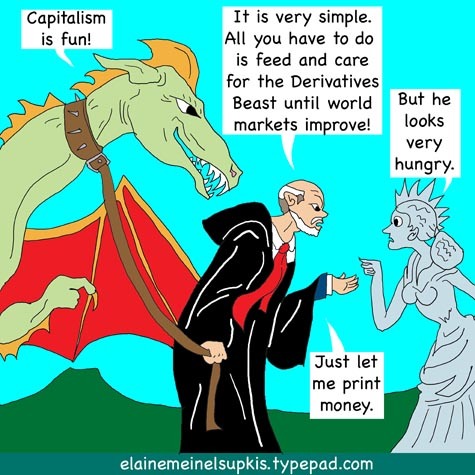
Lest you fear that I have at last taken leave of the modern world, I will end this post with a recommendation for an excellent piece of knowledge-based writing that I would never have been able to find without the internet. Nicholas Hildyard's A (Crumbling) Wall of Money might as well have been called 'Derivatives for Dummies'. I would suggest you read in small chunks, for the same of your blood pressure.

4 November 2009

The Grand Larceny

When I was young we once played a fantastic game with this name. It involved drawing up a list of items which would be very hard to access, then assembling a week later in teams and thieving said items. The most daring raids garnered the most points. I was a wimp even in those days and spent much time gathering many, many milk bottles.

I'm not proud of relating this tale, but even now I remember the excitement of the game - the edginess and competitiveness attached to doing something that was not permitted and involved the thrill of the chase, since some items were unique and had to be stolen before others reached them.

This game was brought to my mind recently, when I read for the first time about the true nature of the extraordinary deception that was practised on the US people under the guise of 'rescuing' financial institutions. Here is the story that set my teeth of edge, and reassured me that there are some journalists who still understand that their job involves investigation and not mere reportage.

The reporters from Bloomberg have picked over the ashes of the dodgey deals between the US Treasury Department, Goldman Sachs, the New York Federal Reserve Bank and the insurance giant AIG. The latter had been creating the infamous ‘credit default swaps’ that bundled up worthless unpayable loans as assets. After the bubble burst, AIG had been trying to persuade the banks to share the losses by taking less than the full value of these ‘assets’ – the article mentions a rate of only 60% of the stated value.

This was all happening a year ago – when most of us were looking on aghast at the instability and destructiveness of the financial system – but the sharks were looking for a killing. The then Treasury Secretary Hank Paulson (the former CEO of Goldman Sachs) used his political power to force AIG to recompense the banks in full. On the basis of this, current Treasury Secretary Timothy Geithner (then President of the Federal Bank of New York) refused to accept any deal with AIG, precipitating its collapse. This collapse was only prevented by an injection of public money amounting to $182 billion dollars.

So here is the larceny. A massive sum is transferred from the working people of the US to a few powerful and extraordinarily rich men. We cannot trace the exact details of how two former bankers who now run the US economy receive their ill-gotten gains, but the picture is fairly clear even without this detail. We are no longer watching politicians bailing out banks; we are being governed by bankers for their own benefit.

7 October 2009

The End of Hegemoney?

Now that the cracks caused by the earthquake that struck the global economy last year have been papered over to the satistfaction of most casual observers, and with stock markets forging ahead (fuelled by the quantitatively eased money that cannot be found for the public sector), the more interesting consequences of the financial crisis are beginning to unwind.

The most potentially momentous is the threat to the hegemonic position of the dollar in world capitalism. Way back at the G20 in April - when our attention was successfully diverted by the trivial tittle-tattle about bankers' bonuses - the Chinese kept their eye on the ball. They joined the Russians in proposing a new neutral international currency to replace the dollar. This call was repeated yesterday by a UN panel - was it a coincidence that this happened on the same day that news leaked about secret deals between the oil states, the Chinese, Russia, France and Japan to end the rule of the petro-dollar by trading petroleum for a basket of currencies? And from a UK perspective, notice which of the 'leading world economies' is missing from this list.

The embarrassing visit by Hilary Clinton to Beijing in February, where she effectively begged the Chinese to continue buying US debt, indicated the desperate position of the US economy - and polity. With quantitative easing on a grand scale being the only thing keeping the once-mighty dollar afloat its credibility as the foundational currency for the world economic system is utterly undermined. If China ends the rather one-sided deal by which it acquires pointless bits of paper in exchange for massive quantities of consumer goods, the financial crisis will return with a vengence and the US economy will be sucked down into the whirlpool of its own debt.

But are the Chinese seriously proposing the Yuan as a viable alternative? Can the currency of a state capitalist economy play the role of currency of first preference in the global economy? China is now selling its own debt in Yuan rather than dollars and because their currency is backed up by real economic power it should prove popular with investors. But the Yuan is not subject to even the limited influence of speculative movement by international capital. It is non-convertible and still politically controlled by the Chinese Communist Party. It is this control that has enabled China to expand so successfully, because it never faced the risk of having its currency picked off by global capital if it looked too threatening, as happened with the once fierce Asian tigers and the Russian rouble in the late 1990s.

So what is China's game? What does it plan to do with the power its people have won for their state through their hard manual work over the past 30 years? For the sake of humanity let us hope that they plan to use this power as political leverage over the US at Copenhagen. The US needs to be helped to manage its way down from the position of bloated, gun-toting pariah that controlling the world's hegemonic currency has left it in. If the US offers a serious movement on carbon reductions in December, perhaps the rest of the world can allow it a graceful descent, rather than the catastrophic demise which China could precipitate at any moment if it were to flood the market with US Treasuries, or refuse to buy more.

The asset bubble that led to last year's financial crisis began way back in 1971, when Nixon reneged on the Bretton Woods deal. The supreme economic dominance that the US has enjoyed since then was won by foul means, not fair ones. The people of the world and the planet itself have borne the cost in wars the US should not have been able to afford to fight and a lifestyle that was never earned from its own work or resources. But secret deals between the leaders of a small number of powerful nations is no way forward for a peaceful and stable world. We need to repeat the call for a global financial structure to be negotiated democratically, not fought out between Washington's Dogs of War and the dinosaurs of the Chinese Communist Party.

14 July 2009

Mr. Bean to Explain Quantitative Easing Policy

This is one of those moments - like when Tom Lehrer gave up satire to commemorate the award of the Nobel Peace Prize to Henry Kissinger - when you feel that all comedians should retire because the whole universe has been created by an almighty stand-up comedian. Not so much intelligent designer as cosmic joker.

Yes, the deputy-director of the bank of England is really called Mr. Bean and he really is undertaking a national tour to convince us of the seriousness of the policy of Quantitative Easing. The BBC managed to post an online story about this with every sign of a straight face:

'Mr Bean is in Leeds on the first leg of a tour of the UK, attempting to explain what the Bank calls its "conventional unconventional" measure to counter the recession. Armed with a box of explanatory pamphlets, optimistically entitled Quantitative Easing Explained, he is on a single-handed mission to the world of gilt yields, money velocity and commercial paper to the people.'

Excuse me - I am loving this so much I can't type straight for fits of hysterical laughing.

It is good enough that the bank have admitted that money was always created from thin air, that the whole time they have been creating money as debt - at huge cost to citizens and the planet - it was completely unncessary. That has given me great satisfaction. But that they leave the task of explaining this policy in the hands of Mr Bean is just a delight too far.

Indications are that the public are unconvinced - questioning why the money is not reaching the small businesses it was apparently created for. The explanation is simple: the vast majority of the thin-air money has been used to buy up national and corporate debt and not sent to small businesses that are strapped for ready cash.

According to the BBC, 'Mr Bean hopes to work out if the bank's policy of pumping billions into the economy is beginning to ease the severity of the recession.' It's just as well they only have Mr. Bean on the case. Anybody with a slightly straighter picture of reality would quickly grasp that this was never the intention. Bankers and corporations have seen their share of the cash; businesspeople and taxpayers will just be paying the tab.

24 February 2009

When is a risk not a risk?

Today the the talk is all of the additional money we are now required to find in the future to pay for the past mistakes of banks. This time the discourse has shifted subtly. Rather than bailouts this is, apparently, insurance.

Let's spend a while to ponder that concept of insurance. The original insurance companies were mutuals, which meant that it was a way of genuinely sharing risk. The risk was that something would happen that you couldn't afford to pay for. Perhaps you would die and there would be nobody to earn money to feed your children; or your house would burn down and you would need money to rebuild.

Once you privatise insurance the risk becomes the sort of risk a gambler enjoys. Now we have a whole new profession - the actuary - whose job is to do the complicated statistics that enables a company to charge each person enough so that the small number of catastrophic events that befall the minority of policy-holders will cost less than the premiums taken from all - thereby generating profits for the company.

In this situation we are still dealing with sharing of risks between people whose chance of facing disaster is more or less the same. But the sort of insurance we are talking about in the financial world - when it comes to AIG, for example - is of a different order entirely.

Companies that ensure 'financial products' that they don't understand and can't investigate closely are gambling on something over which they have no control. The financial companies that create and sell the products are simply passing the risk down the line. In the good times the insurers are raking in premiums and making money for old rope. When the bubble bursts they are going to be the first to go bust, since they are at the bottom of the pile.

Apart from us, of course. Because under the pyramid of bad debt sits Joe Public. Today we are being asked to 'insure' the losses of Lloyds and RBS. The problem with the use of the word 'insurance' to describe the £600bn. we are going to oblige our children to pay is that the disaster has already happened. We know that the loans made by the banks will not be paid back. This must represent another creative move by the financial engineers: a move into ex-post-facto insurance.

18 February 2009

The Artists' Way


It was Lesley Greene, the Green Party councillor in our local well-heeled village of Bisley who first made explicit the importance of art in a low-carbon economy. 'Once the oil runs out', she intoned in her rather pukka way, 'there'll be bugger all else to do'. Now it seems that local artists in Stroud and Dursley have found a way of using the recession to their advantage.

As economic times get harder the property rights carefully honed by the marketeers will start to buckle and bend. I'm not talking bread riots, here, but questions about why property should stand empty when others have a desperate need for it will become sharper. In the end people will ignore the law and start taking over what they need for themselves, their family and their community.

This was the situation in Argentina following the economic collapse of 2001. Named 'la Toma' (the Take), it was a spate of spontaneous actions by workers, who moved backed into factories from which they had been made redundant and restarted them as worker co-operatives. Capitalism had broken down but they still needed work and people still needed the product of that work.

The artists in Dursley are bringing life, creativity and vitality to a row of shops in the town, and the Woolworths in nearby Stroud, a mecca for artists since the time of the Arts and Crafts movement, is likely to follow soon. To think of these one-time temples to consumerism being liberated is refreshing, but the issue of land requisition or squatting will be next on the agenda as the recession bites deeper.

16 February 2009

A Matter of Life and Death


I've been relying for some time on evidence of the disastrous decline in life expectancy in the Soviet Union as an indication of the negative effects of the rapid imposition of a market system. A detailed study published recently in The Lancet provides further underpinning for this case.

The key conclusion of the report is:

Rapid mass privatisation as an economic transition strategy was a crucial determinant of differences in adult mortality trends in post-communist countries; the effect of privatisation was reduced if social capital was high.

The authors are careful to avoid saying that a market system is intrinsically bad for your health. Rather it is the rapid move from one economic system to another that results in social, economic and consequently psychological dislocation. Other medical researchers, such as Richard Wilkinson and Kate Pickett, would disagree with this. Their new book has acres of graphs and tables indicating that the inequality inherent in a market economy itself is, literally, a killer.

If it is the rapid change that causes morbidity and mortality then we can predict a very unhealthy future for Western societies facing climate change and depleting oil supplies. What the research shows is that it isn't the lower living standards but the shock to the system of everything you have always known falling apart. Loss of meaning leaves human beings suffering from what Durkheim called 'anomie', resulting in aggressive behaviour and lack of self-respect and self-care.

By contrast, if offered a strong vision and when encouraged to co-operate to reach a shared goal people thrive, even if their material consumption falls. This is the message of the Transition movement, but one that is distressingly absent in the prescriptions of our politicians, who are still clining to an outmoded and unworkable social and economic model.

Let other folk make money faster
In the air of dark-roomed towns,
I don't dread a peevish master;
Though no man do heed my frowns,
I be free to go abroad,
Or take again my homeward road
To where, for me, the apple tree
Do lean down low in Linden Lea.

From Linden Lea by William Barnes, made famous as a song by Vaughan Williams (it's better with the music!)

5 February 2009

Screening out reality

It has become a shared understanding of our culture in recent years that people are losing touch with the real reality - the one that exists outside our windows - and replacing it with a virtual reality that they imbibe through a screen. In fact, we might go so far as to suggest that the new class divide in our society is between those who gain their sense of reality through a plasma screen and those who find it in a computer screen.

This was made explicit earlier in the week, when heavy snowfall in London created a virtual reality where nobody dared venture outside their homes. In the real world, life could have gone on virtually unchanged in Birmingham, where I was to be part of a Green Dragons' Den panel. But it didn't. Alarmed by TV reports of ice and snow, people stayed at home and the streets and shops were deserted.

I experienced a similar sense of dislocation during the build-up to the Iraq War. I counted myself lucky that I was in Wales, where obviously the neo-colonialist experience meant that the general opinion would be heavily against the war. But talking to friends in other parts of the country I heard that this view was widely geographically shared.

But not shared by the media. Although in our pubs and workplaces we found people agreeing with us, views reported in the media were far less radical. Even though opinion polls showed opposition to the war around the 70-80% level, it is harder to take this seriously when mainstream views dominate the airwaves.

Can we assume that there is a similar shared opinion regarding the need for radical economic action to tackle the financial crisis? It is clear that anti-capitalist views are being barred from the BBC and other TV and radio stations. The most interesting and radical opinions are emerging through phone-ins. It seems to me it is time for us to reclaim our radical tradition - to reject the view of ourselves as a nation of cat-lovers and sports fans and remember the heritage of Tom Paine and Oliver Cromwell. Rebellion is in the air, if not on the air waves.

21 January 2009

Starting to Feel Queasey


There is considerable discussion in green circles these days about whether we should support the nationalisation of the banks. We need to be clear about what this means. First, we need to distinguish between ownership and control. At present, the government is taking on ownership of the banks but, because of its ideological revulsion from any sort of economic management, it is not controlling them.

This is an irresponsible and dangerous policy. Brown and Darling appear to have naively believed that, once substantially publicly owned, banks would automatically start acting in the public interest, abandoning a lifetime of self-interested profiteering. They still appear reluctant to appoint citizen directors, or other public-minded experts, to the banks' boards. A green proposal for control of the banks would surely also include their breaking into smaller, regional and local banks with requirements to serve businesses in their local communities with lending facilities.

The more serious question is whether we can afford to support the banks. Where is the money coming from to balance the bad assets of the bankrupt banks? Initially, we were borrowing it from our children. Now we are creating it in return for our financial credibility in the world - hence the precipitate decline in the pound. The end of this road comes when private-sector investors refuse to accept government 'paper', effectively ceasing to believe that the assets and workers of UK plc can make good on the IOUs.

It appears that we are reaching that situation. The value of long-term gilts (money borrowed from investors now that we promise to pay in 30 years' time) is falling. The quantitative easing we have heard so much about is being used only as a bootstrap technique to conceal this unpopularity of government debt. So the Bank of England is providing itself from nowhere with the ability to buy our own national debt.

No country can absorb the sorts of debts that have been produced by reckless bank lending. The policy of quantatitive easing to finance the unfinanceable lacks all credibility and begins to suggest a situation where, by taking on bankrupt businesses, we may be moving towards banktupting our own nation.

19 January 2009

Over-Shadow Chancellor


Ok, I admit it: I've been naive. I genuinely believed that (a) Gordon Brown understood the nature of the financial crisis and (b) the absurd policy of throwing billions of pounds into the black hole of bank debt was just a shoring up measure while something less outrageously unjust - and capable of rebalancing the economy - was stitched up behind the scenes.

I now realise I was completely wrong about this. The grey suits really don't have a better idea than just fiddling on with more of the same in the hope that, somehow, the greedy corporate gamblers who got us into this mess will find some way out. My evidence that this is the case? The re-emergence of Ken Clarke - the chief proponent of smoke and mirrors economics under the discredited Tory regime.

I've noted frequently on this blog the ubiquity of this 'man of the people' who also rubs shoulders with the leading corporate players. In a move whose significance could not be more symbolic he is now being brought in to the job of mirroring Mandelson, while over-shadowing the flimsy toff-wannabe George Osborne. There is no doubting where the real power now lurks in both front bench teams.

The presence of the Big Bilderberger Beasts on both sides of the dispatch box make it clear who is really running the political show. Voting for any of the 'main political parties' can only ever be to encourage them.

17 January 2009

No, no, no

Margaret Thatcher was not a politician whose reputation was built on her facility to produce a well-turned phrase. She was famous for employing armies of speech writers and taking elocution lessons. Recent politicial shenanigans have forced me to borrow one of her least eloquent quotations and, indeed, have filled me with the sort of rage that must have propelled the intransigent termagant through 20 years of destructive policy-making.

How can it be that we have seemingly taken on the chin decades of servitude to pay for the banking bailout? I have lost count of the dizzying sums involved (if anybody knows where these are handily calculated please drop me a line) but when I last looked it was already enough to keep my putative grandchildren on the capitalist treadmill long into their dotage.

The people we are dealing with here are wideboys and sharks. They are the kind of people who, when given and inch, will take a mile. So we should not be surprised that having pulled this scam so spectacularly in the autumn they are now coming back for another go in the new year.

When it comes to the executives and shareholders of Barclays and RBS, and those who trade in their shares, we are talking about people who are in the habit of living off the work of others. In a recession, of course, when the economy is shrinking and money is tight, they cannot extract value using the traditional methods. They need to bully and defraud the government and taxpayers.

The tactic appears to be for stock-traders to target particular financial institutions and drive down their share price. Those controlling large numbers of shares, working with short sellers, can provoke massive downward movements in company values. The media creates a shock-horror story headlining the 'inevitability' of more public money; the politicians dutifully oblige.

The phrase 'public money' feels safe, almost positive, and is a cover for the fact that money is now being extorted from us and our descendants to be sent directly to bank directors and shareholders. This was originally billed as an unpalatable emergency measure - it now appears to have become routine. The phrase 'impotent rage' seems to sum up how I feel. Any suggestions as to means for making this rage potent would be welcome.

14 January 2009

Paradigm shift


I'm launching my book this afternoon at Ruskin College in Oxford. The commissioning editor has written a few words for the launch and it reminds me of how much the world has moved on in the 18 months or so since I started writing. He recollects the supreme self-confidence of global capitalism in 2006/7, its claims to be not only the greatest economic system in the history of mankind but the only possible way of organising economic affairs: as unchanging as the laws of physics.

How paltry those claims seem now. Green economists were always aware that the economy was failing in two fundamental respects: it generated huge inequalities which led to deaths and suffering in the poorer countries and the poorer parts of our own country; and its expansionst logic threatened the health of the planet. Now it is failing in its own terms as well.

Unlike the vultures who circulated around Woolworths and other familiar friends on the High Street who are now defunct, few will bemoan the special offer deals that should die with the death of capitalism. As this excellent cartoon by Imogen Shaw shows, we have far more to gain than to lose from the new paradigm we will build together.

31 December 2008

Is this the year of the steady state?


The economy has ceased to grow, in fact it has begun to shrink. Interest rates are now at marginal levels and may soon drop to 0%. Combine this with the falls in stock prices and you realise that it is no longer possible to earn money from having money. These are the very characteristics of the steady state economy that greens have been calling for. So should we be celebrating?

The problem with interest and other forms of using money to make money is that it is mortgaging the future. Since money is expanding goods will need to be increased so that they are available when the people who have that money come to demand them. And all those goods need resources and energy to make them. This is an unsustainable way of running an economy.

Because of this link between expanding money supply and increasing demand for goods, in a capitalist economy unless you have constant and exponential growth the money system will collapse--as it just has done. But rather than try to reboot the money system and desperately try to stimulate more economic activity, wouldn't it be more sensible to use this opportunity to shift our economy onto a more sustainable path?

Herman Daly's concept of the steady state economy is one where you do not take more resources from the planet than can be replenished and where scarce resources are used frugally and recycled. The concept also has significant implications for the population, which needs to be stabilised. He argued that this is the only sort of economy that can be sustainable on a limited planet.

The coming year is going to be a grim and challenging one; we will see the darkest face of capitalism. But it will also offer great opportunities for those of us who have a clear vision and proposals for how to bring it to life to make those arguments.

16 December 2008

The Q&A of the Borrowing

I was recently commissioned to answer some questions about where on earth the government is getting all of this money from - a question asked by many in pubs and on buses up and down the land. Irritatingly, they did not then publish the answers I had spent time considering, so I offer it now, in a temporary change to the style of the blog. Comments and corrections are welcome.

What is government borrowing?

When I learned my economics this was called the PSBR or ‘public sector borrowing requirement’ but it has since been renamed the PSNCR or ‘public-sector net cash requirement’. These renamings usually have political intent and in this case I’m guessing it it is to get away from the unhealthy concept of ‘borrowing’. This is the annual amount that central government, local government and the public services borrow each year to keep themselves going. The ‘national debt’ is the accumulated total money that government has borrowed over the years which it couldn’t afford to pay back. Sometimes it goes down but, since the Bank of England was set up in 1694, the trend has been steadily upwards.

Where does this money come from?

The government has three sources of revenue: taxation, where it takes money directly from companies or individuals; from selling government bonds; and from printing money directly. The last of these has become increasingly unpopular since the Second World War, but is in fact a liberating way for government to create money without putting anybody into debt. At present government only creates note and coin in this way, which represents around 3% of total money.

What role do gilts play?

Gilts is just another name for government bonds—gilt-edged securities—because they are safer than anything else, since so long as the country doesn’t sink the government is bound to pay interest twice a year on them. Investors will get their money back after a certain fixed time specified on the bond, however before that time the value of the bonds will fluctuate, depending on the rate of UK interest rates. If interest rates are expected to fall, investors will tend to buy bonds because they are likely to be worth more in the future.

Who is stumping up?

This is an interesting question. Why should anybody want to invest in UK bonds when our economy is clearly short of a paddle and in unpleasant surroundings? If you are somebody with plenty of money to invest your primary concern at the moment is going to be security, so bonds might look quite attractive compared to stock in a corporation. So your gamble is likely to be about which countries bonds are most attractive, based on your view of how the interest rates of countries are going to move. Given that all countries are cutting interest rates one would assume that all national bonds are equally (un)attractive.

This question makes it clear how we are all entangled in the same mess. China owns a vast quantity of US treasuries (their name for government bonds) and if it chose could sell these and destroy the US economy. But if it did that it would lose its main export market and its own economy would falter. So, on a global basis, owning more stock doesn’t necessarily make you more powerful. Remember the old adage: if you own £1m. the bank owns you, but if you owe £1bn you own the bank!

Why should anybody buy our national debt?

Your ability to sell you bonds depends on the general perception of your reliability as an economy. This was the problem Iceland faced, being a volcanic rock with a population the size of Bristol and no resources other than fish and hot water, it couldn't realistically stand behind the debts that its entrepreneurs had racked up. A country’s ability to do this depends on its perceived power in the global capital market. The most powerful economies are those that control the ‘reserve currencies’—the dollar, euro, pound, yen and Swiss franc. These are currencies other governments hold their national reserves in and therefore are good for massive debts. The US is in a special position because in 1944 it negotiated that its currency would actually be held as equivalent to gold in reserve terms. It had to maintain a link between its currency and gold to back this up, but broke that rule in 1971 and since then has been able to print paper and get massive amounts of resources in exchange for it.

The UK is therefore in a strong position in increasing its national debt. One important way of measuring this is comparing the amount our economy produces each year with the size of our national debt—the so-called debt-to-GDP ratio. Ours is currently around 40% and is predicted to go above 50% as the recession deepens. Argentina went bust in 2001 with a debt-to-GDP ratio of less than 40% and a healthy level of exports and resources. The difference was it did not have a reserve currency and when speculators targeted the peso the government could not defend it. So it is really about political rather than economic power.

Who calls in the debt, both to the banks and the government? When?

So long as government continues to pay the interest it owes on the bonds there need never be any ‘calling in’ of the debt. There never has been since this malarkey started in 1694. When the bonds come to the end of their life, the government creates new ones to pay back the people who bought the old ones. The same people probably buy the new ones—at least to some extent.

Aren’t we the taxpayer then going to pay for what we’ve lent?

Yes. Absolutely. This is why Percy Bysshe Shelley called the national debt ‘a system for transferring income from the labouring segment of the population to those who’ had money to lend to government and would thus accrue interest, and who profited from government expenditure in wars. It is a way of transferring money from the poor to the rich and always has been. Amazing how they’ve got away with it for so long isn’t it? I wonder how many people will wise up now.

The banks seem to want to have their cake and eat it; they can take our money but still decide that we’re too much of a risk to invest in?

What is happening with the banks is a bit different. They do not lend pre-existing money but create money through a multiplier process—because they never expect all depositors to come back for their money at the same time. But to accept other banks’ promises to pay requires mutual confidence between the banks and this is lacking. You can see it as rather like a pyramid-selling scheme. While you can find new buyers it works fine, but when the market is exhausted the people at the end of the chain lose their money and the system collapse. That is what just happened. The only way out is for banks to believe in each other again—which is what the government is trying to ensure. Then they will bring money into existence again and the whole upward spiral can start again. So, to be fair, I don’t think the government gave money to the banks to be passed on in loans, but rather to reboot the system. This doesn’t appear to have worked and banks are only following their rulebook in not lending their own money.

Why does government policy on banking keep changing?

When the Rock started the rot the government still believed it could stop the rapid downward spiral if it stood behind just this one bank, initially just in theory. But the bad debts were so frightening to the banks that this didn’t work and it was clear that other banks—-perhaps all the banks—could go down like dominos. At that point it took complete control of Northern Rock. At each stage it has in mind to achieve the rebuilding of confidence as cheaply as possible. Supporting Northern Rock did not rebuild confidence so then they moved to the full-scale bail-out. This also doesn’t seem to be working, since credit is still tight. In a world where businesses rely on debt to survive this is now damaging the real economy that provides goods and services. So the economic bail-out is the latest stage. But it is still jump-starting and is by no means guaranteed. We will have to pay the damage whether or not it succeeds.

There is still no plan to address the problem at source, which is the gap between nominal value in terms of finance and real value in terms of what our economy actually does. On a global basis, 98% of the transactions that take place everyday have nothing to do with the real economy, they are just gambling in the casino economy, most of it speculation in the possible future rises and falls in the value of the various currencies. This is a much more efficient way to make money than actually making stuff.

This sounds like a merry-go round rather than a rescue plan?

It always was a merry-go-round. That is how finance works. It has worked fairly well for the 200-odd years that we have lived in the capitalist economy, but with periodic booms and busts. To achieve a steady-state economy would also require stable money. Government could just create that money by fiat—we would believe it because we believe the government, just like investors believe in the value of government bonds. But this would be money creation without debt. The difference would be that the process would not require our work to pay back the national debt and would therefore undermine the work-money nexus at the heart of capitalism. Sounds tempting doesn’t it?!

Surely the global financial system as currently configured is on any accepted measure a write off?

I agree with you about this. I think the only solution is to go for the full-scale jubilee and go back to the Bretton Woods conference table. We could then reinstate the two major planks of Keynes’s plan at that time: balanced budgets between nations with fines for deficits and surpluses, and a neutral international currency so that no government had the ‘reserve currency’ advantage. In addition I think we could tie this currency to an agreement on climate change and therefore stitch the environmental crisis into the solution too. The main difference between then and now is the liberalization of finance so that it is not under national control. This needs to be reversed with the reintroduction of credit and exchange controls. Without control of finance how can a government claim to be sovereign? And how can we imagine we live in democracies?

8 December 2008

Don't be fooled by the credit window


The private market banks have failed and the function of banking has moved into the public sector. But, taking one step bank, we see that the function of creating money in the private market has also failed. Reducing interest rates, i.e. making money cheaper to borrow, has not managed to stimulate the money creation system that is privately operated, and relies on debt for its existence.

So this monumental market failure requires the public authorities to pick up the pieces again. As all existing money disappears into bottomless pits of commercial debt, governments are considering exactly how they are going to put more money into the economy. Now is a useful time to learn, because the fact that governments can do this proves the case that has long been made by monetary reformers: that we do not need to go into debt to create money to pay for public services or a citizens' income scheme.

The money that will be created by public credit is plainly and unquestionably our money which gives us an unarguable right to decide precisely where the metaphorical helicopter is hovering when the balding and over-excited economist starts shovelling crisp notes out of the side door. No doubt the bloated beneficiaries of government largesse in the construction and arms industries are gesticulating wildly for attention. My choice would rather be using this opportunity to introduce a Citizens' Income scheme. The money would be much more likely to be spent than saved, and therefore achieve objectives other than simply keeping the capitalist economy afloat.

The image of the economist at the helicopter door is particularly appealing, since I have always believed that most economic theory is analogous to the window that was pushed out of aircraft during the war to mislead radar systems tracking their movements. For those with alert antennae this is a time when the real workings of a capitalist economy show themselves especially clearly.

15 November 2008

Dreaming the New Economy

I had an exciting experience on Monday, at a meeting of the Executive of the UK Society for Co-operative Studies. This seems an unlikely setting for an epiphany, but perhaps not when you recall I was amongst friends who had not only been expecting the failure of capitalism but working steadfastly as part of a saner and just alternative for most of their lives.

For half the people in the room the end of a capitalism was already a known reality, and the more I thought about this the more I realised that they were right. Had governments not intervened, the financial sector and then the real economies of the leading capitalist nations would have collapsed over the past couple of months. We the people are now supporting the economy - and also owning large parts of it. That is not capitalism according to any definition I can think of.

Sharing this thrilling news with others can be an interesting experience. When I spoke at a public meeting in Lancaster on Tuesday a couple of people had violent physical reactions to the news - as if they had received significant voltages of unexpected electricity. Others warily pointed to the adaptability of the system in the face of past crises and collapses.

This is a good lesson to remember, but what it tells us is not that we are wrong to think that capitalism is finished but rather that now is the crucial time to argue for the utopia we want to put in its place. We have to have the courage right now to dream the future we want to see, to demand it, and to build it together.

When I used the phrase 'building the post-capitalist economy' as the subtitle for my book Market, Schmarket in 2006 it felt like whistling in the dark, singing songs of hope in the face of the juggernaut of globalisation. But the power of capitalism was always more apparent than real, always the power of the conjuror. Let's not be mesmerised now: now is the time to create the better future we have all dreamed of.

16 October 2008

Hero or Heroin

I'm sure Gordon Brown was secretly delighted to have been compared with Flash Gordon at a recent press conference. Given his recent shady dealings with the bankster fraternity I would have thought Flash Harry was more appropriate. What would the flaming red Gordon of his student days have made of this man who is putting the poor of this country in debt to prop up a failing capitalist system?

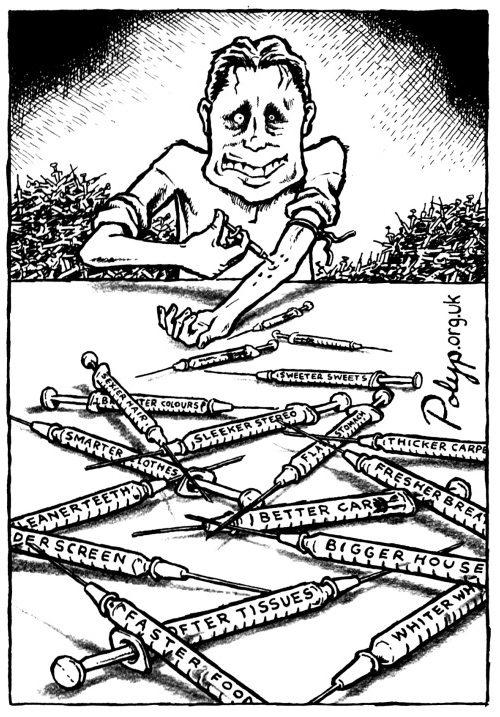
But is it the right thing to do, to fuel capitalism's addiction to money? Isn't Gordon rather acting as a drug dealer, providing more of just what is worst for the global economy, bloated with years of excess and destroying the body it depends on?

If you will indulge my extended metaphor for a while longer, perhaps we could explore what mechanisms we might pursue to tackle the addiction, to move the economy away from its moneylust and towards a balanced steady state. What would be the methadone that we could introduce as a substitute during the transition?

Gordon is calling for a summit to debate a new financial architecture. Part of that might be Richard Douthwaite's Ebcu or environment-backed currency unit. This is a neutral currency created by agreement between the world's nations and under their control. It could contribute to a global economy where the economic power of countries was more equal; in a world dominated by the dollar this can never be the case.

But more importantly, because the ebcu is linked to emissions of carbon dioxide, it operates like a carbon standard, linking economic activity to the ability of the planet to support that activity. It follows the Contraction and Convergence model for a decline in CO2 emissions and a fair sharing of these emissions between countries.

Although the 'summit' will be exactly that - our exalted leaders meeting like so many Old Testament prophets on the mountain top - we should make our demands clear. The agreement should be for a steady-state economy that balances the interests of the people of the world, and the planet we all depend on.

[Thanks to Polyp for another brilliant cartoon. Visit his website and check out his great new animated version of the rats in the trap]