Showing posts with label self-provisioning. Show all posts

31 August 2012

From the Men of Property the Order Came

This week another part of the protection of the vulnerable is stripped away, as the government changes a clause in existing legislation to make squatting a criminal rather than a civil offence. The effect of this is to enable the wealthy to demand that the police undertake to remove squatters from their second or third homes at public expense, rather than them having to undertake civil action at their own risk. Squash, the squatters' support campaign have estimated the cost of squatting at £790m, money we will pay to defend the property interests of the wealthy.

In spite of its urban and somewhat risqué image, squatting is a noble and ancient tradition. Originally it meant squatting on land, laying claim to the right to provide for your own subsistence, to which the building of accommodation was secondary. Much as the members of Brazil's MST do today, our ancestors challenged the feudal land system by occupying farmland and providing for their needs. It was the shift of the economy towards a labour market and industrial production that changed the focus of squatting towards merely the need for a home.

The BBC quotes Housing Minister Grant Shapps as saying 'No longer will there be so-called 'squatters rights'. Instead, from next week, we're tipping the scales of justice back in favour of the homeowner and making the law crystal clear: entering a property with the intention of squatting will be a criminal offence.' This is a typical example of the divide-and-conquer tactics of the Tories, who ignore the fact that many of those who are homeless are in work, but are paid too poorly to afford the profiteering level of rents in many of our most expensive cities, and especially in London.

The answer to the homelessness crisis is for government to intervene in what should never have been a housing market. As a society we consider that education and health are too important for the vagaries of the market to control their allocation and their price - why not with housing too? And Tory ideologues should read their history and recognise the tradition of squatting as much more akin to the empowered economic response at the individual level that they so vehemently espouse than they might feel comfortable with.
.

16 March 2012

Squatting North and South

The Brazilian landless peasansts movement MST ( Movimento dos Trabalhadores Rurais Sem Terra) is well known for its advocacy of land reform to enable people to establish sustainable livelihoods through their own labour, rather than having to engage in exploitative labour-markets and unsustainable economies. I'm glad to see that they now have a website, telling the history of their movement and inspiring similar change in other societies.

In the urban context of Brazil the MST have now been joined by the MTST, the movement of roofless workers (Movimento dos Trabalhadores Sem-Teto). As they say on their website:

Nosso objetivo é combater a máquina de produção de miséria nos centros urbanos, formar militantes e acumular forças no sentido de construir uma nova sociedade. A ocupação de terra, trabalho de organização popular, é a principal forma de ação do movimento. Quando ocupamos um latifúndio urbano ocioso, provamos que não é natural nascer, viver e morrer pobre e oprimido. Não aceitamos a espoliação que muitos chamam de sina.

'Our goal is to combat the production machine of poverty in urban centres, to train militants and gain strength in order to build a new society. The occupation of land by people's organisation is the primary mode of action of the movement. When we occupy idle urban land we prove that is not natural to be born, to live and to die poor and oppressed. We do not accept the dispossession that many call fate.'

As well as their direct action in the form of land occupation, these people of the shanty towns, whose daily life is a struggle against violence and dispossession, communicate their social and political message through a theatre of the oppressed.

I've raised the question recently of why we don't think of the people who live in our deprived communities as 'landless poor'. Since our 'great transformation' to a capitalist economy took place so long ago we accept that without a job you are worthless, whereas in the countries of the South people's first demand is for land so that they can grow their own food, gather fuel, make furniture and so on, rather than having to enter into an unequal contract with an employer.

This demand does not arise often enough in the post-industrialised economies of the West, however the demand for land for housing does. It finds its latest expression in the campaigning group Squash, which is lobbying against government plans to illegalise squatting. This legislation, clearly designed to serve the interests of the land-owning, property-owning class who the Conservatives have always served, will cost £790m. according to research carried out by Squash. More importantly it will deprive the homeless and the landless with the thin vestiges of the right to indepedence that our legal system still respects.
.

16 June 2010

Join the Love Feast


I was recently invited to a Diggers Agape in Gloucester, which, as well as (or perhaps because of?) being the place where Harry Potter was filmed, appears to be the world centre of radical vicars. This sounded like such an esoteric event that I had to find out more about the idea. Here is what Simon Topping, who I believe to be a man of green cloth, although I have never seen him in a dog-collar, had to say about how the idea came about:

'There were three main influences behind the idea. Firstly, as you might imagine, I was influenced by the writings of Gerrard Winstanley and his central idea that “the earth was made by Almighty God to be a common treasury of livelihood for whole mankind in all his branches, without respect of persons.” From this starting point Winstanley goes on to reject the practice of “buying and selling” because no-one can buy or sell what is (or should be) held in common. Hence our idea for the Diggers agape that people should only bring things that have not been bought or sold.

'The second influence is the Christian idea of “koinonia” which is often translated as “fellowship” but, in many of its usages within the New Testament, actually implies material, economic sharing. This “koinonia” was put into practice through the early church’s community of goods in Acts 2:43-7 and 4:32-5 and through the collection of funds by Paul for the impoverished church in Judea (2 Corinthians 8:3-4 ff).

'Finally, the tradition of the “agape” or Love Feast (a non Eucharistic shared meal) has its roots in early church practice (Jude 12) but was revived by the Moravians and by John Wesley, the founder of the Methodist Church to which I belong. Agapes, though now infrequent, do still feature as an element of Methodist church life.

We had the first Diggers Agape in January this year and a second in April with about twelve people attending each one. Amongst the many and varied things which people have brought we have had spring water, nettle soup, elderflower cordial, a road kill pheasant(!), hawthorn and dandelion salad, hazelnuts, parsnip and apple soup, poems, stories, shells, a rendition of the Diggers’ song, a rewriting of Woody Guthries’ “This land is my land” to make it relevant to Gloucestershire.'

This all sounds too good to be true and I shall have to scour my garden, or gutter, for suitable produce for the next eucharistic love feast. Perhaps you could start something similar where you live?

6 May 2009

Revaluing the Wasteland

T. S. Eliot gave the wasteland a bad name. But then he did begin his famous poem with the words:

APRIL is the cruellest month, breeding
Lilacs out of the dead land, mixing
Memory and desire, stirring
Dull roots with spring rain.

Some cruelty! And he doesn't even mention the bluebells.

Yes, yes, I know he had a sort of spiritual wasteland in mind, where humankind had strayed off the path of learning Greek and revelling in high culture. His pessimistic view might have been tempered somewhat if he had strayed off his own path of intellectual endeavour and found his way into the highways and byways of the real Wilderness.

I have a soft spot for Eliot, though. Something about the cadence of his writing rather than the recondite content. And not unconnected to the fact that one of my first boyfriends caught me with a short bit of his verse involving a rose-garden - no doubt the wildest sort of place Eliot himself ever strayed into.

But I digress. What I meant to share with you was the vast range of uses that peasants once put wastelands to. This was before the days of the National Trust, when non-agricultural land was available for foraging rather than recreation. The study by J. M. Neeson called Commoners indicates just how much they were able to provide. Obviously there was grazing and the possibility to gather firewood and other materials that were used for fires — furze (gorse) and bracken (fern). Commoners also took hazel loppings to make hurdles for penning sheep, and fern was also used for animal bedding and, once burnt, its ash was used to make soap. In addition:

'Reed was plentiful and valued most as thatch for roofs and also to cover the stacks, ricks and clamps for all kinds of crops and vegetables. Rushes — bulrushes — were equally plentiful, waterproof, and woven into baskets, mats, hats, chair seats and toys. . . they were also good for bedding, as a netting in the plastering of walls, and wrapping for soft milk cheeses. They made cheap, bright rushlights too' (Neeson, 1989: 166).

The list of foraging crops, especially nuts, berries and fungi is equally long, and as varied as were the possibilities for salad crops and herbs that could be gathered. It is clear from these accounts that the commoning lifestyle offered two other characteristics crucial to a bioregional approach to provisioning: seasonality and shared experience.

The dismantling of the commons was disastrous for commoners but crucial for the growth of the industrial market system, which they were required to staff. Neeson’s account makes clear the link between the ending of subsistence and the population explosion which Malthus and other political economists later bemoaned. She also chronicles how the move from commoner to labourer undermined the resilience and self-reliance of British citizens.

14 March 2008

Home-grown Hats

Most of us can trace our families back to the generation that left the land. In my case this was my grandmother's parents, both of whom lived in the small Devon town of Ivybridge. I'm proud to say that various bits of the family still make their living in Devon and from rural trades.

I have always been most proud of my second cousin who is a thatcher. At a recent family event I discovered that he has now become a teacher but another cousin has, inspired by his example, taken up the thatching trade. My practical limitations give me immense respect for people who actually have a craft and so I was full of interest. This was somewhat diminished when he told me that the thatch he uses on the cottages of Devonshire is actually grown in China.

Here is what William Cobbett has to say on a similar subject (in this case Leghorn bonnets) in his Cottage Economy (written in 1820-21):

'The practice of making hats and bonnets, and other things, of straw, is perhaps of a very ancient date. . . In this country the manufacture was, only a few years ago very flourishing; but it has now greatly declined, and has left in poverty and misery those whom it once well fed and clothed.


The cause of this change has been, the importation of the straw hats and bonnets from Italy, greatly superior, in durability and beauty, to those made in England. . . It seems odd that nobody should have set to work to find out how the Italians came by this fine straw. The importation of these Italisn articles was chiefly from the port of LEGHORN, and therefore the bonnets imported were called Leghorn Bonnets.

The straw manufacturers in this country seem to have made no effort to resist this invasion from Leghorn. And, which is very curious, the Leghorn straw has now begun to be imported, and to be plated in this country. So that we had hands to plat as well as the Italians. All that we wanted was the same kind of straw that the Italians had: and it is truly wonderful that these importations from Leghorn should have gone on increasing year after year, and our domestic manufacture dwindling away at a like pace, without there having been any inquiry relative to the way which the Italians got their straw! . . . There really seems to have been an opinion that England couldnot more produce this straw than it could produce sugar-cane.'

21 February 2008

The Final Frontier

I had the great pleasure last night of listening to Doreen Massey give a public lecture. She is an inspiring example of a public intellectual, an engaged academic, who is both analysing and changing the world. She took as her theme 'the politics of place'. The lecture was highbrow stuff of the kind I often struggle with and in my attempt to convey some of what I learned I am no doubt about to commit mental GBH, but surely that is better than holding back for fear of misrepresentation.

What I like about Doreen's work is her clear statement that the 'end of geography', propagated as what she might call an 'imaginary' by the proponents of this late and most corrupt phase of capitalism is an illusion and should be nailed as such. We are as much indicted in a process of international exploitation as we were in the days when we sent our best and brightest to administer the colonies and half the known world was coloured pink on our schoolroom maps.


Her question - to herself and others - is how we can live a positive response to the globalised world we find ourselves in. She made me question my own easy notion about the local and its safety. How easy it is to sit in Stroud and wrack my conscience in choosing between French organic apples and fair-trade Kenyan mangoes. Within our Transition Town process we have a theme called 'learning from the South' and a commitment to community-to-community trade between ourselves and the poor countries. This is the path towards the solidarity economy that is the 'alternative globalisation'.

But Doreen is right that our involvement in the lives of those in far-distant places goes beyond buying their crops and using their time to provide cheap holidays in warmer climes. London is the capital of the financial system that facilitates the global trade system. This makes our responsibility for challenging that system and its consequences especially acute.

I feel sure that building a strong local alternative economy is part of the answer, but it is not enough. However, the alternative on offer last night - and this was a point made by several questioners - is to be left in a dithering limbo of indecision. Ultimately, any consumption more complex than self-provisioning becomes uncomfortable. Any food we didn't produce ourselves becomes difficult to stomach.

22 January 2008

Making Good Use of the Things that we Find

This blog is called Gaian Economics to engender a sense of reverence for nature and recognition that all our resources - everything whose study falls within the remit of economics - comes initially from the Earth. Indigenous peoples tend to have this recognition at the heart of their culture and practice - a belief they sum up by using phrases like 'The Earth is Our Mother'.

I remember learning in school about the Inuit (we called them eskimos then, of course) and how they used every last part of the caribou: skins for blankets, hides for wigwams, sinew for thread, bones for needles. Not a scrap was wasted, we were told, and we marvelled at this. Such a contrast to the way we lived even then.

I spent this past weekend with my good friends Lydia and Robert, co-creators of Thrift Cottage, and had the usual restful and inspiring time. Robert's knowledge of the natural world - trees and woodworking are his speciality - is something he has learned from joiners and carpenters he has worked with who come from a different era. He is always full of wisdom about his craft that is humbling to somebody like me who lives from their brain.


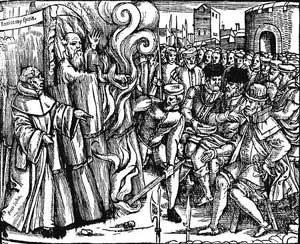
This weekend's gem was a short history of faggots and tallow. These two fundamental parts of the lives of our ancestors just a generation or two ago have slipped out of consciousness. The only picture I have ever seen of a faggot is on the woodcut from Foxe's Book of English Martyrs, but I was interested in converting garden and agricultural waste into fuel and so asked Robert how it is done.

His brother is the tallow man - he recreated by laborious practice the means of extracting this most useful substance from sheep's testicles (didn't I say everything had a use?) following instructions he found in a book from the 1960s. Boatbuilders and joiners are still using blocks of this natural lubricant. Robert says it is the best way of easing a screw into a piece of oak and the only lubricant that resists the tree's attempt to use its natural juices to keep it there. That puts high technology into its place.

16 July 2007

The Beauty of Thrift

I spent the weekend camping in rural Hertfordshire. I suppose it is difficult anywhere in the home countries to feel really in the countryside, but we were in a meadow full of wild flowers with a woodland and vegetable patch nearby.

Lydia has created utopia in a small patch of the South-East. Thrift Cottage is named after Anne Thrift, who left to Lydia the right to inhabit a small patch of Welwyn which she had enjoyed since before the passing of the Town & Country Planning Act in 1948. It so aptly describes the approach Lydia, and more recently her husband Robert, have taken to building the home they share with Scarlett.

Regular readers will wonder about my scatological tendencies, but I none the less need to share my excitement with Lydia's bathroom. Her toilet is a long-drop compost loo. You sit on a beautiful piece of retrieved hardwood which is always warm to the touch. You sprinkle a small quantity of fragrant sawdust, rather than flushing away your shit. All this takes places in an environment of tranquility, with wooden bookshelves and built-in wooden cupboards.

The whole eco-house exemplifies the attitude towards life that we need to foster to live in balance with nature. Opportunism is a key feature, with bricks, slate and wood scavenged from local skips and building sites. This is the Robinson Crusoe approach to building—making use of what your local environment provides—rather than driving to a builders’ merchant to buy building materials made elsewhere in the world—who knows where? I recently saw building stone wrapped in cling-film. It seems superfluous to mention the embodied energy both in the manufacture of bricks and blocks, and in their transport.

Other highlights included an outside bath: fill first and then heat by lighting a fire underneath, a summer pudding made with fruit picked in the local fruit patch, and a relaxing time spent on the turf roof.

Due to inept maintenance of the tracks and unfriendly timetabling I was forced to spend three hours of my homeward journey in Stroud. It was like a journey from the heights of the human spirit to their miserable depths. While I confess it is hard to imagine what the vernacular building style of Swindon might be, I cannot believe that it could be worse than the uniform blockwork, steel and glass, interrupted by mislaid tent-like structures, that is the landscape of Swindon today.
I made one of my increasingly infrequent visits to Tesco to buy an apple and noticed that the local media story was of a local murder by a young man of his mother and father. It felt possible to understand how somebody living in that degraded environment could be driven to such a level of cruelty and despair.