31 October 2008

Samhain blessings


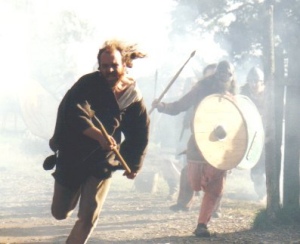
With November 1st we reach one of the pagan quarter days of the year. These have all survived the advent of Christianity in various guises - in this case the festival of halloween. Behind the tawdry pumpkin balloons and plastic tridents, what can we grasp of the deeper meaning of this commemoration of one aspect of our relationship with the earth?

In spite of the cold and the falling of leaves, this is a time of abundance on our community farm. Plants and animals are storing up energy for the winter - the period of rest that our restless economic system no longer allows us. In Celtic tradition, this time of year saw the slaughter of animals that could not be fed through the winter. This meat and the abundant vegetables were preserved for the times when the earth could not provide.

In the pagan system this is the festival of new year. The cycle of the year was seen as symbolic of the life cycle, from birth through flourishing to death and decay. And as the earth came back to life in the spring, so there was promise of reuniting with the earth mother in death. The fading of nature's life in the autumn leads to the dark thoughts of mortality that we now make fun of by dressing up as ghosts.

The failure of our culture to accept the rhythm of life is at the heart of our unsustainable exploitation of resources. Without any sense of connection with the earth we fear death as our final annihilation and struggle to make our material presence felt. Samhain is the best time to re-examine our attitude to death - and to life.

Global poll

Weggis has asked me to add this link to my blog:http://www.iftheworldcouldvote I feel a bit uncertain about the poll, since it seems to be tantamount to accepting that the US President has some sort of right to rule the world. The results are interesting though - especially to see where in the world people favour McCain.

27 October 2008

International Monetary Farce


Where do you turn as national chancellor when your country is bankrupt? If you don't have a reserve currency to protect you this is a situation you are pretty likely to face in the coming months. Your only option is to hope that you get in while the IMF still has some funds.

The International Monetary Fund is the part of the global financial system that is supposed to support the occasional accident that results from over-exuberant capitalist enterprise. It is not in a position to support the whole global banking system. Its pot apparently only extends to $200bn, which, given the size of money flows we've seen recently, appears extremely modest.

So, it could be that the Fund will be coming to national governments, asking them, on our behalf, to put our hands in our pockets again. Now we will be expected to bail out not only our own banking system, but whole economies across the world. The countries themselves will be required to take on more debt - the last thing they actually need. Surely it would be better to cancel all these debts in one almighty jubilee and negotiate the whole system again from scratch?

Imagine yourself as that national chancellor. You have only done what you were advised by economic theory. You have no control over global capital flows, and is isn't really your fault that your rely heavily on oil, or steel, or that you are a country which financial speculators don't like the look of.

The IMF tends to make offers to people who are in no position to refuse, and the offers are usually in the neoliberal mode, requiring restraint on public spending, a contracting state, and more market liberalisation. Exactly the sorts of policies that got those countries into the mess in the first place.

Interestingly, in the past few years many of the poorer countries who have been the recipients (victims?) of IMF loans have wised up and chosen to repay (see stories on Argentina and a story of recent IMF politics). In the insane world of banking, without anybody to lend to, the IMF would have gone bankrupt. It does seem a strange coincidence that exactly at this point a whole new range of countries are being forced into bankruptcy and into crippling loans that will keep the IMF afloat for another few decades.

23 October 2008

So Long, and Thanks for all the Fish

I feel tempted to begin in the immortal words of E. J. Thribb, 'so farewell then Iceland'. The country has overreached itself and been forced to learn the lessons of hubris. I had a conversation with my son in which I said 'Iceland is bankrupt' and he asked, 'What? The supermarket?'. That is the nature of the global economy - it is quite simply beyond belief.

What is the difference between Iceland and the UK or US? For once, in economics, there is a simple answer to that question: we have reserve currencies; Iceland does not. The viking raiders who bestrode the globe arranging impossible deals failed to grasp this fact about the global economy. Only those who are part of the charmed circle can get away with this sort of behaviour.

In a world of global finance, who is really backing up anybody's savings? If your bank is owned by a country with international clout it will be defended by others when the crunch comes. Iceland found itself left exposed - and rather smartly turned to Russia for help. This leverage appears to have resulted in 'support' from the IMF: the terms of this remain to be clarified.

Iceland is an object lesson in what is wrong with capitalism. Like all capitalist economies it grew exponentially and using debt rather than saved value. It ignored the fact that, with few resources other than hot water and fish, and with a population barely larger than the size of Bristol, it was always on borrowed time in its competition with the big boys of global capitalism.

But let us not be deceived by the 'one bad apple' mantra that is used to explain away capitalist disasters. Iceland was not an economic basket-case - it was just a country that played by the rules of the system without knowing its place and ignoring the crucial rule - if you are not at the top table you have nowhere to go when the creditors come to call in their debts.

21 October 2008

Can't Buy Me Equality

The news today is that we do not need to worry about the inequality in our society. A combination of poor people working more and stealthy redistribution of wealth has solved this problem, a new report from the OECD informs us. New Labour has been true to its roots and dealt with the problem of unequal distribution of wealth.

This seems a rather strange story to emerge from the OECD data when what it actually shows (see the figure) is that the UK is the seventh most unequal of the 31 countries that are members of the OECD and that, leaving aside the US, which is a self-referential scandal in equality terms, only Italy, Poland, Turkey, Portugal and Mexico are more unequal societies.


The data for trends in real household income by quintiles, i.e. dividing the population up into 5 strips according to how rich they are, is also interesting. It shows that for the UK, from the 1980s to the 1990s, those in the middle of the income distribution saw an increase of 2% in their incomes while the richest 20% saw their incomes rise by 4.3% and the lowest 20% saw their incomes rise by only 0.7% This was the time when Thatcherite inequality really bit into our social fabric. The fact that things have been reversed very slowly since then seems little comfort. The inequality that developed in our society then has not been reversed.

Leaving aside arguments over measurement and spin - we all know how assumptions and definitions can distort data findings - is it healthy for society and for the planet that the response to the inequality generated by capitalism is always and only through more work? The quality of this work is never questioned, nor its consequences for children being brought up without parents. And for a gaian economist, the question of the increased pressure on the planet that the extra work creates is the most important of all.

16 October 2008

Hero or Heroin

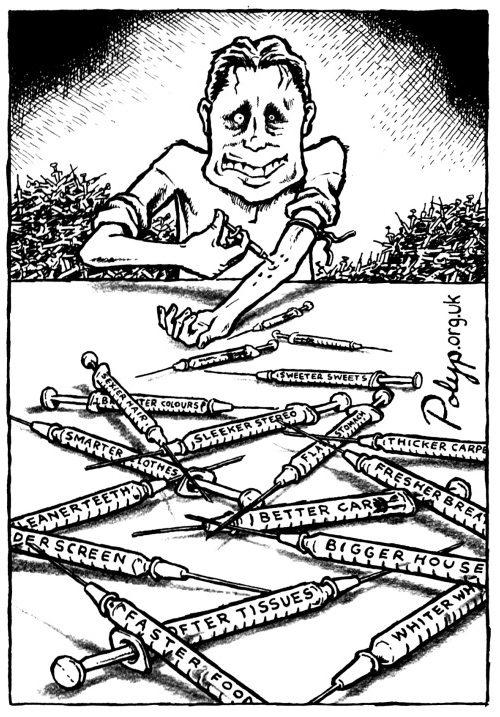
I'm sure Gordon Brown was secretly delighted to have been compared with Flash Gordon at a recent press conference. Given his recent shady dealings with the bankster fraternity I would have thought Flash Harry was more appropriate. What would the flaming red Gordon of his student days have made of this man who is putting the poor of this country in debt to prop up a failing capitalist system?

But is it the right thing to do, to fuel capitalism's addiction to money? Isn't Gordon rather acting as a drug dealer, providing more of just what is worst for the global economy, bloated with years of excess and destroying the body it depends on?

If you will indulge my extended metaphor for a while longer, perhaps we could explore what mechanisms we might pursue to tackle the addiction, to move the economy away from its moneylust and towards a balanced steady state. What would be the methadone that we could introduce as a substitute during the transition?

Gordon is calling for a summit to debate a new financial architecture. Part of that might be Richard Douthwaite's Ebcu or environment-backed currency unit. This is a neutral currency created by agreement between the world's nations and under their control. It could contribute to a global economy where the economic power of countries was more equal; in a world dominated by the dollar this can never be the case.

But more importantly, because the ebcu is linked to emissions of carbon dioxide, it operates like a carbon standard, linking economic activity to the ability of the planet to support that activity. It follows the Contraction and Convergence model for a decline in CO2 emissions and a fair sharing of these emissions between countries.

Although the 'summit' will be exactly that - our exalted leaders meeting like so many Old Testament prophets on the mountain top - we should make our demands clear. The agreement should be for a steady-state economy that balances the interests of the people of the world, and the planet we all depend on.

[Thanks to Polyp for another brilliant cartoon. Visit his website and check out his great new animated version of the rats in the trap]

14 October 2008

Nothing to Fear but the Flannel

It was the fact that we were hearing a lot about Zimbabwe on the news again that gave me the clue. The media-financialist complex has moved into a different gear. Now that they have frightened us into ramping up the national debt even unto the tenth generation we have stopped hearing the market disaster stories and the traders are playing along by boosting the values of stocks.

It is still unclear whether the elastoplast solution will work as there is as yet no sign of a fall in the interest rates banks are charging each other, or any increase in lending between them. The success of this latest attempt to reboot the corrupt banking system so that banks will accept each other's debts as money is not yet evident.

But what about the attempt to convince people that a system which has been variously referred to as a rollercoaster and a confidence trick by sober BBC commentators is the best we ingenious and sophisticated people can come up with? Will this crash prove a radicalising experience that people will remember and that will undermine their faith in the capitalist system as such and send them looking for something better?

As green economists we have grown tired of being told we must be communists just for questioning this wasteful and destructive way of organising economic affairs. We have an alternative paradigm up and ready to go. It will only take the courage of green politicians to announce it and the wisdom of the voters to choose it at the ballot box.

In the mean time I, for one, will be keeping in mind the words of John Lennon from 'Give Me Some Truth':

No short-haired, yellow-bellied, son of tricky dicky
Is gonna mother hubbard soft soap me
With just a pocketful of hope
Money for dope
Money for rope