22 July 2008

The Richness of Life


I've just had the pleasure of reading Cider with Rosie for the first time. Like everybody else I'm amazed I never had the opportunity before - it was a school favourite everywhere except my school, it appears. The explanation must be to do with my Victorian schoolmistresses fears about the possibile influence on tender minds of the scene under the hay wagon. They clearly felt that the face-slashing reality of Brighton Rock was more suitable for pre-pubescent girls.

For whatever reason I'm glad that this gem has been saved for my middle years and now comes to me at around the same age Laurie Lee was when he wrote the book - and very nearly in the same place as well. The village of Slad is only a couple of miles up the road from where I'm writing this. And I have been spared the stifling, smelly, repressive atmosphere of school as a permanent association with the book.

Everything about Lee's writing is rich, as is the childhood he describes. People who live around here and who knew the author and still know his widow tell you that it isn't realistic. That he has rose-tinted spectacles on. The major criticism is that he doesn't portray the family as poor enough. The spendthrift single mother and her frequently bootless, snotty-nosed children as seen from the outside do not match the wealth that Laurie Lee clearly found in the Gloucestershire countryside.

I was listening to Haydn's Creation recently and for the first time - I think because it was sung rather than spoken - thought about the second sentence of the bible: 'The Earth was without form - and void'. This is how death feels to those who live close to the earth: an absence of the teeming, messy variety of life at this time of year. As we have used technology to gain mastery over nature so we have strangled and stifled this life.

The UK economy is based on financial services - 73% of our economy is now in the services sector, and most of this is financial services. What could be more alien to life than this 'industry' which lures us through life with the attraction of money, especially money via pensions (by which time we are really too old to enjoy it and life has passed us by) and persuades us (the insurance 'industry') that we can use money to prevent the accidental disasters that are an inevitable part of life. A paltry attempt to use the meaningless and worthless construct of money to keep life at bay.

17 July 2008

Just Use It!


As the recession deepens, businesses will fold. They will no longer be needing the resources over which they have exerted control in an era when money determined what happened in the economy. We need to shift towards an economy that responds more to energy - and the energy of local people rather than fossil fuel energy.

The recession will offer many opportunities. As car-sales operations fold, forecourts and salesrooms will be unused; the failure of shops will make lots of premises available on the streets of our towns and cities; paddock-owners will have no use for their fields without the profits earned by businesspeople being spent on children's riding lessons. There are opportunities here for using these resources to rebuild the local economy. But how will we deal with the money issue?

Money is the one resources that will be less plentiful - but that offers no problem once you step outside the capitalist economic paradigm. Within a capitalist economy you can't do anything unless you have money; in a sustainable economy money is merely a means to facilitate transactions. Other resources should be not left idle and useful economic activity should not be prevented just because of a historical anomaly.

Several years ago, when I still lived in Aberystwyth, a jaunty anarchist named Bob Maycock led a group that 'liberated' a local defunct night-club and turned it into the People's Palace. For six months we did as we pleased there - and did not need to pay anybody for the privilege. After that, the long arm of the law ensured that, as before the people's arrival, the premises were boarded up and left useless once more.

This clearly identified the law as on the side of the owners and of property. If not, it would permit the use of unused resources by those with genuine need - whether for homes or premises to reskill themselves and provide their own food and clothing. This was not always the case: under Roman Law if land had been left idle for a certain number of years, landless peasants were permitted to make use of it. A similar law applies in Brazil today. In Europe we pay farmers to leave their land idle.

During Argentina's disastrous economic collapse in 2001, empty factories were 'reclaimed' by their workers. They could not tolerate the illogicality of productive resources sitting around, while people were unemployed, and others wanted to buy the goods the factories had produced. This setting right the inefficiencies caused by an economy where money dominated has been documented by Avi Lewis and Naomi Klein. It should provide inspiration for the next steps we will take to use our own recession to the advantage of local communities.

12 July 2008

Time to Get Growing


There is a lot of noise these days about the importance of food security - even the government have jumped on this bandwaggon, following after Jamie Oliver and the legion TV chefs. Suddenly, everybody is growing their own. Most of the chat in the media around the importance of locally grown food focuses on the climate impact of food shipments and transshipments - of the absurd, global conveyor belt of food that ensures we can have strawberries at Christmas and rambutan with our cheesecake.

I recently had the pleasure of hearing Paul Mobbs give his Less is a Four Letter Word presentation, which makes clear that eating from our local soil could eliminate getting on for one-third of all our carbon dioxide emissions. Growing your own food can make a more significant impact on climate change than any decisions you make about personal transport, assuming you have already given up flying.

And if you're wondering what to grow, it might be best to avoid the exotic salads and weirdly coloured beets and go for the humble potato. 2008 is the year of the potato and in an era of concern for food security I can really see why. The humble tuber is the vegetable equivalent of the downtrodden housewife - year after year it can keep us alive, healthy and happy and yet is never accorded love or respect. It is also uncomplaining about soil, although we have not been wise about breeding to deter blight.

While researching FAO statistics yesterday (the UN Food and Agriculture Organisation) I realised just how serious our food deficit really is. The difference between food imports and exports in this country is around the same, in terms of magnitude, as that in China. Both France and the USA - countries that we have harangued at trade negotiations for protecting their farmers - still have healthy trade surpluses in food. The map shows that some of our fellow EU members are just as vulnerable, although few have the density of population that we do.

As the global food market grows more competitive what do we have to trade in return for the staples of our existence? Those famous 'services' that now make up 73% of our economy. I wonder how many customers we will have for our financial services over the next year or two. Will we soon be asking how many investment analysts it takes to grow a carrot, rather than to change a light bulb?

8 July 2008

What is Green Economics?


I recently consulted the wikipedia entry on Green Economics to discover that it has been eliminated. Somebody has translated it into a forwarder to 'ecological economics'. Whether this occurred through ignorance or political manipulation is not clear to me. What is clear is that we need to rebuild a decent entry on green economics. I'm going to start the process and would appreciate your support.

A rather glib phrase we often use as a short-hand for what green economics is about is 'Economics for People and the Planet' - what does this mean? For me a key difference between environmental, ecological and green branches of economics is that, while all three take the environment seriously (in contrast to neoclassical economics), green economics puts social justice at the heart of the discussion.

The typescript for my book which is also called Green Economics (imagination failure here I'm afraid!) is now with Earthscan and due for publication later this year. Producing it has made me think long and hard about what green economics might be, and I'm going to offer some tasters of the content of the book in this blog over the next couple of months.

So, to begin at the beginning, we need a definition. One that establishes why it is worth having green economics in the first place, and what distinguishes it from other branches of the subject. Here are some of the key pointers so far as I am concerned:

Green economics broadens the perspective of ‘economics’ beyond the concerns of the ‘rational economic man’. It seeks to include the perspectives of those who are marginalized within the present economic structure — primarily women and the poor of the world—as well as taking seriously the needs of the planet itself.

Green economics has not grown up as an academic discipline but from the grassroots. It is distinct from environmental economics, which uses conventional economics but brings the environment into the equation; and ecological economics, which is still a measurement-based and academically focused discipline. Green economics is rather about people and the planet.

Green economics seeks to move the target of our economy away from economic growth and towards flourishing, convivial human communities which do not threaten other species or the planet itself. In place of economic growth we should move towards a steady-state economy.

Green economics is the first significant alternative to capitalism that is not communism. It offers a different economic paradigm to challenge neoliberalism.

2 July 2008

When do we want it? Now!


The Joseph Rowntree Trust have produced some new research to attempt to determine how much money we need to live in a way acceptable to ourselves and our society. The outcome of months of number-crunching and a large investment of dosh is £6.38. That is apparently what the minimum wage should be raised to in order to prevent lowly paid Smiths falling behind Joneses next door.

This is a simplistic and frankly disppointing conclusion from a Trust who can usually be expected to ask deeper questions. It's years now since I published my paper 'Sen and the Art of Market-Cycle Maintenance' and yet those with a properly placed concern for the psychological well-being of the less well-off segments of society are still following their relative definition pf poverty.

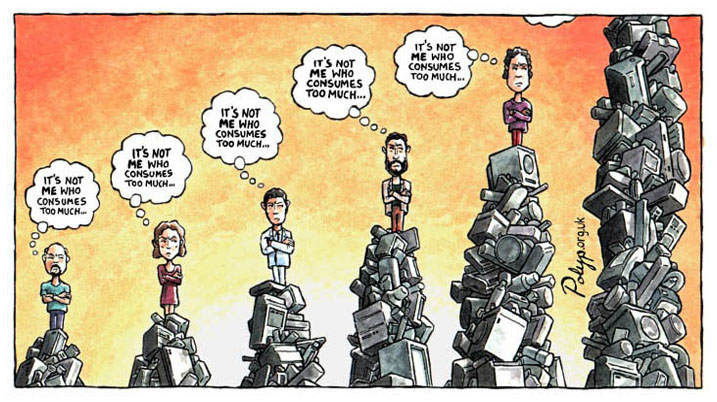
Where does this definition come from? Who decides that we are deprived if we don't have a DVD player today? How long will it be before we need an i-player or foreign holiday in order not to be deprived? Surely it doesn't take much nous to work out that the constant increase in our 'needs' is determined by marketeers who are driving the relentless economic growth that is rapidly eroding the planet we rely on just to survive.

How did this research fail to take note of Richard Layard's work showing that it is not more stuff that makes us happy but better quality relationships?

27 June 2008

Designing Nature's Way

What would it mean to design products and processes the way Nature does? This is a question posed by the industrial ecology movement. According to their website:

Industrial ecology provides a powerful prism through which to examine the impact of industry and technology and associated changes in society and the economy on the biophysical environment. It examines local, regional and global uses and flows of materials and energy in products, processes, industrial sectors and economies and focuses on the potential role of industry in reducing environmental burdens throughout the product life cycle.

Jonathan Porritt argues the importance of encouraging businesses to ‘match the metabolism of the natural world’. By taking ecology into account when they create production systems designers can gear them to nature’s metabolism. An example might be making sure that all the unwanted by-products from production can decompose in a way that aids soil fertility. Or creating 'buildings that, like trees, produce more energy than they consume and purify their own waste water'.

Biomimicry - or deriving specific design ideas directly from nature - is another aspect of industrial ecology. The most famous product 'invented' in this way is Velcro, which was famously derived from the Burdock's 'burrs' which its inventor found in his dog's fur after a country walk.

A more interesting example is the tunnelling machine invented by Marc Brunel - the father with the bizarre choice in names - needed for his ill-fated project to tunnel under the Thames between Rotherhithe and Wapping between 1825 and 1843. He was impressed by the tunnelling properties of the wood-boring beatle that destroyed naval ships, the Teredo navalis:

He examined the perforations, and subsequently the animal. He found it armed with a pair of strong shelly valves which envelops its anterior integuments, and that, with its foot as a fulcrum a rotary motion was given by powerful muscles to the valves, which, acting on the wood like an auger, penetrated gradually but surely, and that as the particles were removed, they were passed through a longitudinal fissure in the foot, which formed a canal to the mouth, and so were engorged. To imitate the action of this animal became Brunel's study.

His explorations inspired the design of a machine based on this animal - a curse to the British naval fleet - which set the standard for burrowing, tunnelling machines. Brunel pere is also a fine argument for being liberal about accepting refugees. He arrived here fleeing from revolutionary France and invented machines to mass-produce pulley-blocks and soldiers' boots that were the unglamorous explanations for British victories in the Napoleonic Wars.

25 June 2008

Post-Colonial Sour Grapes

I can't believe I'm the only person who is sick to the back teeth with the wall-to-wall coverage of the non-election in Zimbabwe. Now don't get me wrong. I am as opposed as the next left-wing greenie with an over-active conscience to the beatings and oppression of the people of that country. But are they really worse than similar treatment meted out to the peoples who suffer under other dictators in other poor countries the world over? So why this particular focus on one African country of 13 million people?

There are two reasons we hear so much about Zimbabwe. The first is that it is a colony we didn't want to let go and the powers that be in this nation appear to still be resentful about that. The second is that the BBC, specifically, has been excluded from the country and can't get over the snubbing. Neither of these are good bases on which to decide the daily news agenda.

We have now reached the bizarre situation where we are asked to celebrate the fact that China - that well-known bastion of democratic rights and freedoms - has supported a UN Security Council motion condemning the lack of freedom and fairness in the Zimbabwean electoral process.

Zimbabwe is not playing by our rules and is therefore paying the price of economic sabotage. The land redistribution is not fair - the land goes to Mugabe's supporters - but it is politically right. If it were to succeed this would be noticed by landless black farmers in neighbouring South Africa.

For my part, whenever I hear another news item about Zimbabwe - it is even invading the sports news now - I wonder what news is being masked by this. What is happening in secret rooms where the powerful of the global capitalist economy make the rules we all have to live by. What are they stitching up to allow this corrupt and rickety system to go staggering on, enabling them to continue to profit at our expense?


It isn't news that the news isn't really news any more. You can now only learn about world affairs by reading between the lines. By the time news about Zimbabwe fades into the background we will know that the new financial regime we will be required to live under - without any chance to vote for it - has been established.