22 January 2008

Making Good Use of the Things that we Find

This blog is called Gaian Economics to engender a sense of reverence for nature and recognition that all our resources - everything whose study falls within the remit of economics - comes initially from the Earth. Indigenous peoples tend to have this recognition at the heart of their culture and practice - a belief they sum up by using phrases like 'The Earth is Our Mother'.

I remember learning in school about the Inuit (we called them eskimos then, of course) and how they used every last part of the caribou: skins for blankets, hides for wigwams, sinew for thread, bones for needles. Not a scrap was wasted, we were told, and we marvelled at this. Such a contrast to the way we lived even then.

I spent this past weekend with my good friends Lydia and Robert, co-creators of Thrift Cottage, and had the usual restful and inspiring time. Robert's knowledge of the natural world - trees and woodworking are his speciality - is something he has learned from joiners and carpenters he has worked with who come from a different era. He is always full of wisdom about his craft that is humbling to somebody like me who lives from their brain.
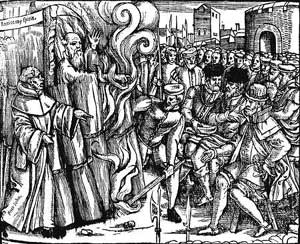

This weekend's gem was a short history of faggots and tallow. These two fundamental parts of the lives of our ancestors just a generation or two ago have slipped out of consciousness. The only picture I have ever seen of a faggot is on the woodcut from Foxe's Book of English Martyrs, but I was interested in converting garden and agricultural waste into fuel and so asked Robert how it is done.

His brother is the tallow man - he recreated by laborious practice the means of extracting this most useful substance from sheep's testicles (didn't I say everything had a use?) following instructions he found in a book from the 1960s. Boatbuilders and joiners are still using blocks of this natural lubricant. Robert says it is the best way of easing a screw into a piece of oak and the only lubricant that resists the tree's attempt to use its natural juices to keep it there. That puts high technology into its place.

18 January 2008

What is the cost of a child?

My original intention was to write a post with this title in response to the news that Tony Blair has been given a lucrative half-a-million-a-year post at J. P. Morgan. Since this bank was implicated in the illegal reconstruction of Iraq, I hoped to find a figure for the number of Iraqi children who died to enable this colonialist wheeze and do the maths. Now who's thinking like an economist?

Economists actually work out the cost of children - and this is part of the problem. Even the most liberal newspapers encourage parents to see their children as 'costs', a recent estimate rising as high as £165,000. This reminds me of the work of economist Gary Becker, who discusses all family relationships as market trade-offs. I laughed at his foolishness; now I realise others were more gullible.

Children have become an important part of the consumer-based economy, with pester power now the subject of discussion in academic journals read by marketing gurus. Parents have been willing to take on debts to over-feed and over-equip their infants - and to assuage their guilt at not giving them enough of what they really want - time and love.


What has finally pushed me into posting on the subject of children is the appearance of Thatcher's feral children in the newspaper headlines. Can anybody really be surprised that the generation that grew up in the 1980s have emerged as bestial and amoral? Wasn't that the culture their generation inherited?

The era of Thatcher was dominated by the law of the jungle so why should we be surprised that it has spawned a generation of wild, untameable people? But this is being unfair to the jungle and its inhabitants. My memory of feral children from Romulus and Remus to Kipling's Kim is that they are noble savages; the stories stand as reminders that the natural world has its own balance and harmony.

Commentators identify the source of the problem as failed parenting whereas they should rather criticise the absence of parenting. In this late and decadent form of capitalism only those who sell their souls in the workplace are accorded value. Even people heroically bringing up children on their own are forced to abandon this most important role to spend hours on the telephone persuading others - perhaps other single parents like themselves - to take on debt to keep the economy afloat.

Many of the children who compete to attract the most ASBOS - a sign of distorted aspiration or an alternative pecking order? - would have probably preferred to be brought up by chimps or wolves since their own parents no doubt spent every waking hour at work on the consumption treadmill.

10 January 2008

My railway station has been turned into a shopping centre


I spent the day in Birmingham today. In spite of its boast of having more canals than Venice, and laudable attempts to reconnect its present citizens with their more radical ancestors such as Thomas Attwood, it remains an unnattractive city, more dedicated to commerce and consumerism than culture.

For most of my visits I have been met by a friend and whisked off by car, or else have travelled by Birmingahm's excellent internal train system out of the urban sprawl around New Street. Today, however, I had to fight my way out of the station to the nearest bus stop. It seemed that this was not encouraged and, looking back, I realised why. New Street Station is these days only an afterthought, the troglodyte sidekick of The Pallisades shopping centre. Visitors are signposted away from the trains past the tempting shop-fronts, the palace of urban consumption.

I pondered on the word 'pallisades', which offers the tempting prospect of sofas and gowns fit for royalty but reminded me instead of coercive fencing, corralling unsuspectnig travellers into a compulsory shopping experience. The sense was reinforced by the Bull Ring shopping centre across the busy highway.

Resisting attempts to be branded I had refused coffee in any cup marked with a corporate logo, on the train as well as in the station, and was now determined to find a non-chain cafe. A piece of toast seemed out of the question, and I was equally reluctant to spend money on a 'six-inch torpedo' from Subway. Eventually, down an unappealing side street, I found the Little Tea Shop. My milky coffee was relabelled as a 'cappuccino' and the price inflated to £1.80 but it arrived in a china mug and I settled for that.

The Turkish owner hummed along to 'Dream a Little Dream of Me' and I thought about Mama Cass, whose terminal tragedy resulted from over-consumption but who none the less continues to comfort those of us finding it increasingly difficult to stomach the inhuman world of transactions between cattle, mediated through brands rather than relationships.

3 January 2008

Chinese whispers a siren song

Some surprise has been expressed by the discovery that the wealth that has been generated by Chinese workers making goods to sell to wealthy Westerners has become concentrated in a few hands. Even in an avowedly communist country, 'development' has led inevitably to inequality.

Or perhaps the surprise is rather that the government in China is concerned about this and is devising policies to deal with it. Because, aside from economists who create an increasingly unconvincing litany of metaphors involving water trickling down or raising boats, the reality is that inequality is an inherent part of capitalism.

Without the inspiration of the super-rich and the fear of joining the lumpenproles why would any of us reluctantly climb back onto the treadmill of work - so especially grim at this time of year and following the extended break most of us took with such alacrity (including this blogger!).

Unfortunately, it would appear that the Chinese are under pressure from the UN to follow entirely the wrong route. The problem is being framed in terms of inequality between the urban and rural areas. Urban incomes are three times as high as rural incomes, leading to suggestions from economists that farmers should become more efficient and China should abandon its policy of self-sufficiency in food.

The comparative figures are, of course, utterly misleading. Like all output figures they only measure what is bought and sold and innumerated in cash. Rural peasants in China do not need much income because they mainly rely on self-provisioning and mutual aid. Just as peasants in our own country did until a hundred years ago or so. The benefit or marketisation will not accrue to them and is more likely to increase real inequality.

More on a couple of programmes from the BBC documenting growing inequality here.

24 December 2007

Turning Towards Each Other

With the year just turning one's mind also inevitably turns to what we have learned and where we are going next year. For people in Gloucestershire this has been The Year of the Flood - a catastrophe which, fulfilling the hope of the management jargonists, has presented us with many opportunities for growth and learning.

Firstly, the foolishness of 'economic development' within a capitalist mindset was made manifest. Take the town of Tewkesbury. Lying at the confluence of the Avon and Severn Rivers it is always going to be at serious risk of flooding. The Abbey there has stood and remained dry for 700 years, but this year it flooded. The reason was unwise building further up the river, removing the possibility of the water moving onto its natural floodplain. Something those who lived in the Dark Ages were surprising enlightened about.

When new housing developments are put in the flood-plain the supermarkets that enable the profiteering are given a superior position on a concrete plinth. Like the cathedrals of old they are now the most revered constructions. Unfortunately, in Tewkesbury this meant that when the flood came people in Morrisons were stranded on an island and had to spend the night in the cafeteria.

Tewkesbury has another flood-plain development planned. This July it was called The Watermeadows but its name has miraculously changed to The Meadows during the summer.

Surviving the floods was a salutory experience, and a very uplifting one after the initial panic had subsided. We amazed ourselves with our resourcefulness, as we found Heath-Robinsonesque ways to channel rainwater into our toilets and wash five heads of hair with half a bucket of water. We found out who our neighbours were (and look after the vulnerable ones) and we found out where our electricity and water came from (amazed that we had never known!)

We were instructed not to flush our toilets with drinking water - some of us realised that this is in fact what we do everyday and thought about ways to make our water use and distribution system less wasteful in future. The most important thing we learned from the flood was that the greatest resource we have is each other, and that in a crisis we do look after each other.

Looking further afield, I was interested to see how attitudes to economic development have changed in Thailand, partly as a result of the tsunami. The country has turned its economy in the direction of sufficienty rather than export-led growth. They are building self-reliance and reinforcing their local communities, as well as finding inspiration from the workings of nature.

2007 has been the year when many people - sadly not many politicians - have started to think seriously about the economics of climate change: about how it will affect their ways of finding daily necessities and the way they interact with their environment and each other.

18 December 2007

Please Stop Talking about Climate Change

It's not just the carbon dioxide emssions associated with the thousands of flights to Bali from around the globe that could be saved if these farcical international negotiations were abandoned once and for all. There would be all the additional hot air produced by over-excited and sweaty men posturing at each other like shaved gorillas. And all that extra methane produced by all those excessive summit-of-extravagance dinners.

Of all the infuriations that arose in my troubled breast during the tortuous days of the Bali discussions the most poignant was the coincidence of the signing of the 'Lisbon' EU treaty, a day before all the HoGs had to be in Brussels, meaning that they had to fly specially to Lisbon only for the tacky signing ceremony, accompanied by lift music. A vast outpouring of C02 just to inflate some Portuguese egos.

I know there are some good people involved in these talks, and I truly wish them well, but the angrier and baser part of me just wishes they would all just fucking shut up. The sight of their hypocritical staged concern while they destroy my planet is more destructive to my soul than can be soothed by the minuscule progress that may have been achieved. How many of those participating are unaware that they can never get anywhere because the negotiators are in hock to the economic interests that cannot tackle climate change without voluntartily giving away their wealth and power?

The pictures show the signatories in Lisbon and the negotiators at Bretton Woods, where this whole crazy system started in 1944. We will never solve the one without addressing the other. A money system based on debt and enforcing geometric economic growth can enver be compatible with sustainability. (I couldn't find a photo of the actual negotiators in Bali - please help if you can). How much has power shifted in the past 60 years: one female out of 27 is an infinite improvement, mathematically, over the no women at all around the table in 1944.


Perhaps the most dangerous thing about negotiations such as those at Bali is the temptation to be sucked into all that displacement activity while what we should be doing is taking the power back into our own hands and sorting out our own economic and social realities. Planet-saving begins at home, not on some paradise island.

13 December 2007

Political, not banking, crisis

The world's central banks have made it easier for the world's commercial banks to increase the amount of debt circulating around the world economy. They began by concertedly reducing interest rates, making it cheaper for commercial banks to lend money. This had little effect, so yesterday they acted together to actively create new money.

It is not clear how this money was 'created' but it was probably by the selling of government bonds, in other words increasing the value of the public debt that we will have to pay off through taxation. Since there is no asset to balance this debt the central banks are guilty of just the sort of monetary inflation that the government says is impossible when policemen want a pay rise. Such action is defensible, it seems, when it is financial investors who want a pay rise.

Is it the fact that the word 'inject' is always used about the creation of debt-money by central banks in this way that leads journalists to use the metaphor of a drug pusher, encouraging debt-addicted banks to go back for another fix? To me the more appropriate metaphor is that of the weak parent.

The role of the central bank is to ensure what the jargon calls 'fiscal probity', which means not lending in an irresponsible way. But how could banks judge what is responsible or not when lending to people to gamble on the future value of unplanted cocoa crops is acceptable? No clear boundaries here. And when the unruly children see their playfully created 'financial instruments' blow up in their faces they are not punished or even reprimanded but simply payed off and allowed to continue. No tough love in the world of banking.


Since the reserve ratio (the proportion between bank lending and assets of real value held in the banks) was abandoned, central banks have only required that commercial banks act with prudence. The purchase of junk assets, such as mortgages held by people with no incomes to pay them back, is a clear example of imprudent behaviour. But do the central banks punish banks for this? Of course not, they just enable this sort of lending to continue.

Central banks, and the governments they answer to, are in an uneviable situation of their own making. Following the ending of credit and exchange controls, the deregulation of financial markets, and the ceding of control of monetary policy to banks by governments, political control over money has been abnegated. The role of politicians was to ensure a money system that served the real economy and our interests as citizens. The role of banks was to maximise profits for shareholders. If things are as bad as they currently seem, and the whole monetary system fails, this will be a disaster for us all.

To see what happened when Argentina experienced a 'credit crunch' see my article.

For more on the creation of money see Richard Douthwaite's excellent (and short!) book The Ecology of Money.

Or you could buy Market, Schmarket where this is covered in Chapter 6.