Showing posts with label banking. Show all posts

17 January 2009

No, no, no

Margaret Thatcher was not a politician whose reputation was built on her facility to produce a well-turned phrase. She was famous for employing armies of speech writers and taking elocution lessons. Recent politicial shenanigans have forced me to borrow one of her least eloquent quotations and, indeed, have filled me with the sort of rage that must have propelled the intransigent termagant through 20 years of destructive policy-making.

How can it be that we have seemingly taken on the chin decades of servitude to pay for the banking bailout? I have lost count of the dizzying sums involved (if anybody knows where these are handily calculated please drop me a line) but when I last looked it was already enough to keep my putative grandchildren on the capitalist treadmill long into their dotage.

The people we are dealing with here are wideboys and sharks. They are the kind of people who, when given and inch, will take a mile. So we should not be surprised that having pulled this scam so spectacularly in the autumn they are now coming back for another go in the new year.

When it comes to the executives and shareholders of Barclays and RBS, and those who trade in their shares, we are talking about people who are in the habit of living off the work of others. In a recession, of course, when the economy is shrinking and money is tight, they cannot extract value using the traditional methods. They need to bully and defraud the government and taxpayers.

The tactic appears to be for stock-traders to target particular financial institutions and drive down their share price. Those controlling large numbers of shares, working with short sellers, can provoke massive downward movements in company values. The media creates a shock-horror story headlining the 'inevitability' of more public money; the politicians dutifully oblige.

The phrase 'public money' feels safe, almost positive, and is a cover for the fact that money is now being extorted from us and our descendants to be sent directly to bank directors and shareholders. This was originally billed as an unpalatable emergency measure - it now appears to have become routine. The phrase 'impotent rage' seems to sum up how I feel. Any suggestions as to means for making this rage potent would be welcome.

13 June 2008

A Common Treasurer

I am the Green Party's economics speaker. In some of my wilder moments I imagine this might put me in some position to be the Treasurer in the first green government - if only I could live that long! More realistically I think it does give me a responsibility to think about green policies as though they were going to be implemented and to take the economic implications seriously.

If, as Greens, we believe the earth is 'a common treasury', what would a common treasurer look like? What role would we play in allocating the wealth from Nature's cornucopia. Surely we would have to conclude, as green economists do, that the wealth must be fairly shared.


All natural bounty would be viewed as 'commons'. Those who enjoy the benefit of it would pay tax and that would allow us to share the wealth with those who do not or cannot access it directly. The foremost example is land - the primary wealth of any nation and the source of most government income in a green economy.

The planet's atmosphere is also a common wealth. At present this is being greedily hoarded by the Western nations, who use it up with their industrial pollution, especially carbon dioxide. The Contraction and Convergence response to the problem of climate change takes the idea of commons seriously and assigns the right to pollute the atmosphere on fairly between the world's citizens.

How should we share this wealth? Richard Douthwaite proposal Cap-and-Share - we all receive licences to pollute which we can sell to generate our citizens' income, or give to companies we would like to support, or destroy if we want to support the planet at our own expense. Other variants of the policy suggest national governments should receive the licences and do the selling, passing the money on to citizens equally.

Perhaps most important of all is to take control of our own money. A common treasurer would, I am sure, have no objection to this. As in the 19th century local authorities would issue legal tender and invest the benefit in local infrastructure projects. How else would they have paid for the civic buildings and sewers we are still using - because since the privatisation and centralisation of money creation we haven't seen the benefit of it as citizens.

We are planning a monetary empowerment in Stroud. One thing holding us back is coming up with a good name. Others are so lucky. In Llandovery they have the Black Ox Bank, the progenitor of the black horse, set up as a drovers' bank by one Mr Lloyd. Fishguard are creating the Bluestone Bank, named after their famous rock which was so valued that it was transported to Salisbury Plain to build Stonehenge. We haven't come up with anything so resonant yet. Or even something funny. I am so envious of Transition Scilly folk, one of whom I met last weekend - their money will be a blast won't it?

19 November 2007

Currency for the Little Big Man

I've often been surprised by the many and varied radical economic initiatives coming out the USA which I have, in my Chauvanistic way, conceived of as the belly of the beast of global capitalism. Well, I suppose the latter is probably largely a correct view, and it is perhaps not surprising that those who live closest to the epicentre of the exploitation have been the most effective at resisting.


In his excellent book Money and Liberation, Pete North describes the struggle to maintain democratic control of the issue of currency in the post-Civil War US. Farmers organised against the 'tyranny of organised capital' and called for democratic paper money rather than the gold-backed money which allowed elites to dominate the economy. Their struggle culminated in the presidential race of William Jennings Bryan as Democratic candidate in 1896. He lost to McKinley, whose campaign had been supported by the plutocrats who reordered US capitalism and tied the dollar back to gold.


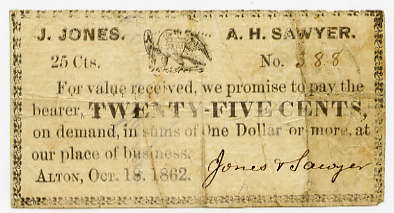
In the 1930s, following the collapse of this phase of capitalism, farmers in the South and West of the US again responded by producing their own currencies, known as 'scrip issue'. Nobel Prize-winning economist Irving Fisher supported this development, as did Upton Sinclair in California. His End Poverty in California movement promoted scrip issue as a means of exchange between co-operatives.

In the US today complementary currencies are more about ecological imperatives than poverty, but from Berkshares to Ithaca hours they are providing inspiration and underwriting alternatives livelihoods.

Given this history we should perhaps not be surprised that last week FBI agents raided the offices of the Liberty Dollar in Evansville, Indiana and confiscated the precious metals used to back this local currency. The activists who created it are reacting against the link between the dollar and global hegemony and war, as well as sharing the general loss of confidence in the dollar as reserve currency. Confidence in the dollar is falling globally and several of the nations who are bankrolling the US by buying government bonds could pull the plug on the whole US economy at the time of their choosing.

Aside from control there are sound financial reasons why bankers wish to keep control of the issue of the money we need to function in a complex economy. Conall Boyal has calculated that, if the Chancellor took the seignorage on money created by private banks there would be an extra £80bn. in the UK kitty. At present this money stays as bank profits. See more here: http://www.conallboyle.com/housing/SeigniorageBromsgroveoct07v2.ppt#22

24 January 2007

Bank money: source of debt and destruction

A bank charter is literally a licence to print money. Since the system of requiring a certain proportion of assets to be kept on reserve has gradually been eroded the only control on banks’ ability to produce money as credit is our willingness to borrow, hence the constant stream of junk mail and TV advertising offers of credit. When the banks lend us the money the debt is listed and the money sought and retrieved but at that point it belongs to the bank. They have used our willingness to borrow as an opportunity to create a debt; when we repay the debt the money they have taken from us belongs to them. No wonder we are seeing record bank profits: they are simply creating their profits out of our debts.

No surprise also that we see spiralling levels of personal, business and public debt. Neoclassical economists see no problem with this. On their planet, the creation of money in this way will be balanced out by a corresponding amount of economic growth. Apart from the obvious fact that money supply is growing far more rapidly than economic activity from a green perspective this growth itself is a problem. So the most important first step towards creating the steady state economy that will not put intolerable pressure on the carrying capacity of the planet is to change the system of money creation that generates the need for the growth.

The discussion so far has been in terms of a national currency, but currencies are also exchanged and used to pay for exchanges of goods and services between national economies. This role is now played primarily by the dollar, which has acquired the status of international reserve currency since the agreement establishing the financial structure to dominate global capitalism after World War II. Under the Bretton Woods Agreement, the USA also extracted the right to have its currency—the dollar—considered the equivalent in terms of economic weight of gold reserves. In the post-war exhaustion, low morale and financial desperation of the other world powers the USA pulled off this extraordinary confidence trick which has enabled their dominance for the past fifty years but left us all with a teetering economic system. The coda to the story is that the USA proved itself incapable of maintaining the value of the dollar and, in the face of the need for massive liquidity resulting from the costs of war in Vietnam, Nixon ‘closed the gold window’ on 15 August 1971. This meant that dollars were now themselves no longer linked to the reserves in Fort Knox but floating free, and foreign Central Banks could no longer exchange their dollars for gold.

Global capitalism relies on one country’s currency to provide credibility for the system as a whole. Initially this role was undertaken by gold itself, as a commodity of real value, but the movement towards fiat money which went hand in hand with the capitalist expansion, meant that currencies rather than gold played this role. The reserve currencies—sterling, the dollar, the yen, and the euro—are all used to underwrite economic activity, but just as in banking there is a central bank so in the currency system there is a central currency and this is the currency of the most powerful player in the global economy—the global hegemon.

It is mainly its own credibility and that of its economy and military structure that guarantees the functioning of the international economy, but it needs its own back-up in the form of gold reserves. During its days of empire the UK played the role of preferred currency. At that time US bankers supported the pound, a fact that alienated those outside the charmed circle who could not understand why US gold was being used to support a foreign competitive economy. Similar questions were raised when Chancellor Gordon Brown sold 415 tonnes of the UK’s 715 tonnes of gold reserves in May 1999, reducing the official reserve percentage held in gold from 16.7 to 7 per cent, and substituting currency, a mixture of dollars, euros, and yen. This is a record low level of gold holdings compared with the 2000-2500 tonnes held between 1958 and 1965, most of which were sold during Britain’s financial crises of the late 1960s and early 1970s.

The may seem like technical stuff, but the central point is simple. The nature of money creation via bank debt is undemocratic and unsustainable. Money should be created by ourselves, as citizens, to facilitate necessary economic exchange. Neither we, nor our governments, should be required to borrow it from banks. The debts this create cripple lives and are also fuelling unsustainable economic growth.

15 January 2007

Where does money come from?

If you ask people where money comes from they will probably tell you from a bank. Dig deeper and you will find that people believe that the money they take out of the bank has been deposited there by somebody: by the person herself, in which case it is simply a withdrawal, or by somebody else, in which case it is a loan. This is the first big myth of money, because the truth is that all or nearly all (depending on your theorist of choice) the money you take from the bank has been created out of thin air by the bank itself.

When you begin teaching students about the economics of banking you teach a fiction known as ‘fractional reserve banking’ and many who have never taken economics as an academic discipline or worked in a bank have a hazy notion about this system. It is understood, because of Hollywood movies about ‘runs on the bank’,that the bank does not actually hold, or need to hold, as much money as it lends to people. Because it is highly unlikely that everybody will come and ask for all their money, all at the same time, the banks can consider themselves to be acting with probity if they retain only a proportion as ‘reserves’, this proportion being understood to be around 10 per cent. Let us for the time being take this story as a reasonable account of how banks create money; it is the one that is reproduced in most economics textbooks. The first stage is the deposit of some money by a punter, let us say £100. Because banks have learned from historical experience that only one in ten of such punters will want her or his money back at any given time, they feel quite secure in lending £900 on the basis of this deposit, effectively inflating its nominal value, and thus reducing its real value, tenfold.

The second myth about money that is universally believed is that it is, and needs to be, backed by something of real value. Governments create money and this money has credibility because the government has a sufficient store of gold in its vaults to support its value. Like the reserve banking story, according to this fiction governments can create more money than the gold they have, but only up to a certain limit. This story was true for some time, but it was found that the uncontrollable growth of the capitalist economy rapidly outstripped the gold available to support it and maintaining a ‘gold standard’ stifled economic growth.

Eagle-eyed and sharp-minded readers will have noticed that there is an inconsistency between the two stories told so far, in that they disagree about who is responsible for creating the money. They have in common the idea that, while there should be something of real value backing up a currency at least in part, who owns this collateral and who therefore creates the money could be either the bank or the government. This was how things were, both banks and government were entitled to create money: governments created money as fiat issues, whereas banks created it in return for a debt.

So there are several different types of money, distinguishable by the nature of their back-up and by who controls them. Banks can create money on the basis of deposits, as credit. Governments can create money by selling bonds, or just by making a decision to create currency. It may be efficient to leave the job of generating credit for economic activity to banks, so long as they operate within political controls, but it will also be necessary to have money created by government both as credit, to fund public works, and as currency, to facilitate economic activity without the creation of parallel debts. The graph shows how the political attitude to money since the Second World has effectively been the privatization of money creation. It shows the relative proportions of money created by banks and governments over that period. This has had the inevitable consequence of increasing the proportion of money paid to bank shareholders and producing a squeeze on the money available for public investment.

. . . to be continued (when you can bear it!)
If you can bear any more just now you might like to follow this link to a short presentation about money.