16 March 2011

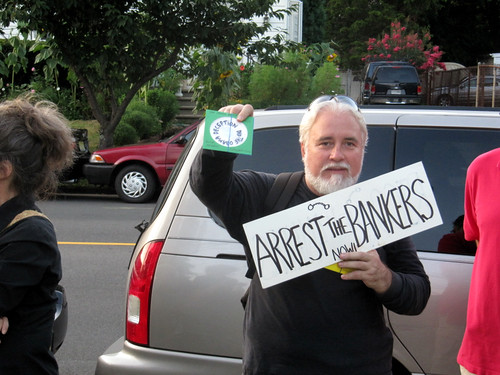
What Happened to the Icelandic Banks?


I have been following the story of Iceland on this blog for some time. Now an academic paper has emerged which tells in a better referenced form the story told by Gunnar Sigurdsson in his film Maybe I Should Have. It is a story of political corruption, as well as of greed, and of the co-option of regulators by politicians. It is, in microcosm, the story of the financial crises that have swamped Western democracies and left us facing economic depression and massive public-spending cuts.

The paper is by Robert H. Wade and Silla Sigurgeirsdottir and is published in the latest issue of the Post-Autistic Economics Review. Iceland is a classic case because it is so extreme: shortly before the crash the value of its banks was 11 times the size of its GDP. It was a huge financial pyramid standing on a tiny rock, and supported, unwittingly, by its 300,000 people.

Wade and Sigurgeirsdottir include some interesting details about how naive UK savers were sucked into filling the void left when the financial markets recognised the vulnerability of the Icelandic market and withdrew. The banks, Landsbanki and Glitnir, hoovered up the savings of UK investors who did not question the unfeasibly high interest rates and believed the words of the best-buy websites. When the banks went bust our government then repaid these savers for their risky behaviour, and has now sent the bill to Iceland.

There is corruption here as well as stupidity. Even after the collapse of Lehmans three UK local authorities invested £33 million in their Icesave accounts, 'as though their expensively paid finance directors were fast asleep' (p. 65). And as for corruption, following the rule that 'the best way to Rob a bank is to own it', in its last few months of life Landsbanki lent 36% of its capital to a few of its main owners, while Glitnir did the same with 17% of its capital. After years of avoiding the consequences of their actions, several Icelandic bankers are now facing prosecution.

The authors conclude:

'Iceland is the story of Icarus in modern dress. Icarus sought to escape from exile in Crete using a pair of wings fashioned from feathers and wax. He was warned not to fly too close to the sun. But overcome by the excitement of flying, he flew too close, the wax melted, and he tumbled into the sea. As of early 2011 his Icelandic counterpart is still in the water, paddling hard but a long way from land, and the direction of the current is unclear.'

The same conclusion could be drawn for all the post-bubble economies, and of course it is important that we 'learn the lessons of Iceland' in terms of crony capitalism and financial instability. But for a green economist the most important lesson is the need to reconnect finance with the real economy. When finance runs out of control the consequence in unsustainability as well as instability. An economy in a steady state would return money to its proper role as a medium of exchange. As Mary Mellor argues, it is this sort of money we should be moving towards to support a sustainable, provisioning economy.

15 March 2011

Stoicism is not Resilience

For those of us who have long been arguing that the global supermarket has led to resource insecurity and social vulnerability the situation in Japan presents itself as an unwelcome object lesson. The complex and intertwined system of a modern society, where electricity, internet, money, food and transport systems are interdependent and highly demanding of energy appears impressive until one part of the chain breaks, and then the others rapidly follow.

A natural disaster like this looks quite different in a technologically sophisticated society like Japan, from the very similar tsunami that hit the less developed areas of Indonesia and the Indian Ocean in 2004. The energy embodied in the airports, highways and rail networks in Japan is immense; while economists argue about whether Japan can afford to borrow enough to replace them, it is the energy cost of rebuilding so much complex infrastructure that is more troubling to a green economist.

The thoughtful coverage on Newsnight last night included economists suggesting that the natural catastrophes affecting Japan may be just the stimulus it needs to get back to the sort of growth path neoliberal economics expects. A new twist on the 'disaster capitalism' idea. There was no consideration of the embodied energy that has been lost in the earthquake and tsunami and the climate cost of replacing this infrastructure.

It seems exquisitely unfair that the Japanese, having been the only nation to suffer the effects of nuclear bombs, are now to become major victims of civilian nuclear power. From the forced ending of Japan's Tokugawa shogunate in 1868, through its use as a testing-ground for US nuclear aggression, through the forced imposition of the American dream during a 7-year occupation after World War II, Japan has not fared well at the hands of Western 'civilisation'.

The dignity, grace and stoicism of the people has impressed Western journalists. But stoicism is not reslience, and these people are the victims of scientific hubris as well as of natural disaster. Rather than rejoining us on the self-destructive high-energy path of consumer capitalism, is it too much to hope that these natural disasters might lead to a return by the Japanese to a path more in keeping with their indigenous Shinto way of living in balance with nature?
.

12 March 2011

Why Are Nuclear Reactors Like Dangerous Dogs?


Across the world we are waiting to find out whether Fukushima is to join the list of nuclear disaster zones: a place which, once unfamiliar, becomes a household name. In spite of the familiar faces of 'nuclear experts' trailing through TV and radio studios, it is clear that nobody can answer this question. The situation is out of control and the only science that is relevant is statistics. We are in the realm not of knowledge but of chance.

As a retired anti-nuclear agitator I find it amusing to watch the Grimes and Grimston show. Their webpages indicate that both are pro-nuclear, yet their TV appearances are bravura performances of scientific disinterest and thoughtful reassurance. The emerging line is that the power-station was damaged in the earthquake, which seems to me to gloss over the fact that the reason it is in trouble is that electricity and water supplies have failed. Such failues are common even in highly technological societies, and can only become more frequent as climate change leads to more unpredictable and more extreme weather events.

But what does all this have to do with our canine companions? I have been afraid of dogs since I was a child. What made me suspicious was my instinct that they were not really domesticated. That somewhere within them lurked the potential for sudden savagery. I can still remember my rage when owners used to say blandly 'He won't hurt you'. 'He won't hurt you', I thought back, but that isn't really the point is it? Just as the owners of those dogs thought they had them under control, so the proponents of nuclear power boast of their ability to 'tame the atom'. But the release of the energy of the nuclear bond has always been a high-risk endeavour. The myth of control is undermined by routine emissions and occasional catastrophes. It cannot be any other way, which is why Greens have always opposed nuclear power.

When the unpredictability of the dangerous dog is expressed the damage is one dead child or a person with a patchwork face. These are tragedies, of course, but on a relatively small scale. The tragedies that will be caused if Fukushima is in the midst of meltdown will be far more devastating. Direct deaths will be the source of infinite debate, and may even be statistically massaged away altogether. The brave workers who sacrifice their lives to save their fellow citizens, like the Chernobyl liquidators, will have their courage insulted by scientific manipulation of data. Who knows where the indirect deaths will occur? If the emergency results in radioactive emissions into the atmosphere we will all spend the rest of our lives with a few more atoms of Caesium or Strontium ticking away, decaying unpredictably, within our cells.
.

9 March 2011

A Budget for Growth or a Balanced Budget?

The voices of capital have been flooding the airwaves for some time with their demands for the budget. We already know that this will be 'a budget for growth' aka a budget that refuses to accept the planet's limits and permits a tiny elite to profit at the expenses of other species human and otherwise. So what can we expect to see from this 'budget for growth'? As Simon Jenkins points out, it will be the bankers, corporate bosses and corporate investors who will decide. His mockery of the so-called Project Merlin, headed up by Barclays boss John Varley is right on target. From spivs to wizards in a few short months.

A 'budget for growth' can be interpreted as a 'budget for business'. Vince Cable weakness was made clear by the secret recordings of his boasting to constituents: vanity. His speech at the Mansion House on 3rd March demonstrates a similar tone, together with an unpleasant attempt to cosy up and laugh off his former critical line with both bankers and business.

Cable identifies his central task as finding a way 'to strengthen a framework in which the private sector can grow the economy out of its current problems', which neatly addresses the deficit problem while ignoring the more fundamental environmental problems. The 'animal spirits' of our entrepreneurs are to be unleashed, while capital is to be encouraged to be more mobile than ever, a clear demonstration of the highly pro-capitalist nature of liberal economic policy. This also applies to its policy towards exercising social control over business. Far from the tyrannical opponent of corrupt business we have been led to expect, Cable undertakes to 'fight damaging regulatory impositions from the EU like the Working Time Directive'.

Perhaps most damaging of all, the speech contained a clear suggestion that the countryside would be thrown open to heedless profit-driven development in a desperate attempt to restore economic growth without regard to the environmental cost. We can expect to see Osborne's Economic Enterprise Zones being given special dispensations, since the underlying logic is one of growth at any cost.

For the first budget from the greenest ever government one would expect a genuinely balanced budget, that is to say a budget that prioritised the need to balance our demands with the planet's limits. This is the real balancing that is required, alongside a rapid shift away from the emphasis on finance and towards encouraging real production in the sectors required for the transition to a low-carbon future.

A policy to bring about this balance would be one that matched the money banks take out of the economy through bonuses with money invested in the sustainable economy. New legislation to equate annual windfall taxes with the amount banks allocated to bonus and other incentive payments could free two birds from one cage: putting a downward pressure on excessive salaries while generating revenue for investments in the public good.
.

7 March 2011

Dissident Economists on the Warpath

As an academic economist I find I am living in interesting times. Yes, really. The profession is in crisis, and much blame is being laid at the door of those who teach politicians how the economy works, and who engage in research to support this teaching. The fact that the financial crisis was predicted only by dissident economists, and the lamentable failure of mainstream economists to explain what has happened, much less provide solutions, has led to severe criticism.

Now we have a box-office documentary, Inside Job, which provides a comprehensible analysis of how the financial crisis happened, and fully implicates the academic economists who were complicit in the bankster capitalism that lay at its heart. Apparently they were asked for interviews to consult their expertise, and then ambushed. According to a review of the film by the Guardian:

'When Glenn Hubbard, George Bush's chief economic adviser and dean of Columbia Business School, is shown as a partisan advocate of deregulation, we have one of the movie's punch-the-air moments. During the interview, Hubbard, who denies he was corrupted by his paid-for relationships with government, angrily barks: "You've got five minutes, mister. Give it your best shot."'

A letter in response also implicates the 'self-referential circulation of authority' found in the peer-review publication system. This gives access to promotion, fame and respect within the academic establishment and is a key part of the Research Excellence Framework, here retitled the 'Research Exalting Finance'. Those wishing to find other ways of measuring the contribution of economic research might consider submitting a proposal to a special issue on 'dissident scholarship' in the American Journal of Economics and Sociology. The dissidents, it would appear, are getting themselves organised.

Another practical step towards the radical restructuring of economics would be to support a new generation of heterodox economists. It is therefore very cheering to see a post advertised that specifically excludes neoclassical economists. The Joan Robinson Research Fellowship in Heterodox Economics is named in honour of our own Sister Joan, disciple of Keynes, and a scholar cheated of her Nobel Prize merely for having the wrong genital design. Girton College Cambridge should be congratulated for funding the post, and for paying tribute to their illustrious alumna.

The existence of the concept of heterodox economics implies that the nature of economics as studied and taught is more religion than science. Perhaps we should rather be arguing for pluralism: for economics to accept the sort of lively debate that is common in all other disciplines. Let us hope that the researcher at Girton will be a key player in these debates, and will be followed by many more.
.

4 March 2011

Rage of a Porritt Spurned

What a pleasure it is to find Jonathan Porritt on rampagingly good form. In a post yesterday he bemoans the passing of the Sustainable Development Commission, of which he was formerly chair, and indeed of any commitment to sustainable development from the Condem government.

This doublespeak is becoming something of a habit with our government. We have numerous examples locally, where our MP tries to portray himself as a defender of the very local services which his government is forcing us to cut. Then we have the odious Pickles portraying the privatisation of public services as something we should feel empowered about.

In case you cannot cope with this level of rage you may enjoy a light-hearted paper called Japan's Phillips Curve Looks Like Japan, whose only reference is a paper called 'All Meat Looks Like South America'. The Phillips Curve is a rather nasty piece of economic theory that says there is an inverse relationship between inflation and unemployment. This can be interpreted as the suggestion that we need unemployment to keep prices under control. The theory is not very well supported empirically, suggesting that its primary motivation is political.

In the paper cited,* you can see a clear relationship between the two variables in the case of Japan, but not what you might expect. As shown in the figure what we ascertain is that the datapoints produce a pretty picture of the country itself. Aw: isn't that sweet!

*Thanks to Tom Lines for sending me this link.

3 March 2011

Inspiration from the Emerald City


This short hiatus in posts can be explained by my recent very enjoyable trip to Freiburg, a Germany city close to the French and Swiss borders and the Black Forest. I was invited to speak to this year's Forum on Enviromental Governance, an event organised by the students of the University MSc in Environmental Governance.

Freiburg styles itself as the 'greenest city in the world' and was voted Germany's greenest city last year. Many of the design features - such as co-housing developments and local food markets - were familiar to me from Stroud. The difference was in terms of scale, and also of the commitment to inclusive ecological communities (such as the famous Solarsiedlung, or 'solar village') and the excellent public transport systems you expect in Germany.


I had assumed that these developments would have grown up with the active support of the local authority, but it seems that even in Germany eco-activists have to lead the way. The famous Vauban development, where eco-homes powered by the sun have replaced a US army base, was privately funded and faced problems with planning permission at every stage.

During my visit I stayed at the Hotel Victoria, which claims to be the world's greenest. It uses no fossil fuels, relying on solar panels, four small wind turbines, and wood pellets from the local forest resource. The level of luxury in the hotel (and the expense) did make me question the concept of 'prosperity without growth'. I am fairly sure that the level of comfort enjoyed in the hotel is not possible for all the world's citizens.

Which brings me to the content of the conference itself. Like many who come to a first consideration of 'the green economy', the students had focused on technical and design aspects. The two first speakers were Ernst Ulrich von Weiszacker, he of Factor-4 and now Factor-5 fame. His claims that energy efficiency could solve the ecological-economic crunch were undermined by Ulrich Hoffman, head of sustainable development at UNCTAD, who quoted Tim Jackson's figure that a 128% increase in efficiency would be necessary to ensure a Western lifestyle to all the world's people, if we assume current population growth trends.


My own contribution was to raise the social, political and cultural questions around a green economy. The students were very interested in the Transition Towns, although they left little space to consider how we are to make changes to our consumption expectations if we are to make a deep green economy a reality. Overall it was a realy inspiring visit. The city itself is a wonderful model, but so is the university and its openness to genuine learning. The 19 MIG students, from 26 countries, will be sustainability leaders and we would benefit greatly in the UK from similar courses.
.